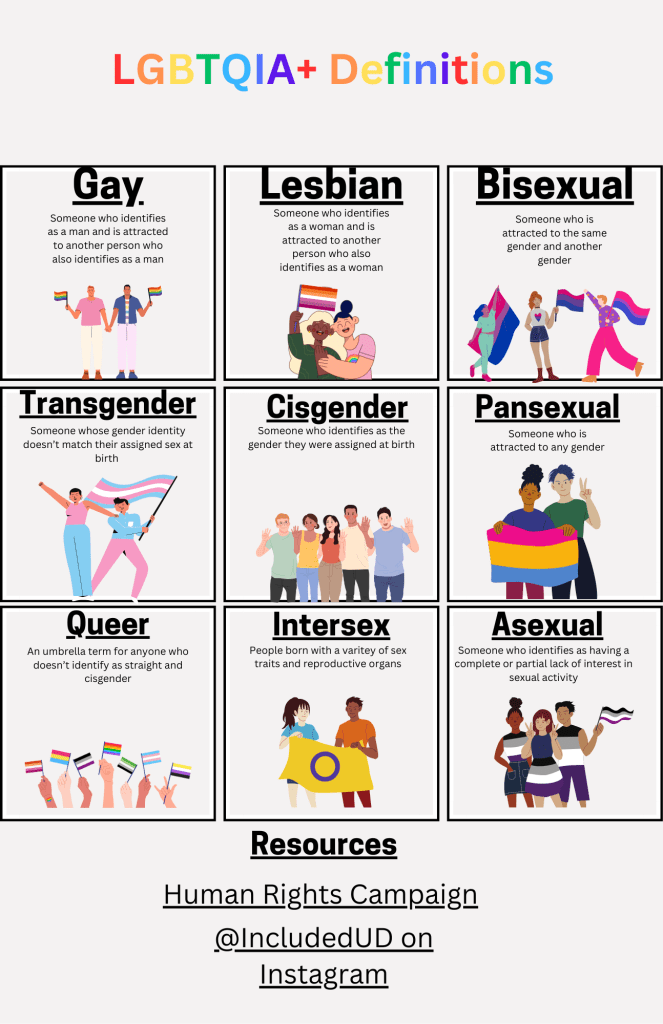
Below is a plain language guide. This resource allows for individuals to easily access and understand LGBTQIA+ identities, and can be used for educational purposes. The definitions were sourced from @IncludedUD on Instagram, as well as the Human Rights Campaign (HRC). These two links will take you to the Instagram and to the HRC’s glossary of LGBTQIA+ terms respectively.
***plain text language***
Below is an screen-reader friendly Plain Language Guide without images.
According to Planned Parenthood, sexual consent is “an agreement to participate in sexual activity. Consent lets someone know that sex is wanted.”
Sexual activity can be a lot of different types of activities, from kissing to sexual intercourse to oral sex.
Judging consent between partners, as well as self-reflection about consent, is crucial for sexual activity. This article will provide resources for accessing and reflecting on consent, and ensure that consent is an easier conversation.
A very helpful tool to gauge consent is the Verbal Informed Sexual Consent Assessment Tool. This source shares important reflection questions to analyze whether someone can give consent, giving a checklist as well as examples of questions to ask.
Consent can be a very simple conversation. Once you know that you and your partner are capable, informed, and confident in making decisions about sexual behaviors, have a conversation with your partner. Ask your partner what their boundaries are, and what sexual behaviors are okay with them. Sexual behaviors are a continuous conversation, that is that the conversation will continue to come up, and the result of the conversation can change. If you or your partner consents to kissing one day, and says “no” to kissing the next day, consent is being taken away and kissing shouldn’t continue to happen until consent is given again. For tools about how to revoke consent, refer to our webpage graphic about Ways to Say No .
This website from Planned Parenthood gives more examples of how to talk with your partner about consent, including examples such as how to check in on consent.
These two videos explain consent and boundaries. The second video also gives an example!
Last year, Planned Parenthood released a series of 4 videos that cover 4 different topics: consent, body image, identity, and birth control/sexually transmitted infections. These videos are linked below, and are available for free on Youtube. The group of friends in each video communicate in American Sign Language, and closed captioning is available in Spanish and English.
This first video is about consent. Ciara and Dev are getting into a relationship, and Ciara discusses with her friends how to set boundaries without feeling “mean”, by being honest, clear, and kind.
This second video is about birth control and sexually transmitted infections. One of the friends, Ciara, tells Ava that she is ready to have sex with Dev, and Ava and Ciara discuss the steps to follow before having sex. First, they discuss STI testing before having intercourse, and then acquiring birth control. Dev, Em, and Bo also talk about condom use, and Em explains that when at the doctor, they are legally required to provide an interpreter for those that are Deaf or hard of hearing.
This third video discusses identity; sexual orientation, gender identity, and Deaf identity. There is a conversation about pronouns as well as owning a Deaf identity between a group of high-school-aged friends.
This final video discusses body image. Two of the high-school-aged friends in the group struggle with their body image, one of which is also struggling with what to wear to a pool party as a transgender person.

 The Birds and The Bees