It is very normal to experience a range of emotions when you find out you are pregnant, since it is a major life event that brings about a lot of change. It’s important to remember that every experience is valid and part of the parenthood journey.
Hormones: There are significant hormonal shifts, which can have an intense impact on your emotions. Your estrogen and progesterone hormones fluctuate, which then influences the hormones that regulate your mood (serotonin and dopamine), leading to mood swings and heightened emotions.
Body and body image changes: Your body goes through a lot of physical changes (weight gain, changes in posture, changes in skin, etc.) which can sometimes provoke emotions about body image and self-esteem. Some expectant parents may feel proud that their body’s changing to nurture life, but others may experience feelings of discomfort or insecurity.
Stress: This is a very stressful time for parents, and you may feel stressed about finances, relationship adjustments, childbirth itself, and parenting. Your body heightens its stress response system (your cortisol levels) which can lead to feelings of anxiety, mood swings, and irritability.
Fatigue: Changing hormones, difficulty sleeping, and stress can cause fatigue and exhaustion, which is very common during pregnancy. This can further heighten feelings and make you emotional.
Emotional Changes Throughout Pregnancy
First trimester: Can bring on a lot of early pregnancy emotions and first-trimester mood swings. You may experience a whirlwind of feelings as you come to terms with the reality of being pregnancy, and may feel excited, anxious, and/or overwhelmed.
Second trimester: Experience a welcome break from intense emotions of early pregnancy. You may feel more stable and have more balanced emotions, but you may continue to feel anxious or stressed.
Third trimester: As you’re preparing for childbirth, it can evoke even stronger emotions. You may be fearful of the unknown, but also excited about the arrival of a child. Common feelings include anticipation and excitement, occasional impatience, and anxiety.
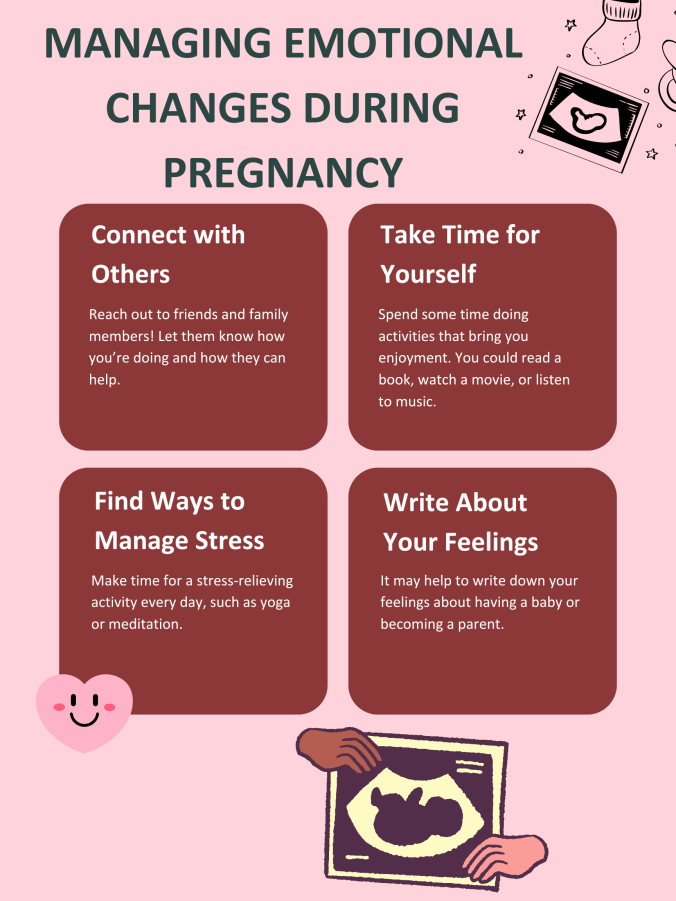
Managing Emotional Changes During Pregnancy
It’s important to be able to identify and label what you’re feeling, so that it can be addressed in healthy and effective ways. Be mindful of what you’re experiencing in the present moment. You also should practice self-compassion by acknowledging the work that your body is doing by being pregnant, and accepting these changes.
NewYork-Presbyterian provided some strategies to manage your emotional changes during pregnancy:
When to Seek Help for Pregnancy Mood Swings
There is no shame in reaching out to a mental health professional when you’re struggling. Symptoms of depression can sometimes resemble pregnancy mood swings, but the American College of Obstetricians and Gynecologists (ACOG) recommends to speak to your provider if you have any of these signs for at least two weeks:
Depressed mood most of the day, almost every day
Loss of interest in work or other activities
Persistent feelings of guilt, hopelessness, or worthlessness
Difficulty sleeping or sleeping more than usual
Loss of appetite or other concerns around weight
Trouble paying attention, concentrating, or making decisions
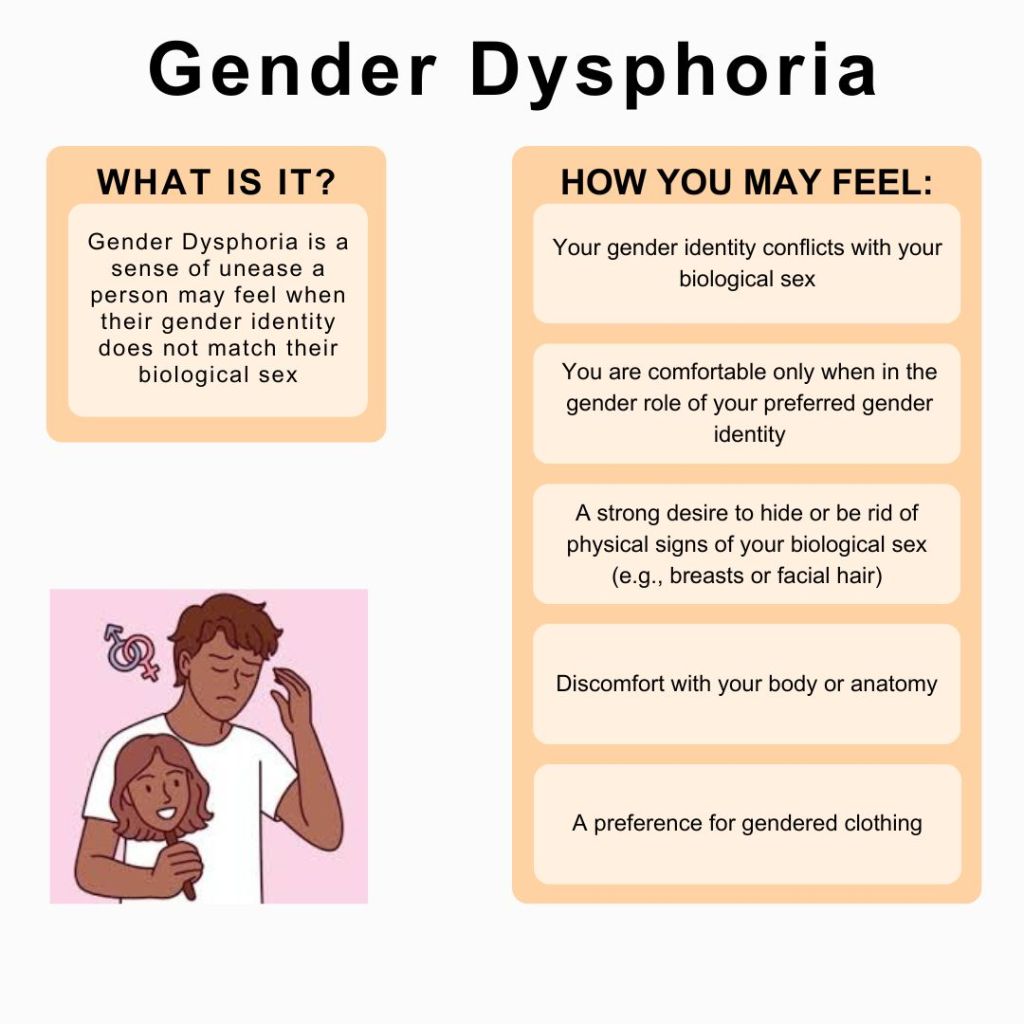
Gender dysphoria is a sense of unease that a person may have because of a mismatch between their sex assigned at birth and gender identity. In adolescence, especially around puberty when young teenagers’ bodies are changing, and they begin exploring their sexual and romantic identities, gender dysphoria typically increases around this time. Included below are some helpful definitions to include in discussions around gender dysphoria, a visual aid tool to discuss how someone may feel if they experience gender dysphoria, and helpful resources from transgender people talking about their gender identity.
Definitions to incorporate while discussing gender dysphoria:
Biological sex – label assigned at birth based on physical characteristics (e.g., chromosomes, hormones, and reproductive organs)
Primary sex characteristics – changes in the reproductive organs (males: growth of testes, penis, scrotum, and spermarche; females: growth of the uterus and menarche)
Secondary sex characteristics – visible physical changes that occur during puberty (males: broader shoulders, a lower voice; females: breast development, hips broaden)
Gender Expression – learned roles, behaviors, and actions of women/girls and men/boys (i.e., how society expects certain genders to act and look like)
Gender identity – our sense of who we are and how we see and describe ourselves
Transgender– people whose gender identity does not match their sex assigned at birth
*For clarification: based on your biological sex (what physical characteristics you are born with), society assigns you a gender (how you should act, what you should be interested, and your role in the world)*
Helpful Resources:
Teen Vogue has an article discussing what it’s like to be transgender and living with gender dysphoria.
The Guardian also has an article where people who identify as transgender discuss their experience with exploring their gender identity. Although gender dysphoria is not the main focus, it is thoroughly discussed in the experiences of the transgender people featured.
This article from BuzzFeed includes people with disabilities exploring their gender identity and how it intersects with their disability. Gender dysphoria is mentioned, but the article mainly focuses on how society has created barriers for transgender people with disabilities. It would still be beneficial to use, as it brings attention to an often overlooked area of the disability and transgender community.
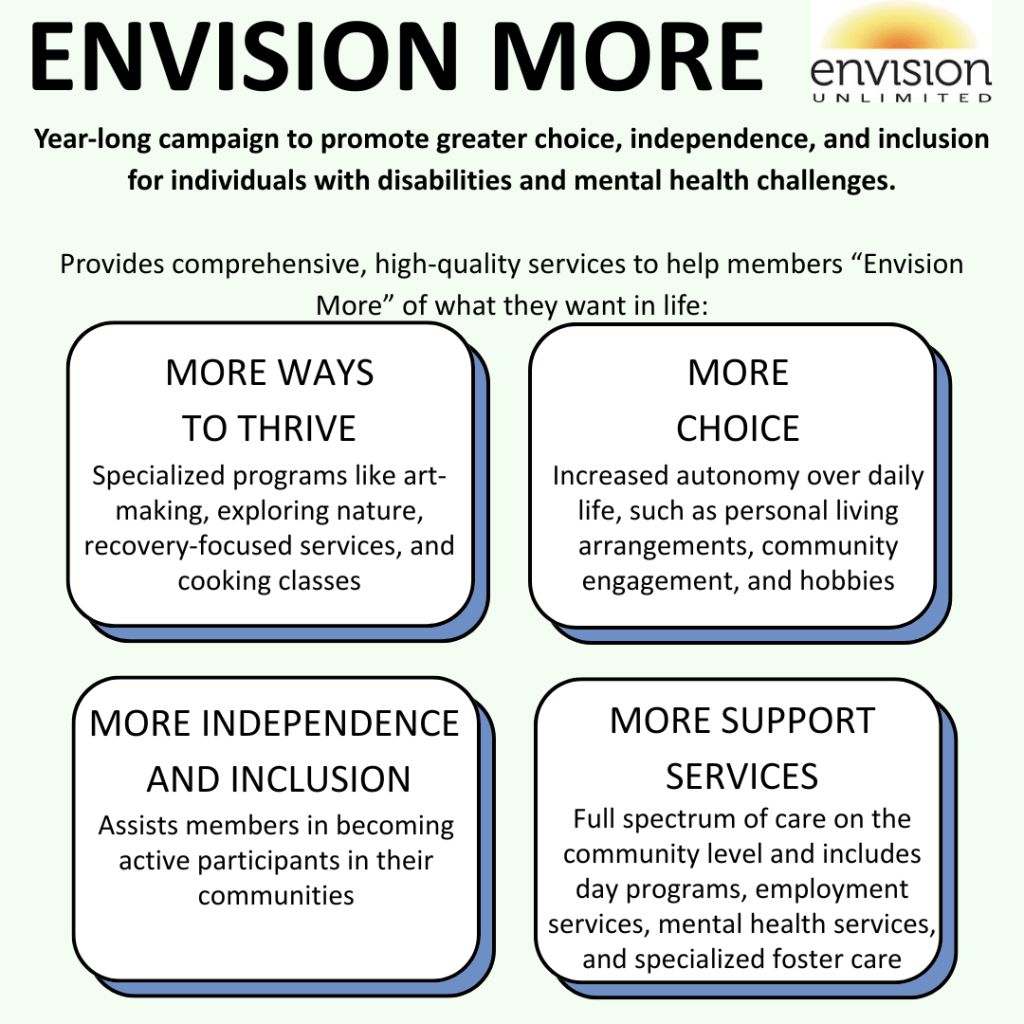
Accessible mental health services can be a challenge for people with disabilities, as there can be a lack of specialized provider training and difficulties with financial costs. We are defining accessibility in terms of disability and financial costs. This post provides a few mental health services for people with disabilities, with some services offering in-person services and others offering both in-person and online services.
Mission Statement: “Envision Unlimited is a certified Community Mental Health Provider offering a full complement of behavioral health services to people with a variety of mental health concerns. We are committed to assisting clients in their best and meaningful lives.”
Offers outpatient therapy services to adults and adolescents, both in person and via telehealth
Based in Chicago, Illinois
Envision Unlimited emphasizes that no one will be denied access to services due to an inability to pay, and a discount is available.
There is also a program called ENVISION MORE for people with disabilities.
Goal: “…to build relationships and support across service systems to help people remain in their homes and communities and enhance the ability of the community to support them.”
Offers crisis prevention and response services to people who have both developmental disabilities and complex behavioral needs, as well as to their families and those who provide supports
Services are available 24 hours a day, 7 days a week to OPWDD (The New York State Office for People with Developmental Disabilities) eligible individuals age 6 and over who meet NYSTART/CSIDD eligibility
Mission Statement: “Promoting and protecting the human rights of people with intellectual and developmental disabilities and actively supporting their full inclusion and participation in the community throughout their lifetimes.”
Delaware Disability Resources and Advocacy Organizations
All of the following services are based in Delaware
Mission Statement: “NAMI Delaware supports, educates, and advocates for an improved quality of life for individuals and families affected by mental health conditions.”
Offers a variety of signature programs, an annual education conference, and special events (for individuals, families, and professionals to receive support and information)
Shapes public policy, has a toll-free NAMI Delaware Helpline, and works with media, educators, healthcare professionals, and elected and appointed officials (to raise awareness, fight stigma, and encourage understanding)
This link is for Delaware’s NAMI program, however, there are more than 650 NAMI State Organizations and Affiliates across the country
Mission Statement: “To improve the quality of life for Delaware’s citizens by promoting health and well-being, fostering self-sufficiency, and protecting vulnerable populations.”
Offers help for mental health issues (in which all services are free, and any referrals are available regardless of insurance), support groups and one-on-one counseling, suicide prevention resources, and other additional resources.
Mission Statement: “The Mental Health Association in Delaware strives to strengthen knowledge, resources and support around mental health and recovery.”
Offers education, support, and advocacy
Support: Offers wellness groups (one is a disability & chronic illness haven wellness group), mental health screening, and a peer support program with the mental health court (mental health court is available for people who have been charged with crimes because of a behavioral health disorder)
Exploring your sexuality can be confusing, especially when you start engaging in sexual acts with other people for the first time. Virginity is the term used to describe the state of never having had sex, and “losing your virginity” can be nerve-wracking. Even the word “losing” is not the best description, because you should be gaining something from your experience instead. There are many misconceptions around sex that can contribute to feeling anxious about having sex for the first time. This is a guide that debunks myths and discusses the many ways you can have sex to help you feel a little more comfortable when engaging in sexual acts, and the importance of your mental wellbeing when it comes to this.
Sex Myths
Myth
Reality
You will feel different after having sex.
People often believe after having sex for the first time it will instantly change everything and bring a complete happiness in your life. The truth is there is no “right” way to feel after having it. You can feel happy, anxious, calm, excited, nervous, or even the same. All of these reactions are completely normal.
Pain is always present.
First time sex can feel uncomfortable at first. The vagina is muscle so when it is being strecthed it comes along with discomfort. But with communication, patience, and enough foreplay with your partner the discomfort will last for only a little bit. If the pain is severe or ongoing it is a good idea to talk to a healthcare professional because sex is not supposed to hurt.
It will be perfect and magical.
Watching television they depict first time sex as something magical and smooth. In reality that is not always the case. First time sex can be awkward and nervewracking and that is okay! Learning and figuring things out with your partner is completely normal. It does not have to be perfect for it to be meaningful.
Talking about boundaries will ruin the mood.
This is absolutely not true. If there is something you do not feel comfortable with when about to have sex with your partner, make sure you say it. You saying it will not ruin the mood whatsoever. It will just make sure that you are being treated with respect and that you are not uncomfortable during the experience. When both partners feel safe and heard, it will create a more positive experience.
Penetration is required.
This is a myth because that statement limits the definition of sex to only penis-in-vagina orientation. Intimacy includes many forms such as oral sex, touching, mutual stimulation, and many other experiences.
Diving Deeper into Inclusive Sex
As mentioned above, “penetration is required” for sex is a myth because of the many ways to be sexual, and based on your pain or mobility restrictions, sensory sensitivities, gender identity, and sexual orientation, sex may be different than how you imagined it. There is no one or “real” way to have sex; it is whatever you and your partner are comfortable with, so it’s important to talk to your partner about boundaries and what sex you would like to have.
There are many different ways people have sex:
Anal sex – a penis is inserted into another person’s anus
Oral sex – a person licks a person’s vulva, vagina, or clitoris or a person kisses/sucks a person’s penis
A person kisses and sucks the other person’s nipples
A person masturbates with another person
A person touches another person’s vagina or penis
Sex toys (ex: dildos…) are used
This fact sheet provides more information on having sex.
Being comfortable in your sexuality and expressing yourself sexually can help you understand yourself better and be in control of your own life. It can also give you confidence to have sex successfully (based on your own personal view of what “successful” sex is) and deepen your connection with your partners.
Resources To Promote Positive Mental Health
For LGBTQ+ individuals with disabilities, the LGBTQ+ community and spaces can act as a protective factor as it helps foster a sense of belonging, reduce isolation, and supports positive self-identity. However, LGTBQ+ people with disabilities also report higher rates of mental health concerns. The Trevor Project has a guide on their website for supporting LGBTQ+ people with disabilities, including direct links to resources that can be found on page 14 on the PDF format.
We wanted to attach some resources if you or someone you know is struggling with mental health concerns. The Cleveland Clinic provides more information about suicide and its warning signs on its website at https://my.clevelandclinic.org/health/articles/suicide.
The Never a Bother campaign is a youth suicide prevention awareness and outreach campaign for young people and their parents, caregivers, and allies. To get involved, please visit https://neverabother.org/
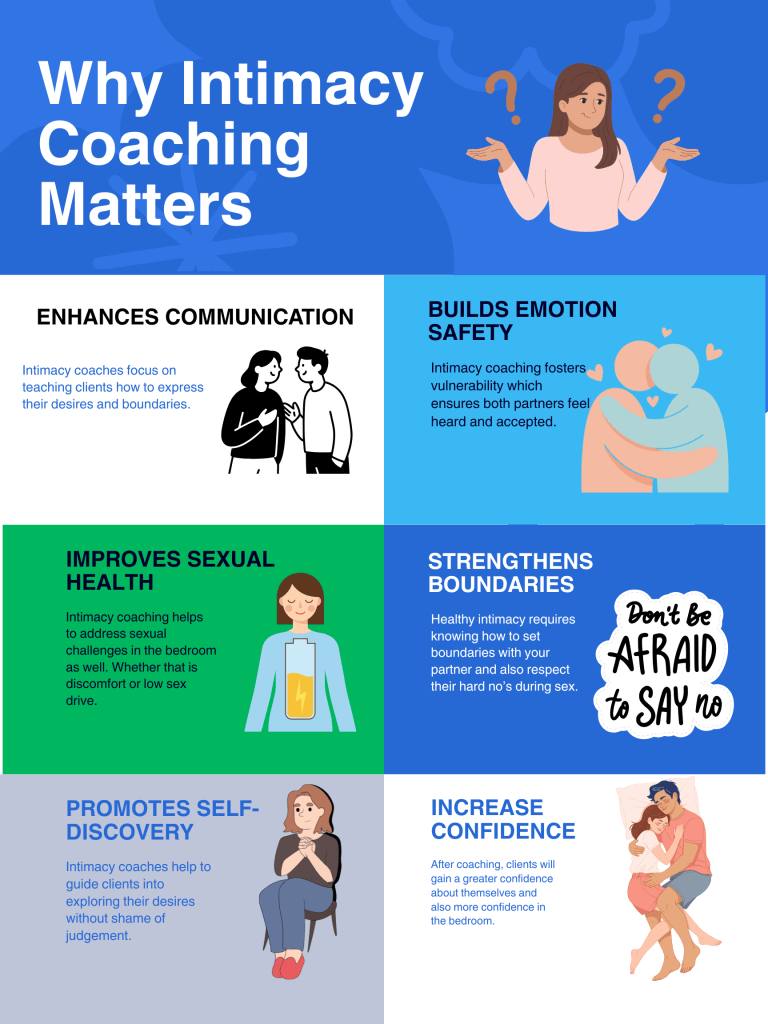
Intimacy coaching is a specialized type of relationship coaching that focuses on helping emotional and physical intimacy. Intimacy and connection are essential parts of being human. Everyone deserves the chance to experience it fully. Intimacy coaching offers a supportive, judgement-free space to help individuals or couples explore and deepen their capacity for emotions, physical, and even spiritual intimacy. An intimacy coach helps you reconnect with your desires and communicate your needs. If you’re looking to bring back the spark, try something new, or simply understand your needs/desires better, intimacy coaching is the perfect way to go.
To learn more about what intimacy coaching does, watch this video.
Here are some intimacy coaches that have great reviews and cater towards people with disabilities.
Joslyn Nerdahl: Certified Sex Coach and Clinical Sexologist, Physical Disabilities
Joslyn Nerdahl is an intimacy coach who specialize in working with people with physical disabilities. She believes that communication and consent are the foundation of healthy intimacy. She has a passion for helping people learn how to talk about sex openly and provides a safe space for her clients to explore their needs and desires. Her services include intimacy coaching, sex education, and sexual rehabilitation. Learn more about her: Services – Joslyn Nerdahl
Grace Myhill is a couples coach and educator who specializes in working with couples where on or both partners are a person with autism. She focuses on each partner experience and validating each other their perspectives. She wants to help both partners work together to build emotional and relation skills. If you want to know more about her work visits her website: https://www.gracemyhill.com/
Dr. Mitchell Tepper: Sex Coach and Educator for People with Physical Disabilities
Dr. Mitchell Tepper is an educator who specializes in working with individuals with disabilities and chronic conditions to help reclaim pleasure and intimacy. His approach focuses on empowerment, inclusion, and accessibility. He emphasizes that everyone, regardless of physical ability deserves access to intimacy, pleasure, and love. To explore his work and resources visit his website: Coaching – Dr. Mitchell Tepper
Amy Gravino: Autism and Sexuality Advocate, Speaker, and Relationship Coach
While Amy Gravino is not an intimacy coach, she still advocates for autism sexuality. She is an educator who empowers autistic adults to embrace healthy relationships, self-advocacy, and sexual expression. If you want to learn more about her advocacy or watch one of her videos visit: A.S.C.O.T Consulting
I think intimacy coaching is a great way to explore yourself, your relationship, and spice things up.
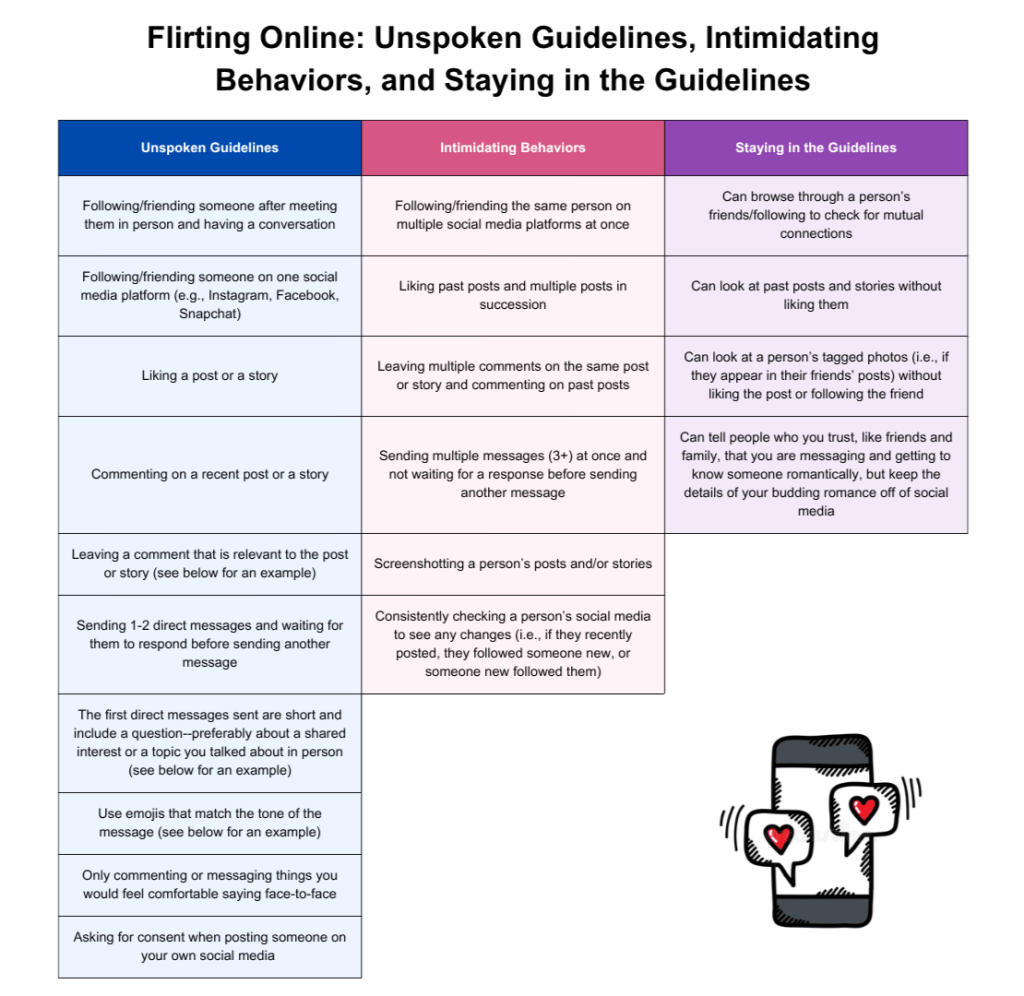
Social media can be difficult to navigate as there are unknown “rules” and behaviors that are widely followed when first interacting with others, especially those you are interested in romantically. This aid demonstrates several unspoken guidelines, intimidating behaviors, and tips on staying within the guidelines on social media when trying to flirt. It is worth mentioning that this is not a comprehensive list of all guidelines and intimidating behaviors, but rather a guide to help you talk to your crush online in a fun, respectful way that keeps everyone comfortable. As a 21-year-old who has been online from a young age, some of these guidelines are based on my own experiences and knowledge.
Example of a relevant comment: Someone posts a photo of them graduating school and you comment, “Congratulations!”
Example of a direct message: You talked to someone last week about a book series and sent this message: “Hi! It’s [your name], we talked last week about [book series]. I started reading it and really liked it. Do you have any other recommendations?”
Examples of using emojis: (1) You are messaging your crush about a movie that you both recently watched and talking about a scene that left you in disbelief: “I can’t believe that happened 😭 I was not expecting it at all!” (2) You made plans to hang out with your crush in person and sent this message: “I’m excited to hang out on Saturday 😊 See you then!”
Teen Vogue has a list of questions to keep the conversation going with your crush, whether you’re looking for something low-pressure, flirty, deep, random, interesting, or just plain fun.
The Napoleon Cat Blog gives some tips for commenting on someone’s post, showing different examples for different post scenarios. Some of them are intended for friends, but can still be used for your crush’s posts. Their 35 Short Comments for Instagram section is best used when you first start commenting, as they are simple, not intimidating, and friendly.
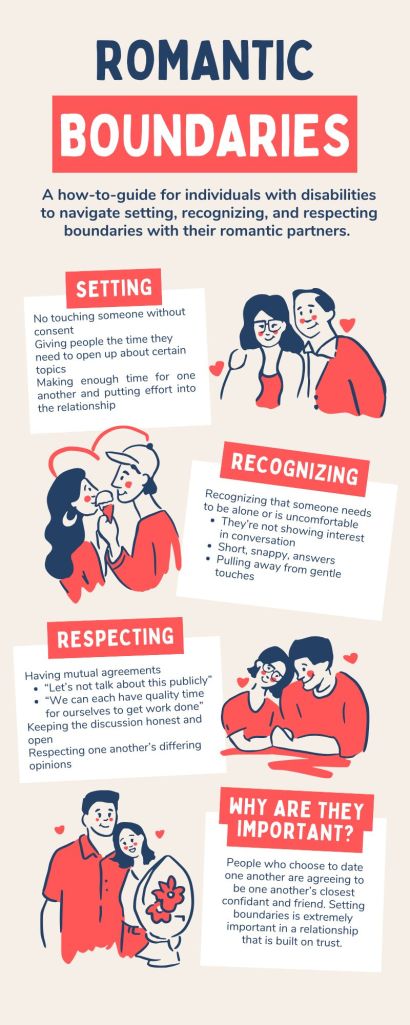
We have created a how-to-guide for individuals with disabilities to navigate setting, recognizing, and respecting boundaries with their romantic partners.
The setting in which you touch someone matters. Do not touch someone without their consent. It is also important to give people time to open up about certain topics and give people time to put in effort into a relationship.
Recognizing that someone needs to be alone or is uncomfortable can take time to learn. If someone is not showing interest in a conversation, if they are giving short, snappy answers, or if someone is pulling away from gentle touches are all signs that someone may be uncomfortable or want to be left alone.
Respecting one another’s differing opinions is very important. Keep a discussion honest and open, and have mutual agreements on when and were to have certain conversations.
Finally, setting boundaries are important because you want to build trust in a relationship. This post includes an infographic that can support someone’s quest in finding and maintaining romantic relationships and boundaries.
To support teaching these concepts, we have created a presentation and lesson plan that are free to use.
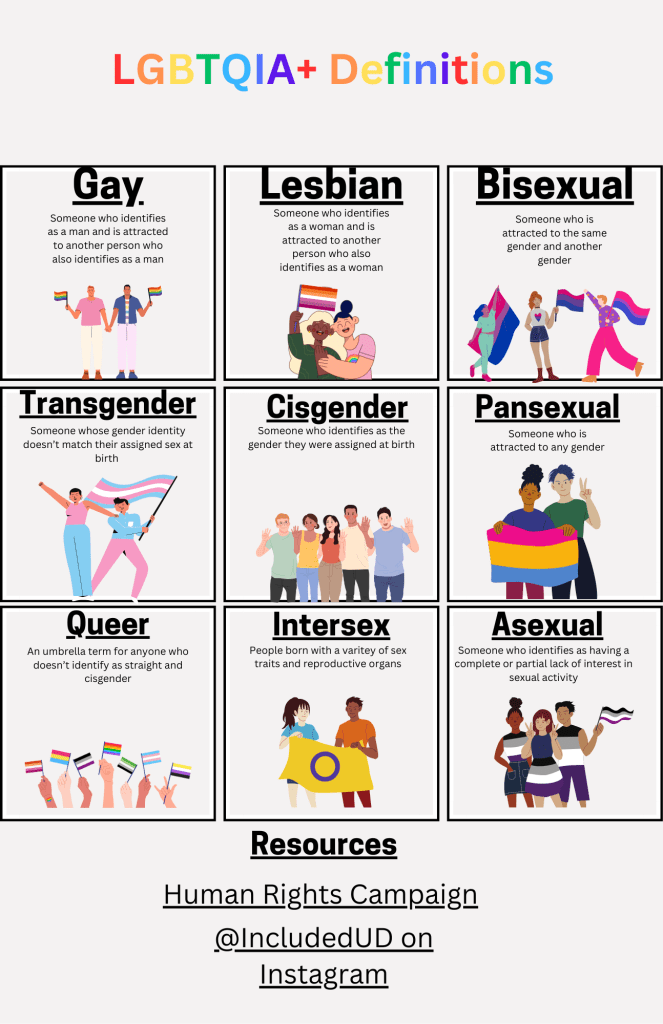
Below is a plain language guide. This resource allows for individuals to easily access and understand LGBTQIA+ identities, and can be used for educational purposes. The definitions were sourced from @IncludedUD on Instagram, as well as the Human Rights Campaign (HRC). These two links will take you to the Instagram and to the HRC’s glossary of LGBTQIA+ terms respectively.
***plain text language***
Below is an screen-reader friendly Plain Language Guide without images.
Last year, Planned Parenthood released a series of 4 videos that cover 4 different topics: consent, body image, identity, and birth control/sexually transmitted infections. These videos are linked below, and are available for free on Youtube. The group of friends in each video communicate in American Sign Language, and closed captioning is available in Spanish and English.
This first video is about consent. Ciara and Dev are getting into a relationship, and Ciara discusses with her friends how to set boundaries without feeling “mean”, by being honest, clear, and kind.
This second video is about birth control and sexually transmitted infections. One of the friends, Ciara, tells Ava that she is ready to have sex with Dev, and Ava and Ciara discuss the steps to follow before having sex. First, they discuss STI testing before having intercourse, and then acquiring birth control. Dev, Em, and Bo also talk about condom use, and Em explains that when at the doctor, they are legally required to provide an interpreter for those that are Deaf or hard of hearing.
This third video discusses identity; sexual orientation, gender identity, and Deaf identity. There is a conversation about pronouns as well as owning a Deaf identity between a group of high-school-aged friends.
This final video discusses body image. Two of the high-school-aged friends in the group struggle with their body image, one of which is also struggling with what to wear to a pool party as a transgender person.
Going to the doctor for a sexual health visit can be scary if you don’t know what to expect. Here are some resources to explore in order to be prepared!
The Autistic Women & Nonbinary Network shares a list of gynecologists and other intimate care providers who offer accessible and inclusive care.
Cerebral Palsy Foundation posted several videos on preparing for a mammogram appointment and how to optimize your visit.
If you’re wondering what kind of doctor to see about sexual health, the National Coalition for Sexual Health lists who to see for different kinds of appointments.
The Office of Developmental Primary Care at the University of California, San Francisco, offers a guide on relationships, romance, sexuality, and sexual health. The guide includes tips for successful medical appointments and what to expect at a doctor visit.
Planned Parenthood offers information on what to expect at a wellness visit, which is a doctor’s visit that is centered around your reproductive health.
Alabama:The University of Alabama at Birmingham offers resources on sexuality and relationships, sexual abuse, and tips for parents when discussing sexuality with their children.
Alaska: Olmstead Rights shares a list of resources and advocacy organizations in Alaska. The resources are directed towards individuals with physical, intellectual and developmental disabilities, and mental illness.
Arizona:Special Olympics Arizona offers a list of resources for individuals with disabilities who want to learn more about health and wellness.
Arkansas: The Arkansas Disability Coalition is an organization that helps families and individuals with disabilities by providing health-related support, information, and resources.
California: Disability Without Abuse Project is dedicated to spreading awareness about abuse faced by individuals with intellectual or developmental disabilities. They offer resources, a newsfeed, and a blog for people who are interested in learning more.
Colorado:The Initiative Colorado works to raise awareness and break down barriers to accessing health services.
Connecticut:The Center for Relationship and Sexuality Education strives to make sexual health information more accessible for members of the intellectual and developmental disability community. They provide learning materials and professional development programs.
Delaware: Planned Parenthood of Delaware provides education and training services for people with intellectual and developmental disabilities.
Florida: The Disability and Health Program aims to increase the accessibility and availability of health resources for people in the disability community.
Hawaii:Hawaii Pacific Health is a resource for people who would like to learn more about sexual abuse, and for those who have already experienced sexual abuse.
Idaho:DisAbility Rights Idaho provides protection and advocacy for people with disabilities.
Illinois:Community Choices supports individuals with disabilities in the process of filling medications, scheduling and going to appointments, and connecting with health representatives.
Indiana: Indiana Institute on Disability and Community has a feature on their website where you can input information to find resources specific to your situation. They also offer training and workshops and other opportunities to become involved in the community.
Iowa: The Iowa Department of Public Health provides a list of resources for people with disabilities who would like to learn more about sexual health.
Louisiana: Green Clinic offers resources for dating violence and sexual assault, and sexual health. They also share resources for STI testing.
Maine: MomentumRELATE offers education, dialogue, advocacy, and training for people with disabilities. They are committed to helping people develop a healthy and positive understanding of sexuality and relationships.
Maryland: Respectability offers general sexuality resources for members of the disability community. Some of the topics they includes resources for are masturbation, hygiene and self care, puberty, and relationships.
Massachusetts: The Massachusetts Department of Public Health and the Massachusetts Department of Developmental Services collaborated to create a guide on healthy relationships and sexuality.
Minnesota:Family Tree Clinic offers a wide range of services including birth control, annual exams, trans hormone care, STI testing and treatment, and Rapid HIV testing. They also offer a health education program for members of the community who are deaf, deafblind, and hard of hearing.
Mississippi: The Arc focuses on respect, abilities, freedom of choice, and inclusion. They provide resources for people with disabilities regarding self-advocacy.
Missouri:SHADE (Sexual Health and Disability Education) teaches sexual education to people with disabilities. They have a newsletter, resources, and guides for supplemental information.
Nebraska: Munroe-Meyer Institute has a team of occupational therapists, physical therapists, psychologists, and recreational therapists who offer sexual health services to individuals with intellectual and developmental disabilities.
Nevada:Planned Parenthood offers comprehensive sex education and services for individuals with disabilities.
New Hampshire: Disability Rights Center – NH offers information and assistance regarding Medicaid and healthcare, access and accommodations, and general health.
New Hampshire: Elevatus Training is an organization that offers extensive information about navigating sexuality as a person with a disability.
New Jersey:The Division of Disability Services in the Department of Human Services collaborates with health educators, policy makers, and experts in the field of health to create an inclusive setting for people with disabilities to learn about sexual health.
New Jersey: A.S.C.O.T. Counseling offers presentations and counseling on subjects like autism and sexuality, and the experiences women on the spectrum have.
New York: Project SHINE works to create innovative and accessible sexual health tools for members of the disability community.
North Carolina:Autism Society of North Carolina offers an extensive list of resources about sexual health for youth and adults with disabilities.
North Dakota:My Ally Health is a reproductive health clinic. They assure that their services are available to anyone regardless of disability status, race, sex, religion, or economic status.
Ohio:The Ohio Developmental Disabilities Council has meetings, sends newsletters, holds events, and offers resources about health for people with disabilities. One of their previous events involved a discussion about healthy romantic relationships and sexuality in the I/DD community!
Pennsylvania: Positive Approaches Journal was published by the Pennsylvania Department of Human Services. The journal features research and information on sexuality, LGBTQIA+ inclusion, and relationships.
Rhode Island:Zencare is a resource that connects people with disabilities with sex therapists in the area.
South Carolina:United Spinal Association is a source for people with spinal cord injuries or disorders. They provide tips for patients and discuss how to plan for a doctor visit.
South Carolina:Able South Carolina is a community-based nonprofit that offers a variety of services for individuals with disabilities.
South Dakota:Bridging South Dakota is a program that offers support for people with disabilities who are survivors of sexual assault.
South Dakota: Planned Parenthood provides a variety of services, such as abortion, birth control, pregnancy testing and services, and STD testing and treatment.
Tennessee:Tennessee Disability Services offers a list of resources on dating and romantic relationships, targeted towards individuals with intellectual disabilities.
Tennessee: Autism Tennessee offers occasional events that involve discussions about relationships and sex. Their Sexual Identity & Inclusion Alliance facilitator is very passionate about creating equal access to information for everyone.
Texas: Planned Parenthood provides a variety of services, such as abortion, birth control, pregnancy testing and services, and STD testing and treatment.
Texas:Navigate Life Texas is a resource for parents of children with disabilities. They offer tips on discussing puberty and sexuality, how to talk to the doctor, and more.
Utah:Planned Parenthood Association of Utah provides a variety of services, such as abortion, birth control, pregnancy testing and services, and STD testing and treatment.
Vermont: Planned Parenthood of Northern New England offers sexuality education for people with developmental disabilities, along with other sexual health resources and services.
Virginia: Disability-inclusive Sexual Health Network (DSHN) connects and supports youths with disabilities in Virginia through sexual education. They have a youth advisory board, resources, and plenty of ways to get involved on their website.
Washington:The Arc of King County shares resources on relationships, sexuality, and gender. Their goal is to ensure that everyone gets equal access to sexual health information.
Washington: The University of Washington has compiled a list of resources on sexuality and relationships for individuals with intellectual disabilities and autism.
Wisconsin:Wisconsin Behavioral Health Clinic emphasizes the importance of making sexual health information more accessible, and offers a variety of resources and services for people with disabilities.
Wyoming:The University of Wyoming shares resources on sexual and reproductive health, healthy relationships, and sexual orientation.
If you have a relevant organization that you would like added to this list, please contact us.
Making decisions about dating can be tough, especially if you don’t really know what types of decisions to make. This graphic can be used to help steer the conversation about dating and how to make healthy decisions. It is available for download here.
Rewire News Group is a news website that is focused on sexual health and social justice. They are looking to “reshape the national dialogue on all things sex by making it more inclusive, positive, and centered on social justice.” The website itself is not focused on intellectual disabilities, however, they do offer some amazing articles about issues in the disability community.
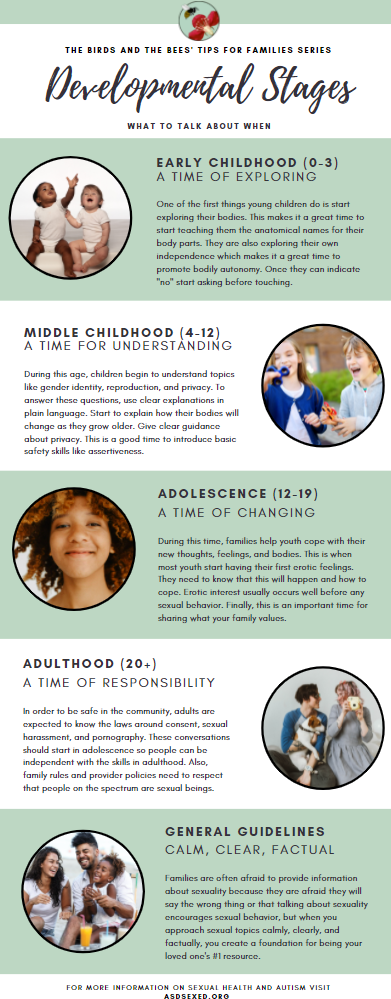
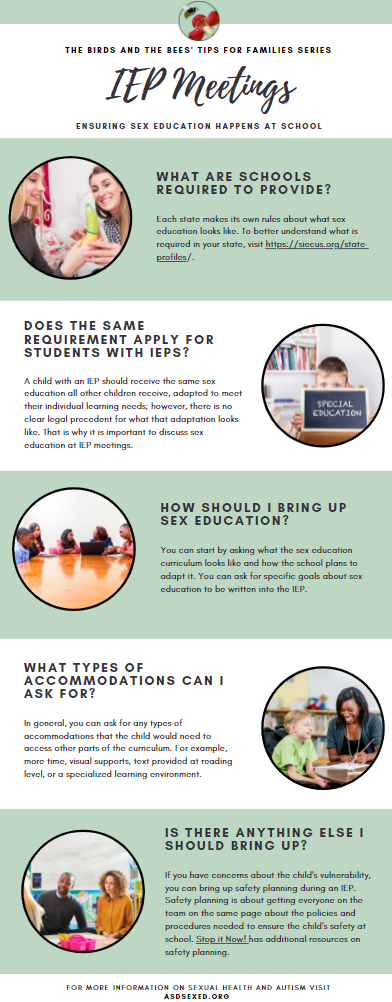
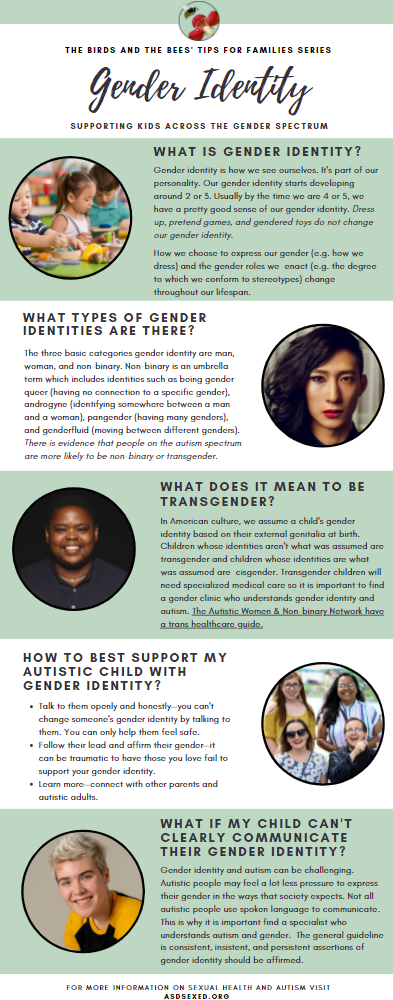
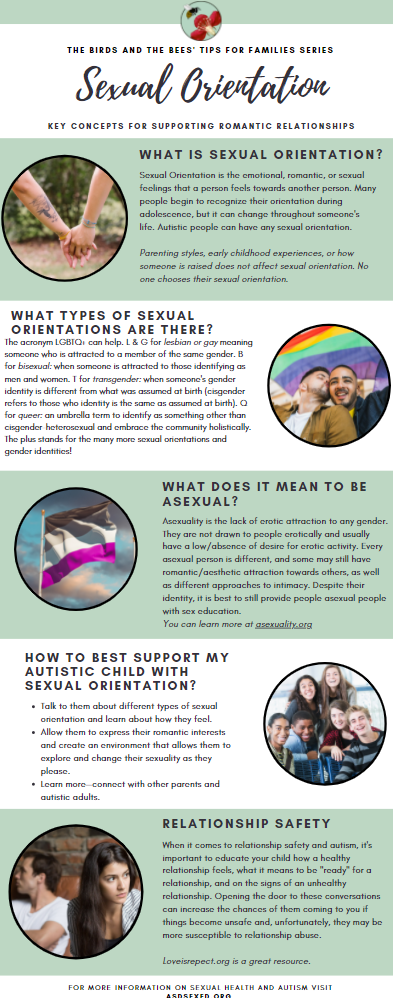
Navigating developmental stages, education, and sex education can be extremely difficult. The Birds & The Bees team put together a parent tip sheet that offers basic information and resources for parents of autistic children. View the tip sheets in the slide show and download below.
The Organization for Autism Research (OAR) was founded by parents and grandparents. OAR strives to use science to address social, educational, and treatment concerns in the Autism community. Their mission is to fund research, provide useful information and resources to the community, as well as hold programs to improve quality of life for individuals with Autism.
The OAR has put together an online guide for sexuality and sex ed. This guide is self-paced and intended for people on the Autism Spectrum aged 15 and older. This guide consists of nine modules: Public vs Private, Puberty, Healthy Relationships, Consent, Dating 101, Sexual Orientation/Gender Identity, Am I Ready?, Sexual Activity, Online Relationships and Safety. Each module consists of a video overview and 10-15 smaller sections.
This guide is completely free and can be accessed at the link below: