New Research Regarding Autism and Sexuality

Sandra Byers, Shana Nicholas, Susan Voyer, and Georgianna Reilly have an paper coming out in Austim this month.  They survied 141 men and women with “high functioning autism and/or Aspergers syndrome” (AQ score of 26 or greater) about their sexual wellbeing.  You can read the abstract of the article for free or pay for the entire article but I’ve summarized the interesting findings below.

Gender Differences:  The men had greater sexual well being but less sexual knowledge.  They weren’t different in all areas; for example, they were the same in terms of sexual activity and sexual self esteem.  They were different in areas such as arousability and sexual desires (this is pretty consistent with neurotypical gender differences).

Autism Symptomatology: Folks who reported less autism symptomatology had better sexual well being but not necessarily more sexual activity (both with partners and alone).  The folks who reported more autism symptomatology reported more difficulty with the other parts of sexual life like assertiveness and desire.

Relationship Status: Folks in romantic relationships relationships  reported better sexual well being.  Everyone in the study had been in a relationship at some point so this is comparing the folks currently in a relationship from those not in a relationship at this time.

So how did they define sexual well being?  

The looked at sexual well being in two main domains: dyadic (with another) and solitary (on your own).  In these domains they examined affection, genital activity, sexual assertiveness, sexual satisfaction, arousability, sexual desire, sexual thoughts, sexual anxiety, and sexual problems.

One of the take home recommendations for education relates to the two domains.  These reachers highlighted the importance of sexuality education that teaches about partnered sexual expression and solitary sexual expression.  They also recommended that sexuality education specifically focus on developing a positive sexual self-image.  I can’t disagree with them there!

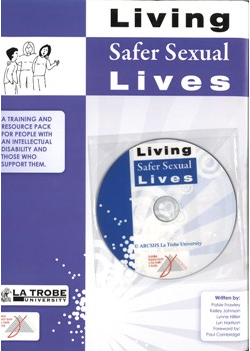
Living Safer Sexual Lives- Training Pack

Living Safer Sexual Lives is a training pack available for purchase ($57.23) for those of you who may be doing training on human sexuality and disabilities.  I have not personally used their materials, but it was developed in a very interesting way and it’s not very expensive so I thought I’d pass it along.  A research group in Australia interviewed several people with intellectual disability about their sexual lives and then used their stories to develop this training.  The training is targeted toward parents, professionals, and self advocates.  The training pack has three parts: introduction, training, and resources (including a DVD of people with intellectual disability telling their stories).

You can read the full report which outlines the findings from the interviews and how they used the interviews to shape the training.  The report also includes accounts from people with disabilities about their sexuality.

The key themes that emerged from the stories were:

  • Diversity and similarity. Diversity within the lives of the story-tellers and similarities between needs and desires of this group and other adults.
  • The issues of rights and sexuality.
  • The hidden nature of people’s sexual lives.
  • Celebration of sexuality and relationships.
  • Gender issues.
  • Loneliness and rejection.

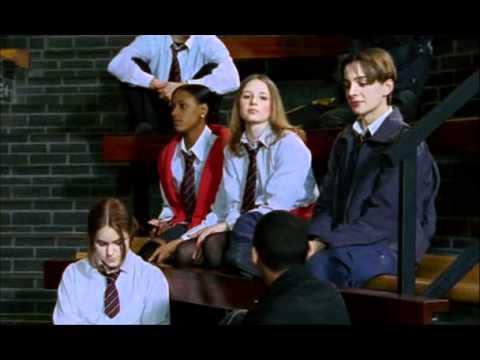
Video Teaching Tool- The Body Story

I came across this looking for educational resources for teaching about puberty.  It is not specifically designed for students with intellectual and/or developmental disabilities but is very well done and could serve as a basis for instruction.  It’s available to stream free on YouTube and I’ve posted it here.  You can also find it available for purchase if you would prefer a DVD.

This is the puberty episode…

The series also has a reproduction episode but it’s presented with the baby as a “body snatcher” which I think would be very confusing.

Parent Newsletters and Research about Sexual Behavior and DD

This series of parent news letters is available in English and Spanish.  They provide guidelines for families in regards to talking about sexuality topics.  They are not adapted for children with special needs, but I thought they could be useful regardless (especially the more general issues).  On this page the also have a fact sheet (English only) that has a lot of data about teens sexual behavior.  There is very little (almost no) information about the sexual behavior of adolescents or adults with developmental disabilities but I’ve summarized the research that is available below.   (You would need access to an academic library to read the full articles cited below for free).  Despite the limited research, most people (be they parents or professionals) come to my workshop because they already know people with disabilities have sexual intersts!

There have been several studies that suggest that individuals with ASD have a desire for intimate relationships (Henault & Attwood, 2002; Van Bourgondien, Reichle, & Palmer, 1997; Ousley & Mesibov, 1991). These studies may define “interest” as instances of sexual behavior.  For example, one study that reports the majority of 89 individuals with ASD living in group homes in North Carolina displayed some sort of sexual behavior (Van Bourgondien, Reichle, & Palmer, 1997).  Other studies define “interest” as self-reports of sexual activity and knowledge (Ousley & Mesibov, 1991). In both cases they are reacting to earlier studies that reported that individuals with ASD (and other disabilities) had no interest for intimate relationships with others (Despert,1971; Rumsey, Rapoport, Sceery,1985) and common myths that report individuals with ASD to be asexual (Irvine, 2005).

Despite the trend to move toward a more accepting view of sexual interest among individuals with ASD and other developmental disabilities, there remain questions as to what extent individuals with disabilities are interested in sexual activity. For example, most studies look at sexual behavior however individuals may be interested in intimate relationships even if they are not displaying sexual behavior. Some studies have shown that individuals with more knowledge are less likely to want to engage in sexual activity (Konstantareas & Lunsky,1997); however it seems that the relationship between access to sexuality education and the desire for support with relationship development remains unclear.

Developmental Messages for 0-5 Year Olds

In The Birds and the Bees workshop we talk a little bit about how we start teaching folks about sexuality from birth. We mostly teach sexuality through how we socialize and interact with infants.  SEICUS has a set of guidelines for being more intentional about promoting healthy sexual development in 0-5 year olds.  For me, some of the developmental messages and core concepts where exactly where some of the guys I’ve worked with were at, even if they were much older.  I especially like the discussions about sexual abuse prevention (pages 56-57), masturbation (45-46), and sexual curiosity (47-49).  I also think you could get some great ideas for teaching about gender roles (59-61) that you could do outside of what may be considered a sex ed class.  For each of the 19 topics they discuss they include a discussion section, key messages, additional messages for older preschool children, and how adults can help.

You can download the guidelines for free… RightFromTheStart

New Laws Regarding Guardianship and Access Sexual Violence Services

Thank you to Kelli at the Developmental Services Center for sending out this information!  Over the past three years, three laws have been passed that improve public policy with the goal of increasing access to services for women with disabilities who experience sexual violence:

P.A. 96-318, eff. Jan. 1, 2010-  Consent of a guardian, health care surrogate or health care power of attorney is not required in order for a victim with a disability to receive health care or release forensic evidence following a sexual assault.

If a victim with a disability is unable to consent to the release of evidence, and the victim’s guardian, health care surrogate or health care power of attorney is unavailable or unwilling to release the information, an investigating law enforcement officer may release the evidence.

P.A. 96-1010, eff. Jan 1, 2011- An adult with a guardian can:

  •  decide whether his or her guardian can look at her/his rape crisis center records; and
  •  decide whether or not to waive the rape crisis center privilege.

P.A. 97-165, eff. Jan. 1, 2012-   An adult with a guardian can attend up to five, forty-five minute counseling sessions without the consent of, or notice to, the guardian unless the counselor or therapist believes such disclosure is necessary.

Click the link below to download fact sheets created for advocates and self-advocates

Public Policy Committee Fact Sheets 6.12.12

These fact sheets are a product of the Illinois Imagines Project, a collaborative among the Illinois Department of Human Services, the Illinois Coalition Against Sexual Assault, and self-advocates for people with disabilities.

Thank you to these groups who not only created these facts sheets but also advocated for these protections!

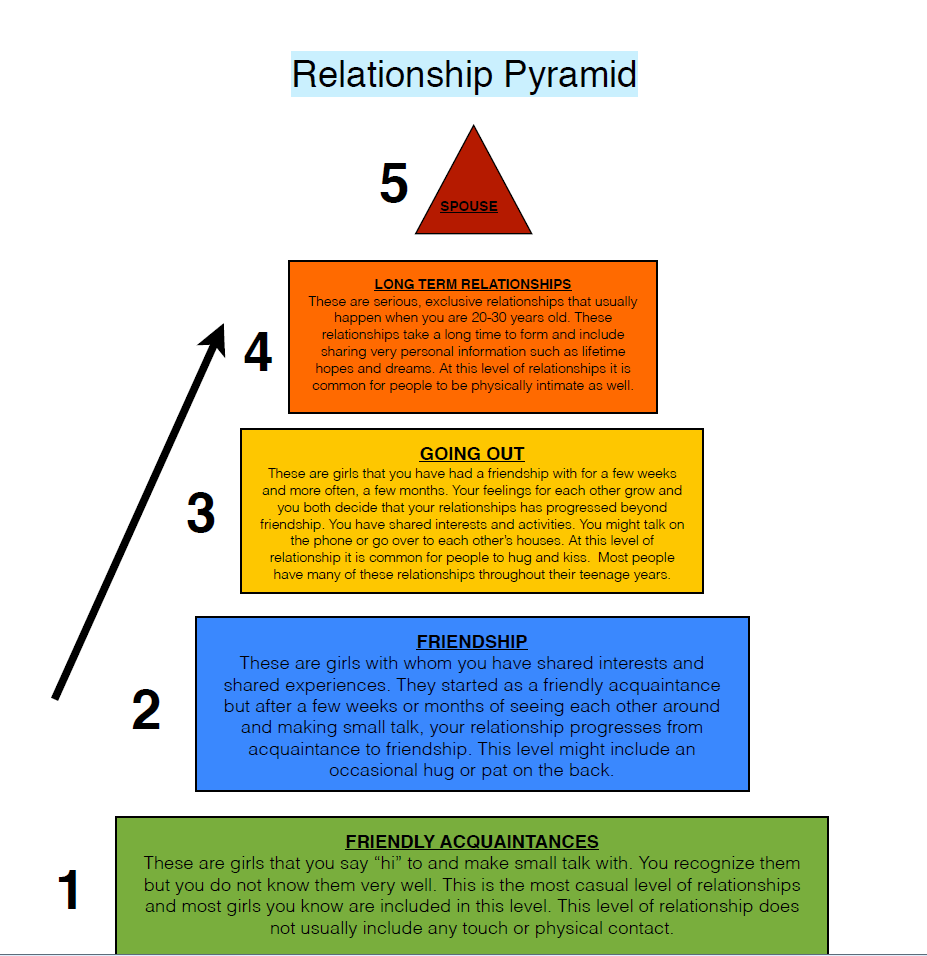
Relationship Pyramid

Here is an example of a five point scale that was developed by April Keaton, LCSW, to explain the different levels of relationships.  The pyramid shape was used to convey that you might have a lot of “friendly acquaintances” but much fewer “long term relationships”.  It was important for this person to connect the level of the relationship with the level of intimacy so you see examples of intimate behaviors at each level of the pyramid.  There’s also an element of time built into the descriptions.     You wouldn’t have to start with pyramid filled out.  You could start with a blank pyramid and support an individual with filling in the levels.  You could add names of individuals at each level.  You can download the pdf of this image by clicking here.

How to be in Middle School

In the crushes unit of Human Sexuality 101 for middle school, we used this video on handling a crush.  We were talking about this during The Birds and the Bees workshop in Champaign today and it reminded me that I should probably highlight this resource on its own.

The How to be in Middle School series covers topics such as how to invite someone to a dance, how to go to a dance, first kiss, handling kissing games, and many more topics (including less relationshipy videos like how to clean your room quickly).  The videos present clear rules and how to guides.  We planned an activity around the rules in our group.

The Circles of Sexuality

No, these aren’t the circles we usually talk about related to levels of intimacy and based on the Circles curriculum.  These circles developed by Dr. Dennis Dailey, focus on Sensuality, Sexualization, Intimacy, Sexual Identity, and Sexual Health.  I think these might make a good framework for a 5 module course or could be used to introduce the concept of sexuality.  Click here for a full explanation of The Circles of Sexuality

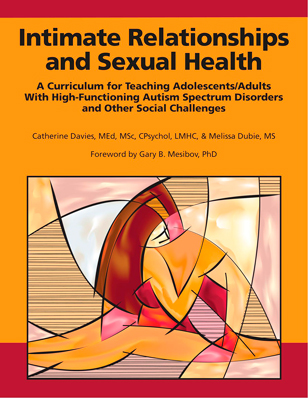
“Intimate Relationships and Sexual Health” – A Curriculum

Courtesy of Indiana University

Thank you to the folks at TAP in Rockford for bringing this curriculum to my attention!

Intimate Relationships and Sexual Health” is a curriculum written by Catherine Davies and Melissa Dubie who are affiliated with the Indian Resource Center for Autism.

“Intimate Relationships and Sexual Health” is geared toward folks who are pretty independent and have few intellectual impairments, so it’s not for everyone.  But they do do a nice job of showing how to think about lesson planning  that would apply to anybody.  You can see a fair amount of the curriculum on Amazon to see if it might work for you.

Explaining Anatomy

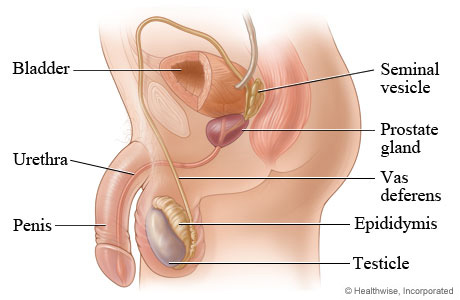
I had a blast in Carbondale (thank you all)!  People really responded to the time we spent thinking about how to explain concepts like arousal and orgasm.  In the anatomy lesson of the curriculum we’ve been did this summer, I have similar explanations for explaining the reproductive parts of the body.  I’m going to include the entire list here, but if the entire list is too overwhelming for your students choose 3-5 physiological parts to focus on per gender.  I would recommend reading over the full WEB MD definitions of these terms (click here for the worksheet Body Part Functions)- you may come up with better explanations!

Some general ideas I try to convey…

  • Some people’s reproductive organs are mostly inside the body and some people’s are mostly outside the body.
  • Reproductive organs are a system of tubes, canals, and storage centers that connect to one another.
  • Reproductive organs produce genetic information and try to bring it together. 

Vulva: A part of a person’s body that is used for reproduction, urination, and pleasure. The vulva is outside the body. Every vulva looks a little bit different, but they all have folds of skin, openings into the body, and a clitoris. During puberty, the folds of skin become covered in hair.

Labia majora: Skin that protects the vulva

Labia minora: Skin that protects the opening to the vagina

Clitoris:  Skin and nerves that cause pleasure

Vagina (birth canal): The vagina is used for reproduction and pleasure. During reproduction, the job of the vagina is to connect the uterus to the outside world. When a baby is born, the vagina squeezes in a special way to help the baby out of the uterus. When being used for pleasure, the vagina can be touched to make the body feel good.

Uterus:  Where a baby grows

Ovaries: Holds the eggs (which hold genetic information)

Fallopian Tubes:  Connects the ovaries and the uterus


Penis
: A part of a person’s body that is used for reproduction, urination, and pleasure. The penis is outside the body. Every penis is a little bit different but they all are shaped like tubes with a small hole at the end.

Scrotum: A tissue sack that holds the testes. During puberty it gets covered with hair.

Testicles (testes): Produces sperm (genetic information)

Epidermis: Where sperm mature

Vas deferens: Brings sperm to the urethra

Ejaculatory ducts: a connector.

Urethra: carries urine and semen out of the body

Seminal Vesicles & Prostate Gland: Produce sperm energy

Bulbourethral gland (Cowper’s glands): Produces lubricant (makes things slippery)

Sexuality Education Policy- An Example

I know many of you are interested in writing a sexuality policy for your agency to help guide decisions around teaching human sexuality.  Here is an example I thought might be helpful from Florida’s disability council.

What I really like about this policy is that they organized it around student responsibilities and educator responsibilities.  I think this is a nice model for conceptualizing a sexuality policy.  Below, I’ve highlighted the “Quick Reference Fact Sheet on Choice and Education Instruction” which is part of the policy.

Impact: A Newsletter

A workshop participant put me in touch with this awesome resource (thanks Cate!).  Impact is a newsletter from the University of Minnesota’s Institute on Community Integration which is part of their Center for Excellence in Developmental Disabilities.  They have many products and services that you may find useful (many of which are available online or at little cost).  Their newsletters contain ” strategies, research, and success stories in specific focus areas related to persons with intellectual, developmental, and other disabilities. ”

The sexuality issue has several interesting articles written by individuals with disabilities, service providers, family, and community members.  In addition to the articles, the newsletter provides information about additional resources in several areas: education, parent support, advocacy, sexual health, and sexual safety.

The story in Impact that touched me the most was one about two men who were harshly punished for their love for one another while institutionalized but were finally able to be married.  Once they were both living in group homes and reunited…”they decided they would not live together, they would not have sex, until they were married.  They had been punished so often, told continuously that they were dirty, sinful, hateful creatures, that they needed to get married ‘liked other people.'”  Dave Hingsburger* commented “How we hate the hearts of people with disabilities!  We have caged their bodies, disfigured their genitals, drugged their thoughts.  But we have never, ever captured their hearts or controlled their spirits.”

*The link in the text is to Dave Hingsburger’s blog.  He is the author of several resources for teaching human sexuality and abuse prevention to individuals with intellectual and developmental disabilities.  The resources can be found at Diverse City Press.

How to Explain Sex to Someone with an Intellectual Disability

This may be more difficult than it appears at first.  I like to communicate and teach broad and complex ideas about what sex is, but this can be really difficult for folks to grasp at first.  I usually start out talking about reproduction because it’s a little more concrete and then move into sex more generally once reproductive intercourse, erection, ejaculation, and arousal have been covered.  So lets start with those (and I’ll toss in a couple other concepts that may be difficult to explain).  These are how I explain these concepts, but a curriculum you use may have other suggestions you find helpful.  I used board maker pictures here, but real pictures would also be appropriate in many cases.
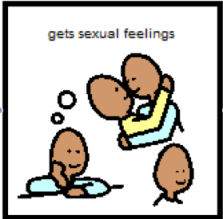
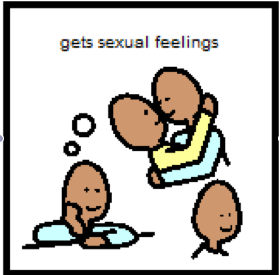
Arousal: “When you have sexy feelings and you feel tingly or excited all over your body especially in your private area*.”

*You could substitute genitals, vulva, or penis for private area to be more concrete.  Sometimes with middle school students I say “you know where” to be intentionally more vague- but only if I’m confident they do know where.
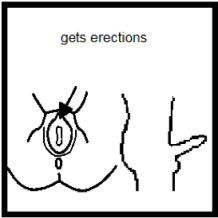
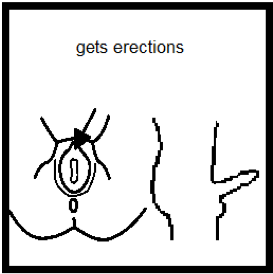
Erection: “When blood fills the penis making it harder and bigger”.  I follow this up with the why it happens, “because you have sexy feelings.  You feel aroused.”

Sometimes I add, the blood fills up the spongy tissue of the penis, but other times I omit the blood part and just say the penis gets harder and bigger.  This would depend on the level of complexity the individual can handle.

Ejaculation/Orgasm: “You have sexy feelings, your body feels really good, and you get so excited that you have an orgasm- a big burst of sensation*.” If they have a penis, I add “then fluid comes out of the penis.”  If they have a vulva, I add “then some fluid may come out of the vagina”.  If they ask what kind of fluid you could add, “a sticky milky fluid” and then if they have a penis, “with sperm in it.”

*If sensation is an inappropriate word you could replace it with feelings.

Reproductive Intercourse: “When a person put their penis in another person’s vagina and releases sperm, ejaculates.  If the sperm meets with an egg then the person might get pregnant.  A baby might grow inside the uterus.”

As students are first learning I do call this sex but once they have this I build that sex is bigger than just one act.  It is heteronormative* to present reproductive intercourse as if it was sex.  It could make students who are not interested in vaginal intercourse feel as if their form of sexual expression is less valid.  At the same time, the students that I work with are often overwhelmed by all the new information and have difficulty navigating all the nuances.  When I call this form of sex, “sex”, I do match it with vaginal sex, reproductive intercourse, or intercourse to allude to the idea that there are other forms of sex.

*If you’re not familiar with the term heteronormative, it refers to when heterosexuality is used as the default.  It also refers to other lifestyles that are considered the default.  For example, a heteronormative definition of family would be if you used, implicitly or explicitly, a husband, a wife, and children as the definition of family.
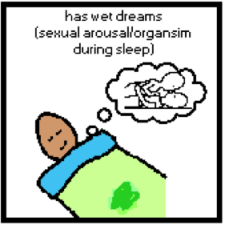
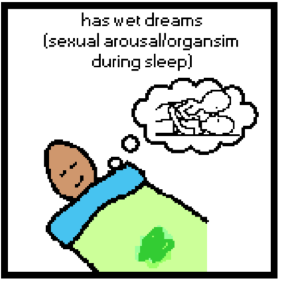
Wet Dream: “Sometimes when you’re sleeping you have have sexy feelings.  These feelings can be so good that you may get really excited in your sleep.  You may feel so good that fluid comes out of your body.”

If they know erection and ejaculation, you can use those words too but I try to limit my use of those words if I’m not confident they have a full conception of the terms.

People with vulvas can have wet dreams too! Regardless of whether there is ejaculation, having organisms and arousal during sleep can be scary. It is an important thing to prepare children for as their bodies change with puberty.

Sex: “Sex is when two people have sexy feelings they want to share with each other so they touch each other’s private parts to make each other feel good.”  You can expand it further, “A person might put their penis inside a person’s vagina.  Sometimes people kiss and lick each other’s vulva or penis.  A person might put their penis inside a person’s anus*.”  If they ask why someone has sex, I would answer “Either because they want to have a baby, because they love each other and they want to share those feelings, or because they want to have fun.”

*I would use butthole if I thought that was a word the person understood better.  In this definition, I’ve defined sex as anal, vaginal, or oral intercourse.

Sperm/Egg: The cells inside a persons body that have genetic information.

Not all folks will grasp the concept of genetic information but they will probably know that it means scientific or medical information.

Next week, well be covering reproduction in Human Sexuality 101 so look check out the curriculum for that section for more information.

Free Curriculum and Parent Resources

A lot of the curriculum we used for the puberty unit of our Human Sexuality 101 group was adapted from “Teaching Sexual Health“.  They are a group out of Canada that provides support for teachers and parents.  I used their general curriculum but they also have a curriculum for students of differing ability levels.  They have great resources for parents including “webisodes” that give examples of parents talking to kids about sexuality topics.  The website is very well organized and easy to use!

Image