Menstruation Plan

In preparing for the puberty section of Human Sexuality 101 I was looking at research on methods for teaching young girls with ASD about menstruation and came across an article using Social Stories (only a preview of the article is available for free).

In short, here’s the Four P Plan for Period Support

1.  Prepare a period kit

2.  Preinstruct (perhaps using social stories)

3.  Practice

4.  Plan for pain relief

Klett & Turan used a combination of three Social Stories adapted from Mary Warbol’s “Taking Care of Myself: A Hygiene, Puberty, and Personal Curriculum for Young People with Autism” (this book is not just for girls).  They implemented the social stories before menarche (first period) and then planed to revisit them after menses began. These stories focused on growing upwhat a period is, and how to take care of a period (I would reprint them but you have to be careful about Social Stories and their copy rights). They also used simulations with the girls using red syrup so they could practice changing a “used” menstrual pad.  They reviewed the social stories over several days and completed simulations over several days.  They also used different types of menstrual pads in case the girls did not always have access to the same type.  They also asked the children questions about menstruation to check for comprehension (such as “What is the blood from your vagina called?” and “Do you need to wear a pad when you don’t have your period?”).  This method proved effective in these case studies and the parents who implemented the plans where happy with it.
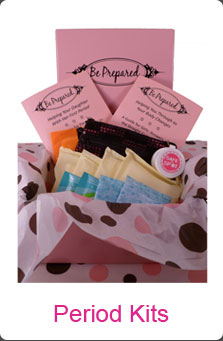
ImageI have a good friend who made a menstrual kit for his daughter to start keeping in her book bag around age 11.  In a zip lock bag he placed a change of underwear, menstrual pads, Tylenol, a change of shorts, and bathroom wipes. That way, if her first period was at school, she had everything she needed and wouldn’t need to ask for support unless she wanted to. I personally think this is a wonderful idea and wish my mom had thought of it when I was middle school!  This idea has caught on because you can buy premade kits. Also, they make underwear that help keep menstrual pads in place.

I have heard that some families also preemptively use pain relief to support with discomfort and PMS.  Not all girls associate the physical discomfort with their period or are able to communicate “I feel bloated” or “I have cramps.” Although these are phrases that you can teach and prompt, some families just start using an over the counter painkiller two or three days before they anticipate the start of the period.  This isn’t foolproof because, especially when girls first start getting their period, they may have irregular cycles.


Teaching Videos

There are many videos out there that are excellent for instruction and also for expanding your personal understanding of sexuality topics.  I have a few on my resource list but wanted review a couple that are available.  Click on the link to be taken to the page where it can be purchased.  I’ve included previews and prices (you can get the videos cheaper for personal use- these are the instructional prices).

Is Love Enough? Is a documentary about parenting with disabilities.  It’s $195.00

Monica and David is a documentary about a couple with Down Syndrome. $200 (but sometimes is on sale for $100).

The Kiss is a 52 second video featuring two actors with Down Syndrome.  It is short and poignant.

Bumblebees is a short video made by an individual with autism following his first date.

Bumblebees from Jenna Kanell on Vimeo.

Despite being told as a child he would never speak or walk, Vance accomplished what doctors thought was impossible. But now he has a new challenge: dating.

Made for the 48 Hour Disability Film Challenge.

Prerequisites:
Genre – Romantic Comedy
Setting – Living room / park
Elements – Comb / balloon
Theme – A reunion

When I see “Sexuality and the Arts” on the SIECUS topics list, I admit, I can get a little overwhelmed with trying to explore this topic in a way that is relevant to individuals with intellectual and developmental disabilities.  But I think the Sprout Movie festival is a great place to start.  Here is one of their Poetic Shorts, “How do I know?”

Sex Ed in the News

ABC just did an article about teaching human sexuality to students with intellectual disability.  They focus on a New York school that has incorporated teaching sexuality into their mission.  One of my favorite lines from the article is that “Sex ed is not a goal, but a process.”  They mention in the article that New York City schools mandate sexuality education and I just wanted to comment on this, based on my experience in Illinois.

Although there is not specific information that addresses the willingness of school administrations to offer comprehensive sexuality education to individuals with ASD, there is information available for offering this type of education in general.  As part of the Affordable Health Care Act federal funding was opened up for comprehensive sexuality education called PREP- Personal Responsibility Education Program as well as Title V- abstinence only education meaning that states get to choose the type of sexuality education offered and may offer both (SIECUS, n.d.).  For fiscal year 2010, 43 states applied for PREP funding which means their sexuality education must cover abstinence, contraception use, healthy relationships, adolescent development, finical responsibility, educational and career success, and healthy life.  Until PREP funding was aproved funding was only available for Title V abstinence only education.

Even if comprehensive sexuality education is being offered in the schools, that does not mean it is being offered to individuals with disabilities.  Under the Individuals with Disabilities Education Act, students with Individual Education Plans have access to adapted general education curriculum.  At this point, my understanding is that, in Illinois this means a student can participate in a general education sexuality class room unsupported, with an aide, or opt out.  If the student (or more accurately, the student’s guardian), opts out, then the child’s special educator is required to adapt the curriculum with parental permission.  There are no standards for what that adaptation must cover.  Teachers may be working with professionally developed curriculum for individuals with disabilities, independently adapting a general education curriculum, or may be creating their own curriculum from scratch.  Due to the diverse needs and strengths among individuals with students with disabilities there may be great variability in how long it takes to cover various topics, to what depth topics can be covered, and what further adaptations may be needed.

Autism Now- A Resource

Autism Now isn’t specifically focused on topics related to sexuality but they do have some great resources I thought I could highlight.

They have a series of webinars related to sexuality topics. If you click on the link you’ll be taken to a registration box that you have to fill out to view the material.  I’ve also included links to the slides- this is a direct link, you don’t need to register.

Slides:  “Sex is when people use their bodies together to share love and pleasure.”

Slides: “Research says that the IQ has to be below 50 before you can say IQ and parenting skill are connected (Feldman& Tymchuk, 2002).”

And they just had one on May 15th, but you’ll have to keep an eye on the archive list because it’s not up yet-  “Let’s Talk About Sex: Discussing the Topics of Sex, Protection, and/or Sexuality from Three Unique Viewpoints”

In addition to the webinars they have some general “fact sheet” style info that might be helpful on topics such as dating, marriage, divorce, relationships, sexuality, parenting, and friendships.  These include general information as well as parent tips.

I was really impressed by the quality and quantity of ASD related resources on a variety of topics so it’s a good one to have in your tool belt.

I just wanted to link to one other power point presentation that I thought had a lot of good information.  “Sexuality & Sexuality Instruction with Learners with Autism Spectrum Disorders and Other Developmental Disabilities” by Peter F. Gerhardt, Ed.D., Director The McCarton Upper School

Gender Identity and Disability

During the workshop we talk a little bit about gender identity and gender fluidity but I thought it might make sense to talk about this topic more in depth.  Parks, Hall, and Taylor* looked at gender dysphoria (discontent with with biological sex) with individuals with cognitive disabilities and suggest “Developing a gender dysphoria or wanting to cross-dress usually has ramifications for the person’s family and social network, perhaps more so with people with intellectual disability, who may be more dependent on family and paid caregivers and have less choice about who is in their network. They may experience more hostility and gain less appropriate support from their network.”  But there is still very little information about how common it is, why for some individuals gender is more fluid (have a wide flexible range of gender expression), and how best to support individuals with disabilities with issues related to gender.   This topic also raises issues related to guardianship and self determination.  Some individuals start going on puberty suppressants and hormone replacement starting in adolescence so their bodies can match the gender they express and the gender they identify with.  For people with disabilities, who gets to make that choice?

Could having a developmental disability lead to difficulties with gender identity?

This is a little difficult to answer.  There are very few studies ask this question.  In Holland they looked at co-morbidity of ASD and gender disorders * and did find more individuals with ASD coming to their clinic then you would expect.  However individuals with ASD may be tapped into to services which might account for this difference.  When individuals with disabilities seek support they may be unable to give an accurate history and professionals in this area may be unfamiliar with working with people with disabilities which could lead to false impressions.

Given how little is known, where can I go for more information?

There are new clinical guidelines that address how clinicians should assess and support individuals with autism and persistent gender dysphoria. The new clinical guidelines (there haven’t been any in the past) affirm the right of individuals with autism to obtain gender realignment. It also affirms that many individuals with autism experience gender outside the male-female binary. Check out a reader friendly overview of the guidelines on Spectrum News.

Gender Spectrum is a great place to start looking for more information.  This is a website that can link families with medical, mental health, social, and legal services.  The have great definitions of all the different terminology and a great overview of gender development.

Here is also a This American Life podcast that features interviews with two little girls who were born as biological males and their families.  For me, it was really eye opening and helped me connect this topic to real people.

On May 19th the Washington Post published an article on this topic (which I thought was really well done) featuring a little boy named Tyler.  The story had almost 2,500 comments 5 days later.  They published a follow up article about the response on May 21st, “I heard from transgendered senior citizens who lamented their decades living a lie.  I got e-mails from confused parents who had their aha moment when they read Tyler’s story.  And sure, I heard from the haters”.  This article not only has nice information but also speaks to the relevance and controversy surrounding this topic.

*This links to the abstract of the article.  Unfortunately, the full text of the article is not available for free online.

Implementing Sexuality Education

When you think about implementing sexuality education, it is important to think of what your agency is already doing because it is often easier to build on something than to start from scratch.

I’m going to present a model for one approach for implementing sexuality education at the agency level.  This isn’t the only way to do this, but rather a suggestion of one path that I have found to be successful. Your agency may already have completed some phases or find some phases to be unnecessary.

Phase I: Start a committee- bring together a few people who are interested in topics of human sexuality and willing to do some of this work.

Phase II: Draft a sexuality policy- this will serve as a foundation the committee’s path.

Phase III: Invest in curriculum and teaching materials-  you don’t need much to start out with, but I think it’s helpful to have something and you can always add later.  Having said that, I’ve never come across anything that didn’t need some adaptation.

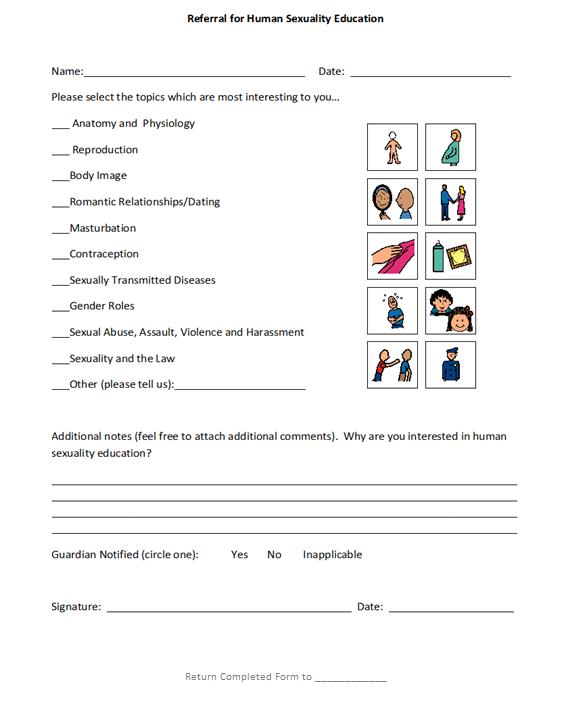
Phase IV: Start thinking about who you want to target and how- do you want to do small groups or individual education?  Who is going actually implement the education and what support do they need (training, regular meetings to process how it’s going)?  What will your process be for getting individuals receiving services involved?  (I’ve attached a sample Referral Form).

Phase V: Start Implementing!

Phase VI: Expand and Revise- self advocates, expanding curriculum, increasing training for all employees…there’s so many interesting and fun places you can go.

You may be saying to yourself, “this is great, but I’m not really in a position to implement agency wide change where I work”.  Here are some questions to ask yourself in regards to what you can do at a personal level.

  • Where could I fit in with what my agency is already doing?
  • How can I reinforce and incorporate human sexuality concepts into my everyday interactions?
  • How can I incorporate human sexuality concepts into programing?
  • What can I do to advocate for human sexuality education?

Are Individuals with ASD at an Increased Risk of Sexual Abuse?

It is difficult to determine the exact risk of sexual abuse for individuals with ASD (it’s hard to get a good report of sexual abuse among the general population).  The first national survey reports victimization rates of 27% for women and 16% of men among the general population (Finkelhor et al., 1990). A study has shown that children with disabilities are 1.7 times more likely to experience sexual abuse however all children with disabilities were examined, not just individuals with ASD (Crosse, Kaye & Ratnofsky, 1993). Individuals who are caregiver dependent may be at the highest risk because family members, family acquaintances, and paid caregivers are the most likely to commit sexual abuse (Mansell et al., 1996). Difficulties communicating, lack of knowledge of sexual norms and activities, and isolation may contribute to increased risk of sexual abuse among individuals with ASD. Sexuality education may provide opportunities to for individuals to be better able to communicate and better understand social norms and activities. Furthermore if the support systems of individuals with ASD are in openly talking about sexuality it may create a climate where this abuse is less likely to happen.  The Department of Human Services in Illinois has started a project to end sexual violence against women with disabilities.  I’ve gotten to meet several people working on the project and they are very knowledgeable and dedicated.  I hope they succeed!

Supporting People with Disabilities with BEING Sexuality Educators

What does supporting people with disabilities with BEING sexuality educators?

It’s all about self-advocacy!

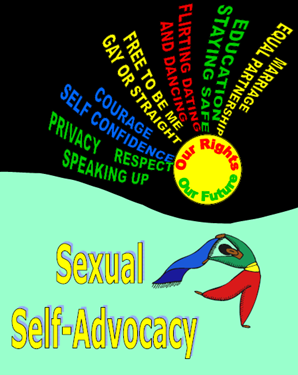
According to SDC (UIC’s Institute on Disability and Human Development and their Sexuality and Disability Consortium (SDC), “Sexual Self-Advocacy means: People with disabilities taking control of their own sexuality by making their own decisions and speaking up for themselves and others about sexuality.”

As sexuality educators, individuals with disabilities can be…

  • Safe people for their friends to talk to
  • Knowledgeable sources of information
  • Leaders and co-leaders in educational sessions
  • Models of healthy sexual relationships
  • Advocates for raising awareness about sexuality topics
  • Fill in the blank ____________

This is a great webinar to learn more about how to advance sexual self-advocacy for people with disabilities.

Another great resource for learning more about sexual self-advocacy is  The Green Mountain Self-Advocates.  They have developed materials for self-advocates interested in teach human sexuality (as well as many other topics).

SDC recommends the Developmental Disabilities and Sexuality Curriculum which has a self-advocacy component built in.

Teaching About Joking

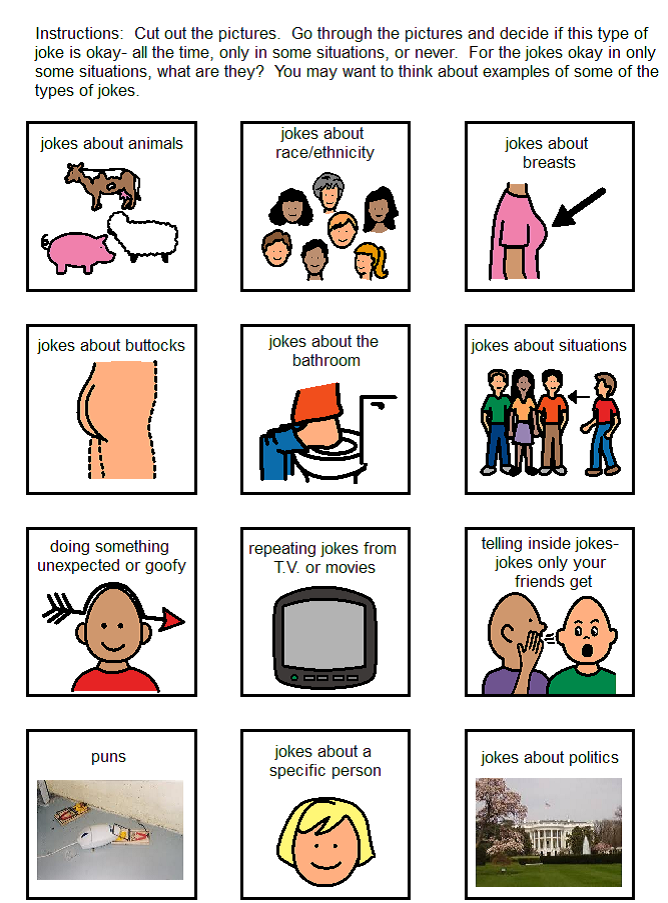
Here is an activity you may want to try out for teaching about joking in context.  Joking is really difficult because it’s very nuanced.  It can be a great way to connect with people but also hurtful.  I also think it is difficult because of the educational context- jokes that aren’t appropriate at school, work, etc. It might be okay in some places but it feels weird saying- “yeah, it’s okay to tell fart jokes with your friends.”  It really easy to cross over from actual social skills to formal social skills.  

Hierarchy: Masturbation Training by Lisa Mitchell

Below is a “Hierarchy: Masturbation Training” by Lisa Mitchell, LCSW-R at Penn State.  Her plan for what she calls, “private touching”, was specifically developed for individuals with Autism Spectrum Disorders, but I think it is a good general framework.  The hierarchy goes from lowest level of support to highest level of support.  Across the board, masturbation is a topic people want more information about.  I think this is a nice way to think about what kind of education or training is available as well as what you might want to try before moving on to something more intensive.  I have also included a link to her entire powerpoint.  She covers other topics/tips you may find interesting (relationship checklist, key concepts for topic areas, teaching techniques, problem behaviors).

  1. When appropriate, work with families and/or residence to establish a visual “private time schedule.”
  2. When appropriate, supply individual with lubricant, explaining that it is for use during “private time.”
  3. Meet with individual. Present illustrations of same sex persons masturbating, in conjunction with verbal explanation regarding technique.
  4. Meet with individual. Use illustrations and anatomical model in conjunction with verbal explanation of technique.
  5. Meet with individual. Use anatomically correct dolls to demonstrate appropriate masturbatory technique, in conjunction with verbal explanation.
  6. When appropriate, supply masturbatory aids such as body pillows, magazines, collages of stimulating pictures, vibrating pillows, masturbation sleeves, masturbation pumps, or vibrators. Explain safe usage of such aids.
  7. Meet with individual. Arrange for multiple viewings (when necessary) of instructional masturbation movies “Handmade Love” for males, or “Fingertips” for females. Viewings should occur in the individual’s bedroom or the private location where masturbation will be allowed to occur. Trainer may need to supply a verbal explanation while simultaneously viewing the tape to reinforce principles. (I would have the person watch on their own before feeling the need to view with another present. In general I think the videos are very good but very explicit. You could use the video in place of the verbal instructions indicated in the hierarchy).
  8. For individuals with more significant challenges, consider use of ABA type
    approach (preferably done with relatively unfamiliar trainer) to teach more
    successful masturbatory technique. Shape up steps one at a time (e.g. “Pull pants
    and underwear down”, “Lay on belly”, “Put pillow between legs”, “Rock from side to
    side”. Or “Pull pants down”, “Sit on bed”. “Put fingers around penis”, “Rub up and
    down, up and down.”) – I have heard of this method, but I do not know anyone personally who has ever instructed on masturbation at this level.  I would want to have a very comprehensive plan on how this would be implemented, full team support, and special attention paid to protecting the individual being instructed and the person doing the instruction.  

Free Curriculum- Parent Version, Teacher Version, Spanish Version

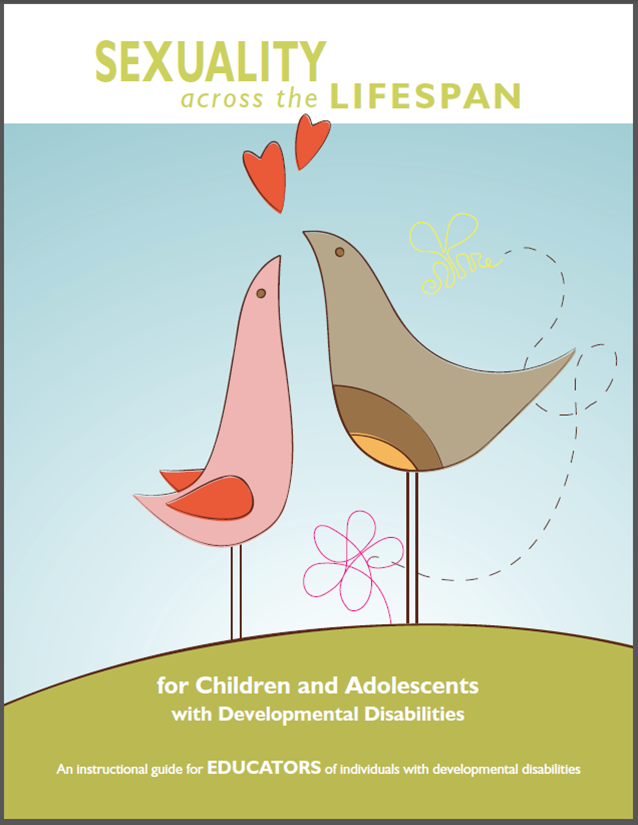
ImageI’m really excited about this free curriculum, “Sexuality Across the Lifespan” by: DiAnn L. Baxley and Anna L. Zendell.  It has versions for educators, teachers, and Spanish speakers.  You can view the curriculum by clicking on the links below.

What makes this special?  They do a nice job at adjusting lessons for different age groups, giving ideas for supplemental activities, and giving ideas for incorporating the topics into routines.  The parent version really focuses on how to reinforce healthy sexual development through interactions and daily routines.

This curriculum in not comprehensive but does have sections on social skills, dating, sexual abuse, puberty, and anatomy.  I hope you find this useful!

Let’s Talk About Ability and Sexuality

http://vimeo.com/17317232

This video was filmed at the Healthy Relationships and Sexuality Conference in California 2010. What’s special about this conference is that it was organized by people with disabilities (and their allies) for people with disabilities.

I’ve highlighted some of my favorite quotes from the video. My main point in posting it, is not so much that you watch it and learn a bunch of facts, but rather use as an example of a teaching tool. Creating a video like this is a wonderful learning experience and helps give purpose and permanence to the expression of ideas.

“Sexuality needs to be part of the service planning process” – “It’s not the people with disabilities who are uncomfortable but the staff who are helping support them” – ” “The definition of support needs to change as the person changes” – “A person with a disability can always find love” – “Disability does not define me. The way I think about other people and the way I treat other people: that’s what defines me” – “Maybe people will eventually become more open to us” – “If you get asked a frank question, give a frank answer”

Teaching Strategies- Autism Internet Modules

Many of the teaching strategies that you use when teaching human sexuality you also use in many other contexts.  Autism Internet Modules can help you learn teaching strategies like the ones listed below (currently they have 37 modules and they are always adding more).  The modules give a really complete overview (they can be a little boring but overall they are very helpful).  Some these may be a review but others may be something you have heard of but aren’t quite sure what it really is.  What’s especially nice is often the expert who developed the technique is the one teaching the module.  Just a little warning- you do have to set up a log in.  Many of these interventions have been specifically developed for people with Autism Spectrum Disorders- but not all of them!

Antecedent-Based Interventions (ABI) – Differential Reinforcement – Extinction – Functional Communication Training – Language and Communication – Naturalistic Intervention – Overview of Social Skills Functioning and Programming – Parent-Implemented Intervention – Peer-Mediated Instruction and Intervention (PMII) – Picture Exchange Communication System (PECS) – Pivotal Response Training (PRT) – Preparing Individuals for Employment – Prompting – Reinforcement – Repetitive Patterns of Behavior, Interests, and Activities – Response Interruption/Redirection – Rules and Routines – Self-Management – Social Narratives – Social Skills Groups – Social Supports for Transition-Aged Individuals – The Incredible 5-Point Scale – Visual Supports

For those of you who attended the workshop, in the workbook starting on page 34 there is a table with examples of strategies.  Some of the strategies come from Autism Internet Modules.

Introduction to Sexuality Education for Individuals Who Are Deaf-Blind and Significantly Developmentally Delayed

I found this great (free) book online.  Although it targets parents, caregivers, and professionals who work with individuals who are deaf-blind and significantly developmentally delayed- you may find useful info even if this not your target population.  Kate Moss & Robbie Blaha’s overall approach to education considers four basic tools for instruction: routines, units, teachable moments, and behavior plans.  Chapters include …

Chapter 1 – Introduction
Chapter 2 – Sexuality Education
Chapter 3 – Developing an Instruction Plan
Chapter 4 – Modesty
Chapter 5 – Appropriate Touch and Personal Boundaries
Chapter 6 – Menstruation
Chapter 7 – Masturbation
Chapter 8 – Sexual Health Care
Chapter 9 – Sexual Abuse

I just want to highlight a couple of things I found particularly useful.  They provide instructions for developing a sexual education policy and provide a model policy as well as sample permission forms.  I also thought that their plan for supporting with menstruation was well thought out and useful.

There’s also the Texas School for the Blind and Visually-Impaired’s website, which offers some strategies for supporting and educating visually impaired individuals about many topics such as gender roles, social skills, personal safety, gender identity, sexual language, masturbation, and reproductive anatomy.

Sexuality and Intellectual/Developmental Disability Community Forum

I just wanted to share this upcoming event with you (Friday, April 13th from 12:00-3:30).  It looks really interesting.  The Sexuality and Disability Consortium (SDC) at the University of Illinois at Chicago is hosting a roundtable discussion and a presentation by Linda Sandman, MSW, LCSW, Clinical Director of the Developmental Disabilities Family Clinics on…

Successes and Challenges:Sexuality Education with People with Intellectual/Developmental Disabilities.

After the main discussion you can choose to attend one of several roundtable discussions on the following topics • Sexual self-advocacy • How to talk to families about sexuality • Why is sexuality education important in my agency • Sharing sexuality education resources

The cost is only $10 and self advocates are welcome.

If you can’t make, don’t worry.  I’ll post an update on what I learn.