Implementing Sexuality Education

When you think about implementing sexuality education, it is important to think of what your agency is already doing because it is often easier to build on something than to start from scratch.

I’m going to present a model for one approach for implementing sexuality education at the agency level.  This isn’t the only way to do this, but rather a suggestion of one path that I have found to be successful. Your agency may already have completed some phases or find some phases to be unnecessary.

Phase I: Start a committee- bring together a few people who are interested in topics of human sexuality and willing to do some of this work.

Phase II: Draft a sexuality policy- this will serve as a foundation the committee’s path.

Phase III: Invest in curriculum and teaching materials-  you don’t need much to start out with, but I think it’s helpful to have something and you can always add later.  Having said that, I’ve never come across anything that didn’t need some adaptation.

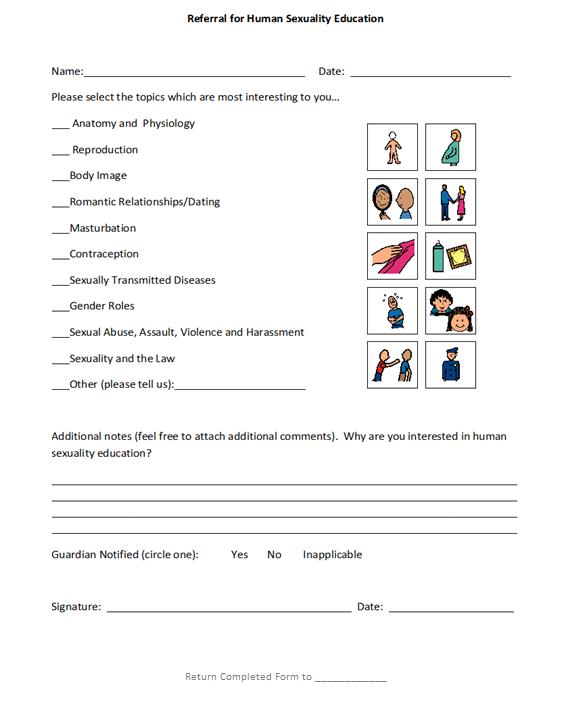
Phase IV: Start thinking about who you want to target and how- do you want to do small groups or individual education?  Who is going actually implement the education and what support do they need (training, regular meetings to process how it’s going)?  What will your process be for getting individuals receiving services involved?  (I’ve attached a sample Referral Form).

Phase V: Start Implementing!

Phase VI: Expand and Revise- self advocates, expanding curriculum, increasing training for all employees…there’s so many interesting and fun places you can go.

You may be saying to yourself, “this is great, but I’m not really in a position to implement agency wide change where I work”.  Here are some questions to ask yourself in regards to what you can do at a personal level.

  • Where could I fit in with what my agency is already doing?
  • How can I reinforce and incorporate human sexuality concepts into my everyday interactions?
  • How can I incorporate human sexuality concepts into programing?
  • What can I do to advocate for human sexuality education?
Teaching Strategies- Autism Internet Modules

Many of the teaching strategies that you use when teaching human sexuality you also use in many other contexts.  Autism Internet Modules can help you learn teaching strategies like the ones listed below (currently they have 37 modules and they are always adding more).  The modules give a really complete overview (they can be a little boring but overall they are very helpful).  Some these may be a review but others may be something you have heard of but aren’t quite sure what it really is.  What’s especially nice is often the expert who developed the technique is the one teaching the module.  Just a little warning- you do have to set up a log in.  Many of these interventions have been specifically developed for people with Autism Spectrum Disorders- but not all of them!

Antecedent-Based Interventions (ABI) – Differential Reinforcement – Extinction – Functional Communication Training – Language and Communication – Naturalistic Intervention – Overview of Social Skills Functioning and Programming – Parent-Implemented Intervention – Peer-Mediated Instruction and Intervention (PMII) – Picture Exchange Communication System (PECS) – Pivotal Response Training (PRT) – Preparing Individuals for Employment – Prompting – Reinforcement – Repetitive Patterns of Behavior, Interests, and Activities – Response Interruption/Redirection – Rules and Routines – Self-Management – Social Narratives – Social Skills Groups – Social Supports for Transition-Aged Individuals – The Incredible 5-Point Scale – Visual Supports

For those of you who attended the workshop, in the workbook starting on page 34 there is a table with examples of strategies.  Some of the strategies come from Autism Internet Modules.

Sexuality and Intellectual/Developmental Disability Community Forum

I just wanted to share this upcoming event with you (Friday, April 13th from 12:00-3:30).  It looks really interesting.  The Sexuality and Disability Consortium (SDC) at the University of Illinois at Chicago is hosting a roundtable discussion and a presentation by Linda Sandman, MSW, LCSW, Clinical Director of the Developmental Disabilities Family Clinics on…

Successes and Challenges:Sexuality Education with People with Intellectual/Developmental Disabilities.

After the main discussion you can choose to attend one of several roundtable discussions on the following topics • Sexual self-advocacy • How to talk to families about sexuality • Why is sexuality education important in my agency • Sharing sexuality education resources

The cost is only $10 and self advocates are welcome.

If you can’t make, don’t worry.  I’ll post an update on what I learn.