How to Guide on Flirting Online

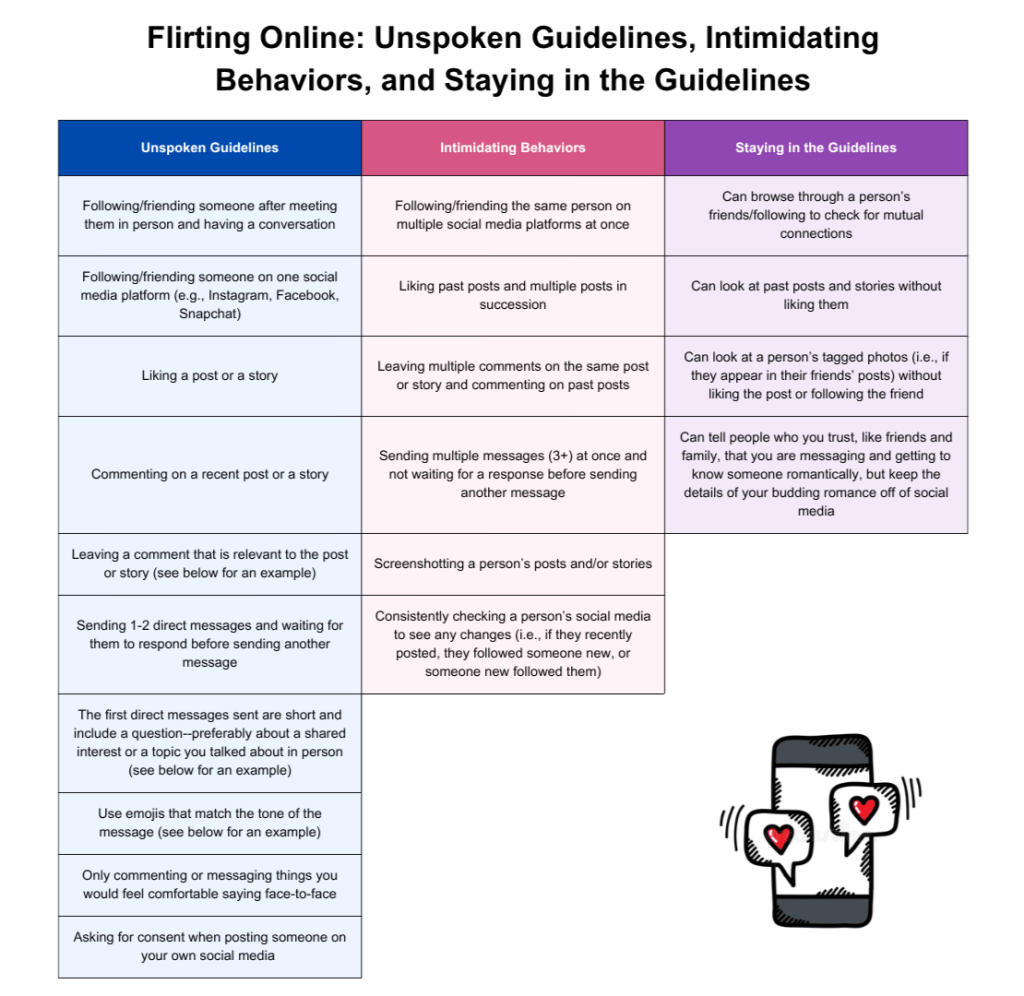
Social media can be difficult to navigate as there are unknown “rules” and behaviors that are widely followed when first interacting with others, especially those you are interested in romantically. This aid demonstrates several unspoken guidelines, intimidating behaviors, and tips on staying within the guidelines on social media when trying to flirt. It is worth mentioning that this is not a comprehensive list of all guidelines and intimidating behaviors, but rather a guide to help you talk to your crush online in a fun, respectful way that keeps everyone comfortable. As a 21-year-old who has been online from a young age, some of these guidelines are based on my own experiences and knowledge.

Table of unspoken guidelines, intimidating behaviors, and tips on staying in the guidelines. From top going down, unspoken guidelines: following/friending someone after them meeting in person, following/friending someone on one social media platform, liking a post/story, commenting on recent post/story, leaving relevant comments on posts/stories, sending 1-2 direct messages and waiting for a response before sending another message, the first direct messages are short and include a question, use emojis that match message tone, only commenting/messaging things you can say face-to-face, and ask for consent when posting someone. From top going down, intimidating behaviors: following/friending someone on multiple social media platforms at once, liking past posts and multiple posts in succession, leaving multiple comments and commenting on past posts, sending multiple messages at once and not waiting for a response before sending another message, screenshotting posts and stories, and consistently checking a person's social media for any changes. From top going down, staying in the guidelines: can browse through a person's friends/following, can look at past posts and stories without liking them, can look at a person's tagged photos without liking the post or following the friend, and can tell people who you trust, like friends and family, that you are getting to know someone, but keeping the details of your budding romance off of social media.

Example of a relevant comment: Someone posts a photo of them graduating school and you comment, “Congratulations!”

Example of a direct message: You talked to someone last week about a book series and sent this message: “Hi! It’s [your name], we talked last week about [book series]. I started reading it and really liked it. Do you have any other recommendations?”

Examples of using emojis: (1) You are messaging your crush about a movie that you both recently watched and talking about a scene that left you in disbelief: “I can’t believe that happened 😭 I was not expecting it at all!” (2) You made plans to hang out with your crush in person and sent this message: “I’m excited to hang out on Saturday 😊 See you then!”

Teen Vogue has a list of questions to keep the conversation going with your crush, whether you’re looking for something low-pressure, flirty, deep, random, interesting, or just plain fun.

The Napoleon Cat Blog gives some tips for commenting on someone’s post, showing different examples for different post scenarios. Some of them are intended for friends, but can still be used for your crush’s posts. Their 35 Short Comments for Instagram section is best used when you first start commenting, as they are simple, not intimidating, and friendly.

Teaching Consent

Dr. Curtiss was invited to the Center of Disability Studies at the University of Delaware to present on Sexual Consent and Disability. Participants learned what sexual consent is from a sexual health perspective and a legal perspective. They also learned important considerations when teaching consent and how teaching consent promotes sexual safety.

When Dr. Curtiss talks about teaching sexual consent she discussed four main skills: Saying No, Recognizing No, Respecting No, and Saying Yes. To say No, you need to be able to say NO with different levels of intensity, to have multiple strategies for saying NO, a be able to say NO in a variety of contexts including online. To be able to recognize No, you need to be able to recognize verbal, non-vebal, and contextual NO as well as NO by omission. To be able to respect NO you need to have self-regulation skills to manage emotional reaction to hearing NO. To be able to say YES, you need to understand what feel comfortable.

Sexual Safety Series Resource Flyers

These resource flyers range from sex education to online safety. Some of the resources are Delaware specific but email us if you’d like one updated for your area. You can download PDFs here:

Sexuality Resources for Parents

Raising an individual with a disability presents a different set of obstacles then an abled individual may, but one topic that all parents must address is sexuality. Individuals with disabilities are sexual beings and therefore deserve an education on sexuality. While parents may acknowledge this need, finding resources and strategies to present the information may be more difficult if you are raising an individual who requires a different method of learning.

The Sexuality Resource Center for Parents provides a well rounded variety of information pertaining to sexuality. The website includes a section of information labeled “for all parents” that contains subjects they believe are useful for all children. In addition, they provide sections titles “For parents of children of typical development”, “For parents of children with developmental disabilities”, and “For parents of children with physical disabilities”. In each section, you can find a variety of information such as basics, specifics, activities, and additional resources. They also include tip guides!

The Sexuality Resource Center for Parents works to provide a better, comprehensive information base for parents to use when addressing sexuality to their child. The variety of knowledge is extremely useful when trying to find information to meet your child’s specific needs. In their own words, their mission statement claims “It’s time to acknowledge that children with developmental disabilities will become adults with sexual feelings, and as such, we must provide them with the information and skills they’ll need to become sexually healthy adults.

http://www.srcp.org/index.html

Learning from Temple Grandin

I had the honor of presenting at the Champaign-Urbana Autism Conference where Temple Grandin was the key note speaker. So much of her message could be applied to human sexuality instruction.

  • Don’t yell “no!” Calmly tell people what they should be doing. (Dr. Grandin was talking about putting her finger in her water cup at the dinner table, but the same rule applies to masturbation).
  • Give lots and lots of examples of what falls within a category and it will eventually build up the concept you are working on. (Dr. Grandin was talking about understanding church steeples but the same strategy can be used to understand body parts).
  • Once you have a concept down use that concept to expand. (Dr. Grandin was talking about airplanes, but the same principle applies to privacy – one you get private body parts down you can use the concept of privacy to understand places and ideas).
  • And from Eustacia Cutler (Dr. Grandin’s mother), “The more we understand how autism [and sexuality] works the less anxious we become.” And sexuality added.

I focused on goals for sexuality instruction across the lifespan (exploring, understanding boundaries, coping with changes, and living your story) as well as modalities for instruction (socialization, formal lessons, behavior planning, and advocacy).  You can find my presentation here.


Signs of Flirting

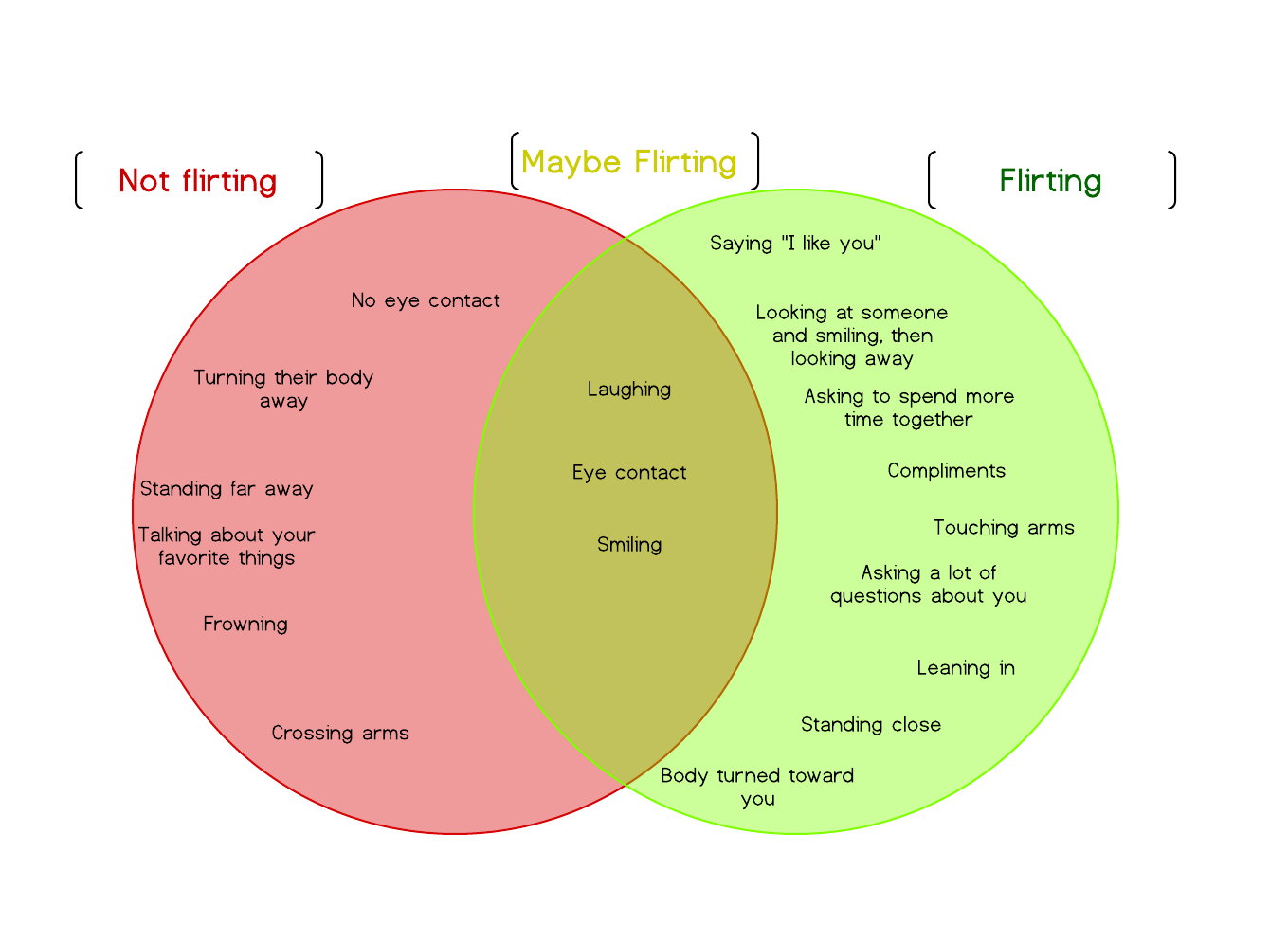
Flirting can be a difficult subject to talk about because it always varies. This aid has some typical behaviors that are flirting, maybe flirting, and not flirting. It’s important to note that this is not a exhaustive list and that some of these behaviors are not guarantees of flirty or not flirty behavior, but it is a great place to start the conversation.  This activity can be used to steer a conversation about how and when flirting occurs, and the fluidity of these behaviors.

Download the signs of Flirting activity here.

Social Signals- Curriculum

Social Signals ($159.oo) is a series of  videos and curriculum are designed to teach adolescent students with autism and intellectual disability about safe relationship skills.  There is also a parent curriculum for $23.99.  They have a sample video and lesson available for free so you can preview before you purchase.  I liked the video.  I like to teach about expected and unexpected behaviors and I think these videos could be a good tool.  There are also sample lessons that accompany the videos.

Relationship Pyramid

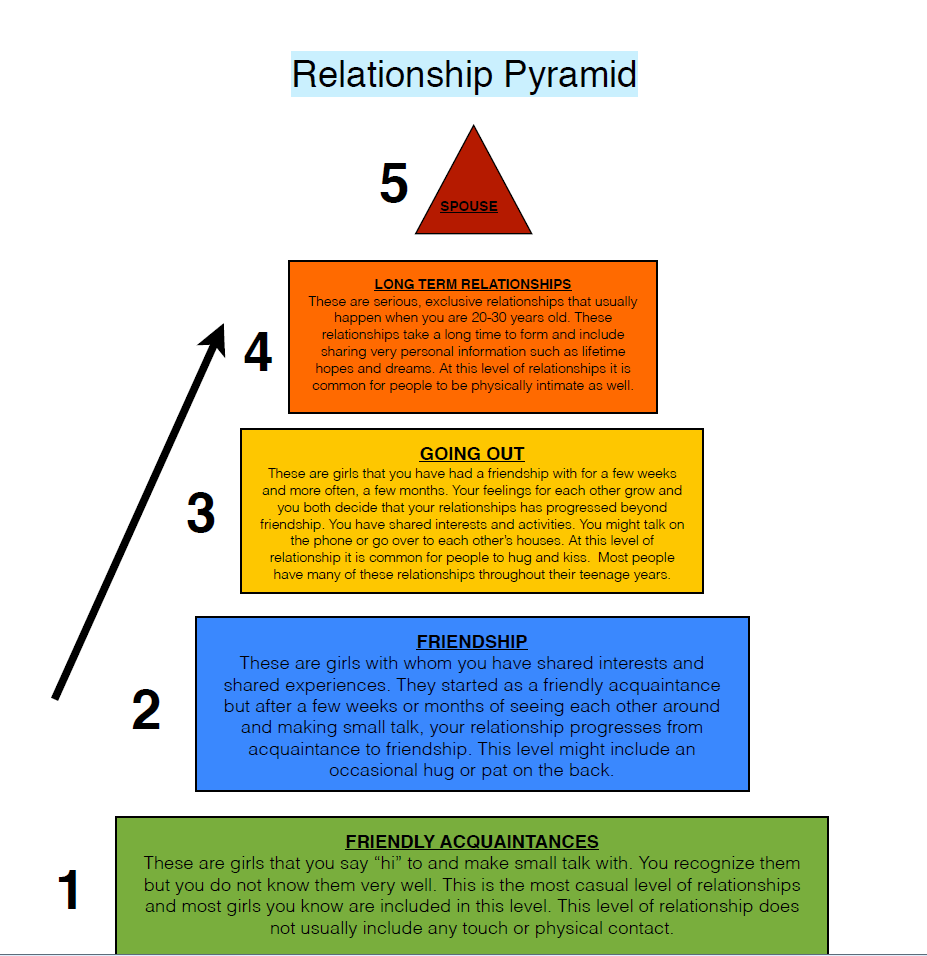
Here is an example of a five point scale that was developed by April Keaton, LCSW, to explain the different levels of relationships.  The pyramid shape was used to convey that you might have a lot of “friendly acquaintances” but much fewer “long term relationships”.  It was important for this person to connect the level of the relationship with the level of intimacy so you see examples of intimate behaviors at each level of the pyramid.  There’s also an element of time built into the descriptions.     You wouldn’t have to start with pyramid filled out.  You could start with a blank pyramid and support an individual with filling in the levels.  You could add names of individuals at each level.  You can download the pdf of this image by clicking here.

The Circles of Sexuality

No, these aren’t the circles we usually talk about related to levels of intimacy and based on the Circles curriculum.  These circles developed by Dr. Dennis Dailey, focus on Sensuality, Sexualization, Intimacy, Sexual Identity, and Sexual Health.  I think these might make a good framework for a 5 module course or could be used to introduce the concept of sexuality.  Click here for a full explanation of The Circles of Sexuality

Teaching About Joking

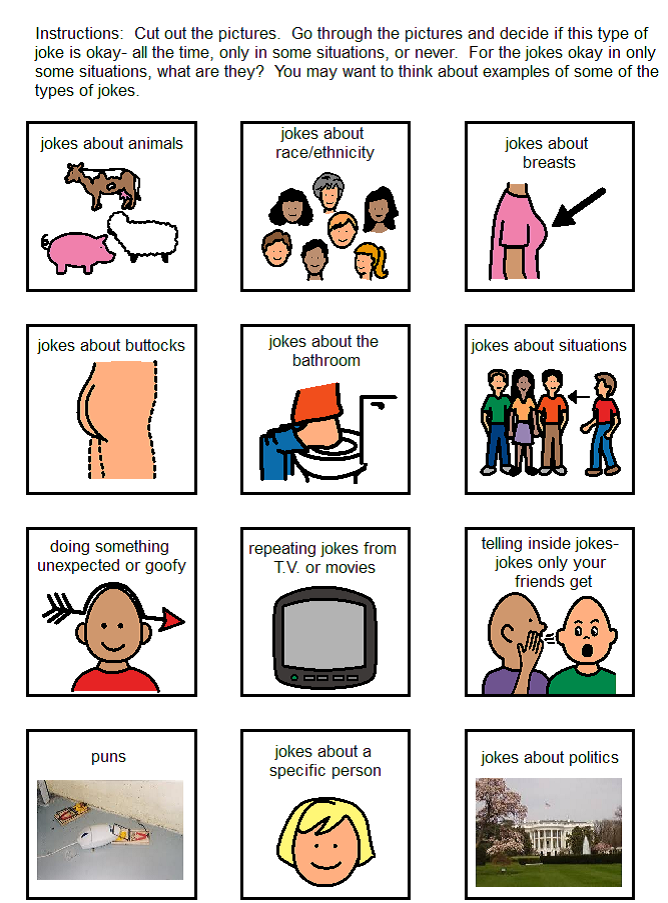
Here is an activity you may want to try out for teaching about joking in context.  Joking is really difficult because it’s very nuanced.  It can be a great way to connect with people but also hurtful.  I also think it is difficult because of the educational context- jokes that aren’t appropriate at school, work, etc. It might be okay in some places but it feels weird saying- “yeah, it’s okay to tell fart jokes with your friends.”  It really easy to cross over from actual social skills to formal social skills.  

10 Easy Things You Can Do that Promote Privacy and Positive Relationships

Although this list can be used with any population, it is geared towards individuals who need a considerable amount of support. Many of these are probably things you already do!

1.  Prompt clients/consumers/students to greet one another.

I’m always surprised to realize that some people don’t know the names of the other people they spend time with each day.  A simple greeting is a wonderful, simple, social script that you have natural opportunities to practice each day.

2.  Ask permission or notify an individual before touching their person or their wheel chair.

This reinforces that an individual has control and autonomy over his or her own body.  It’s important for people to feel in control of their body so that they feel safe and also so they can keep others’ safe.  It also communicates that a person’s body is something that needs to be treated with respect.

3.  Keep all aspects of a personal care (toileting) routine private.

This means that you don’t follow behind someone with a Depends (or other personal care item)- use a bag.  It also means you don’t announce taking someone to the restroom to the group (say it quietly so only the person you are speaking to can hear).

4.  Do not speak negatively about clients/consumers/students in front of others – including saying they are having  behaviors.

People are very perceptive about when others are speaking negatively about them. When you say so and so is having behaviors it makes the situation very public, embarrasses the individual, and gives positive reinforcement (in the form of attention) to the behavior.  If for your safety you need to communicate this, use a code (In Champaign we would say “did you see the Illini’s defense last night?” which meant we are having a potentially dangerous behavior situation please hang out until all clear).

5.  Do not affectionately kiss, cuddle, or pat on the head clients/consumers/students.

In someways this is a no brainer and in other ways it is hard.  I know so many people who are touch deprived and it seems harmless to give someone a hug when you see them but these types of affection have several negative side effects.  1) They send an inappropriate message of how to interact in non-sheltered situations (you can’t hug people you meet on the bus).  2) They communicate that the individual is child-like and a-sexual.  3) They can create a climate where it is difficult to detect sexual predators.

6.  Make home movies.

A flip camera is less than $200 and very easy to use.  Make videos showing people being friendly to one another, answering questions about what is important to them, and daily routines or special events.  People love watching themselves and their friends.  It allows them to tell a story that they may not be able to tell by themselves.

7.  While maintaining appropriate boundaries, talk about emotions (including your own).

All people have complex feelings regardless of their abilities in other areas, but people don’t always have the words to communicate them.  It is appropriate to model emotional expression.  For example, when I go with a group from our day program to deliver food to families, I tell a story about how I feel.  I say, “It makes me a little sad to know that people don’t have any food, but the family was so happy we brought them food.  It makes me feel happy and proud to help someone else.  I like to do it.”  I just talk about it as we’re driving back.  It’s also appropriate to name clients’/students’/consumers’ emotions, “You seem like you might be a little bored” or “You look so proud to have gotten your pay check.” What you are doing with these easy statements is creating an emotionally safe environment.  (Note: this is way different than unloading personal problems on clients/students/consumers).

8.  When referring to intimate body parts, use the correct word.

9.  During lunch/snack/work breaks prompt folks to talk to one another, even if it the same conversation you had yesterday, and preferably incorporate pictures.

Perhaps combine with number 10 🙂

10.  Have a regular discussions about current events.

One of my favorite stories came out of a current event discussion.  It was during the 2008 primaries and I said that Hillary Clinton was running.  The person I was talking to said, “Hillary sounds like a girls name” and I said, “It is.”  He started laughing hysterically, and said, “Sarah don’t tease me, a woman can’t run for president.”  What a great way to start talking about gender!
My Looking Guide

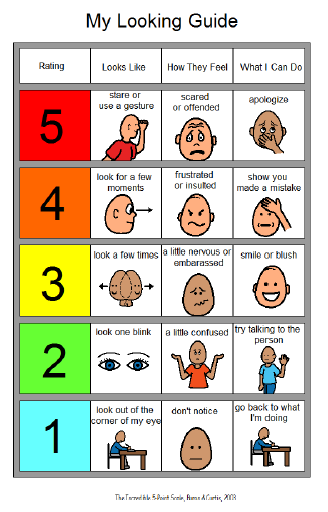
You might have seen this visual aid at the workshop.  Often folks don’t understand why something as simple as looking at someone else may get them into trouble.  This visual support explains how the other person might feel as well as what they can do in various situations.  Click on the link if you would like to view this image as a pdf (feel free to copy and use it for educational purposes).

My looking guide.