Communicating About Sexuality Adaptively

f1mj421_02_1

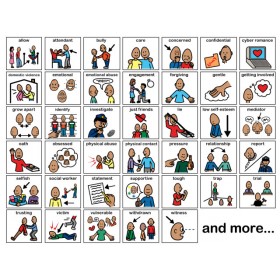
It can be a little overwhelming to start thinking about communicating pictorially about human sexuality topics, but there are some supports available.

Many of you already use Board Maker (computer software that helps make visual supports and PECS).  They have a “Communicating About Sexuality” add on that is very useful and only costs $15.00 (but you have to already have Board Maker).

If you would like some guidelines on how to approach augmentative and alternative communication (AAC) in regards to sexuality Speak Up has resources that you may find useful.  Speak Up is a group dedicated to preventing sexual abuse/victimization among people who use alternative communication.  They have guidelines, suggestions for communication displays, and information about building sexual vocabulary.  This group surveyed individuals who use AAC and found that ACC users say they need:

  • People who recognize that they are sexual
  • Information about sexuality
  • Vocabulary to communicate about sexuality
  • People to communicate with about sexuality
  • Accessible resources and services

Sounds pretty darn reasonable to me.


Human Sexuality and Disability

asdsexed840Individuals with physical, cognitive, or emotional disabilities have a right to education about sexuality, sexual health care, and opportunities for socializing and sexual expression. Healthcare workers and other caregivers must receive comprehensive sexuality education, as well as training in understanding and supporting sexual development, behavior, and related healthcare for individuals with disabilities. The policies and procedures of social agencies and healthcare delivery systems should ensure that services and benefits are provided to all persons without discrimination because of disability.

Human sexuality encompasses the sexual knowledge, beliefs, attitudes, values, and behaviors of individuals. Its various dimensions involve the anatomy, physiology, and biochemistry of the sexual response system; identity, orientation, roles, and personality; and thoughts, feelings, and relationships. Sexuality is influenced by ethical, spiritual, cultural, and moral concerns. All persons are sexual, in the broadest sense of the word.

From Sexuality Information & Education Council of the US, www.siecus.org

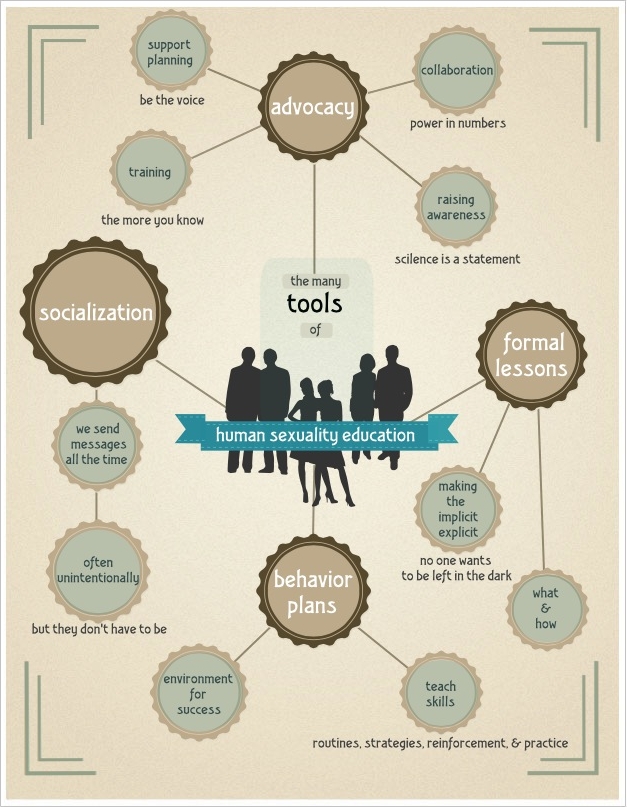
Tools for Teaching Human Sexuality

Teaching human sexuality is about formal lessons, selecting information, and choosing how to teach it, but it’s more than that.  To be a sexuality educator you have to see the whole person and be committed to support that person.  It’s not easy, it won’t be prefect, and you might make mistakes.  But it’s not impossible either and you have lots of tools.

To me, it’s about asking “why not?”.  Why not teach someone about different sexual positions?  Why not incorporate questions about sexual life into annual planning meetings?  Why not teach someone how to ask someone else on a date?  Why not affirm someone when they are expressing their sexuality?  Sometimes there are good answers to these questions but a lot of times there just aren’t.  Being a sexuality educator is about being an advocate.  It’s about giving people information in an engaging way they can digest.  It’s about teaching skills and changing patterns of behavior.  It’s about sending the message that there is nothing fundamentally wrong with who you are.  I really appreciate people taking time to read this blog because I think the work you do is really important.  Thank you!

Image

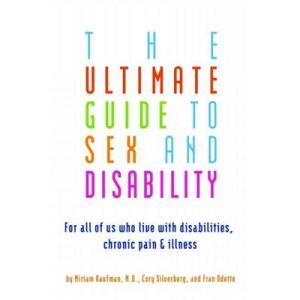
The Ultimate Guide to Sex and Disability

the guideThis book by Miriam Kaufman, Cory Silverberg, and Fran Odette is eye opening.  It’s written by people with disabilities for people with disabilities and focuses on the joys of sexual intimacy.  As a typically developing person, it challenged a lot of my assumptions about sex and made me think about new things.  Chapters include: Myths About Disability and Sex; Desire and Self-Esteem; Sexual Anatomy and Sexual Response; Communication; Sex with Ourselves; Sex with Others; Oral Sex, Penetration and Positioning; Sex Toys, Books, and Videos; Yoga and Tantric Sex; S/M; Sexual Health; Sexual Violence and Sexuality; Resources; and Glossary of Gender and Sex Terms.   I want to share two passages with you.

Sex and Spontaneity

“We’re taught that sex is suppose to be spontaneous, something that just comes naturally (like ‘true love’).  This belief is damaging to everyone, but is a real problem for people living with disabilities, because any amount of planning makes sex not spontaneous.  Believing in this myth pretty much ensures a lously sex life.
While sex has many meanings, at its heart sex is a process of communication.  Whether we are flirting from across a crowded room, giving someone head for the first time, or making love while listening to a piece of music that totally turns us on, being sexual is being in contact with ourselves and our surroundings.  The idea that this process can happen without thinking, talking, or planning is ridiculous.
Maybe we are willing to buy into the myth of sexual spontaneity because talking about our desires is difficult.  It’s risky, and makes us feel exposed and vulnerable, and often vulnerability is equated with weakness.”

This made me think a lot about the way I teach reproduction and sexual intimacy.  I tend to focus a lot sexual behavior, but not as much on the planning and communication that comprises that behavior.  Also, I do a lot of role playing, planning out what you’re going to say in advance, and scripting.  I’ve never really done that around negotiating intimacy.

Privacy

“If we were taught anything about sex at all when we were younger, many of us learned that sex was something private, inappropriate to talk about or do in front of others.  Privacy becomes a requirement for sexuality.
From someone living in an institution, or using attendant services, or needing the assistance of someone else to facilitate communication, privacy is a completely different reality.  The definition of privacy changes when you have no lock on your door, or when you request private time at a specific hours knowing that it will probably be written down in a log-book.  This myth is one of those ‘no-win situations,’ because we’re told that real sex is a private matter and, guess what, you can’t have that kind of privacy.”

This passage really challenged me to think about how I teach privacy and how I teach about relationship types.  I think sometimes I might ignore that what a lot of people think of as privacy and the individual I am working with reality of privacy are two disparate things.

I do wish this book focused a little more on people with intellectual disability and was written at lower reading level.  I do think people with ID/DD could read it with support, especially sections.  Much of the book is testimonies by people with disabilities and I think these passages could be great teaching tools.  There are also suggested exercises- one of the exercises was about looking at your body.  I teach antimony all the time, but I don’t think I’ve ever said, “when you’re at home, alone in your bedroom, look at and feel your body and check out the parts we’ve been talking about, you can even use a mirror.”

Music- A Different Way to Teach Sex Ed

Songs for Your Body is a curriculum comprised of, you guessed it, songs.   They cover hygiene, abuse, masturbation, contraception, sexually transmitted infections, and sexual health.  You can preview the songs on their website- I liked the masturbation songs.  In general, they’re a little hokey but I think it’s a good example of thinking outside the box.  The CD is $15.41 including shipping and handling and comes with a booklet of lyrics and activities.

Facilitated Sex

What is facilitated sex?  This brief video explains what facilitated sexual activity is and some of the considerations.

Dr. Mitchel Tepper is an expert in the area of sexual health, disabilities, and medical conditions with a specific focus on physical disabilities.  His website can connect you with a lot of great information (I especially like his blog).

Some things to keep in mind about facilitated sex…

  • Facilitated sex is a continuum.  Dr. Sarah Earle suggests it might include providing sex education, fostering an environment that allows intimacy, the procurement of sexual goods,  and arranging for paid-for sexual services.
  • Many individuals with disabilities would be unable to participate in many parts of sexual expression without some level of facilitation.
  • It’s not that abuse and victimization aren’t concerns- they are!  It is also important to consider how to support individuals with exploring sexual pleasure and sexual facilitation is part of that picture.