Gender Dysphoria in Adolescents

Gender dysphoria is a sense of unease that a person may have because of a mismatch between their sex assigned at birth and gender identity. In adolescence, especially around puberty when young teenagers’ bodies are changing, and they begin exploring their sexual and romantic identities, gender dysphoria typically increases around this time. Included below are some helpful definitions to include in discussions around gender dysphoria, a visual aid tool to discuss how someone may feel if they experience gender dysphoria, and helpful resources from transgender people talking about their gender identity.

Definitions to incorporate while discussing gender dysphoria:

  • Biological sex – label assigned at birth based on physical characteristics (e.g., chromosomes, hormones, and reproductive organs)
  • Primary sex characteristics – changes in the reproductive organs (males: growth of testes, penis, scrotum, and spermarche; females: growth of the uterus and menarche)
  • Secondary sex characteristics – visible physical changes that occur during puberty (males: broader shoulders, a lower voice; females: breast development, hips broaden)
  • Gender Expression – learned roles, behaviors, and actions of women/girls and men/boys (i.e., how society expects certain genders to act and look like)
  • Gender identity – our sense of who we are and how we see and describe ourselves
  • Transgender – people whose gender identity does not match their sex assigned at birth

*For clarification: based on your biological sex (what physical characteristics you are born with), society assigns you a gender (how you should act, what you should be interested, and your role in the world)*
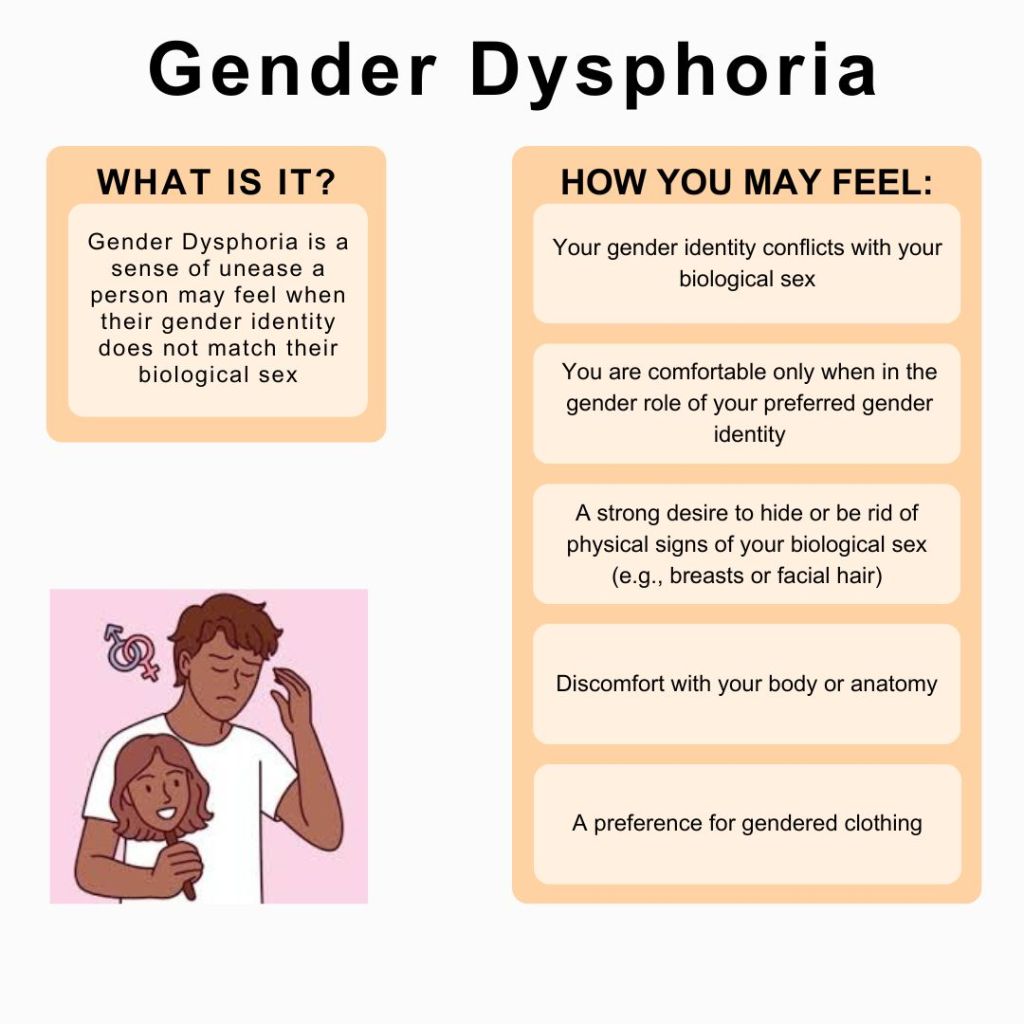
Title: Gender Dysphoria. A single text box titled "What is it?" with the definition below: gender dysphoria is a sense of unease a person may feel when their gender identity does not match their biological sex. A single-column table titled "How you may feel:" In descending order: your gender identity conflicts with your biological sex, you are comfortable only when in the gender role of your preferred gender identity, a strong desire to hide or be rid of physical signs of your biological sex (e.g., breasts or facial hair), discomfort with your body or anatomy, and/or a preference for gendered clothing.

Helpful Resources:

Teen Vogue has an article discussing what it’s like to be transgender and living with gender dysphoria.

The Guardian also has an article where people who identify as transgender discuss their experience with exploring their gender identity. Although gender dysphoria is not the main focus, it is thoroughly discussed in the experiences of the transgender people featured.

This article from BuzzFeed includes people with disabilities exploring their gender identity and how it intersects with their disability. Gender dysphoria is mentioned, but the article mainly focuses on how society has created barriers for transgender people with disabilities. It would still be beneficial to use, as it brings attention to an often overlooked area of the disability and transgender community.
Accessible Mental Health Services

Accessible mental health services can be a challenge for people with disabilities, as there can be a lack of specialized provider training and difficulties with financial costs. We are defining accessibility in terms of disability and financial costs. This post provides a few mental health services for people with disabilities, with some services offering in-person services and others offering both in-person and online services.

Envision Unlimited

Mission Statement: “Envision Unlimited is a certified Community Mental Health Provider offering a full complement of behavioral health services to people with a variety of mental health concerns. We are committed to assisting clients in their best and meaningful lives.”

  • Offers outpatient therapy services to adults and adolescents, both in person and via telehealth
  • Based in Chicago, Illinois

Envision Unlimited emphasizes that no one will be denied access to services due to an inability to pay, and a discount is available.

There is also a program called ENVISION MORE for people with disabilities.

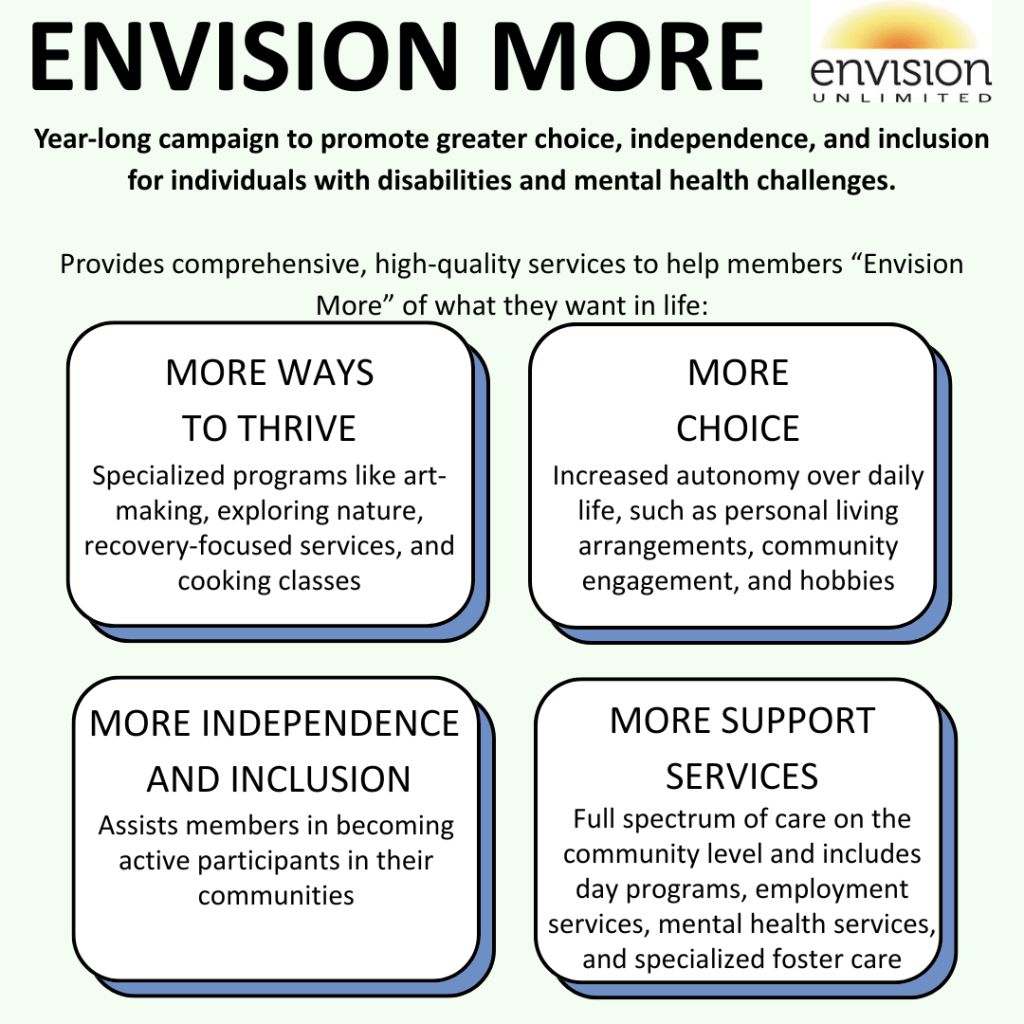
Title: ENVISION MORE. Year-long campaign to promote greater choice, independence, and inclusion for individuals with disabilities and mental health challenges. Provides comprehensive, high-quality services to help members "Envision More" of what they want in life. Box 1: More Ways to Thrive; Specialized programs like art-making, exploring nature, recovery-focused services, and cooking classes. Box 2: More Choice; Increased autonomy over daily life, such as personal living arrangements, community engagement, and hobbies. Box 3: More Independence and Inclusion; Assists members in becoming active participants in their communities. Box 4: More Support Services; Full spectrum of care on the community level, and includes day programs, employment services, mental health services, and specialized foster care. The logo for Envision Unlimited is in the upper right-hand corner.

NYSTART (New York Systemic, Therapeutic, Assessment Resources and Treatment)/CSIDD (Crisis Services for Individuals with Intellectual and/or Developmental Disabilities)

Goal: “…to build relationships and support across service systems to help people remain in their homes and communities and enhance the ability of the community to support them.”

  • Offers crisis prevention and response services to people who have both developmental disabilities and complex behavioral needs, as well as to their families and those who provide supports
  • Services are available 24 hours a day, 7 days a week to OPWDD (The New York State Office for People with Developmental Disabilities) eligible individuals age 6 and over who meet NYSTART/CSIDD eligibility
  • Based in New York, must be a New York resident 

The Arc

The Arc company logo.

Mission Statement: “Promoting and protecting the human rights of people with intellectual and developmental disabilities and actively supporting their full inclusion and participation in the community throughout their lifetimes.”

Delaware Disability Resources and Advocacy Organizations

  • All of the following services are based in Delaware

NAMI (National Alliance on Mental Illness)

Mission Statement: “NAMI Delaware supports, educates, and advocates for an improved quality of life for individuals and families affected by mental health conditions.”

  • Offers a variety of signature programs, an annual education conference, and special events (for individuals, families, and professionals to receive support and information)
  • Shapes public policy, has a toll-free NAMI Delaware Helpline, and works with media, educators, healthcare professionals, and elected and appointed officials (to raise awareness, fight stigma, and encourage understanding)
  • This link is for Delaware’s NAMI program, however, there are more than 650 NAMI State Organizations and Affiliates across the country

Division of Substance Abuse and Mental Health

Mission Statement: “To improve the quality of life for Delaware’s citizens by promoting health and well-being, fostering self-sufficiency, and protecting vulnerable populations.”

  • Offers help for mental health issues (in which all services are free, and any referrals are available regardless of insurance), support groups and one-on-one counseling, suicide prevention resources, and other additional resources. 

Mental Health Association in Delaware

Mission Statement: “The Mental Health Association in Delaware strives to strengthen knowledge, resources and support around mental health and recovery.”

  • Offers education, support, and advocacy
  • Support: Offers wellness groups (one is a disability & chronic illness haven wellness group), mental health screening, and a peer support program with the mental health court (mental health court is available for people who have been charged with crimes because of a behavioral health disorder)