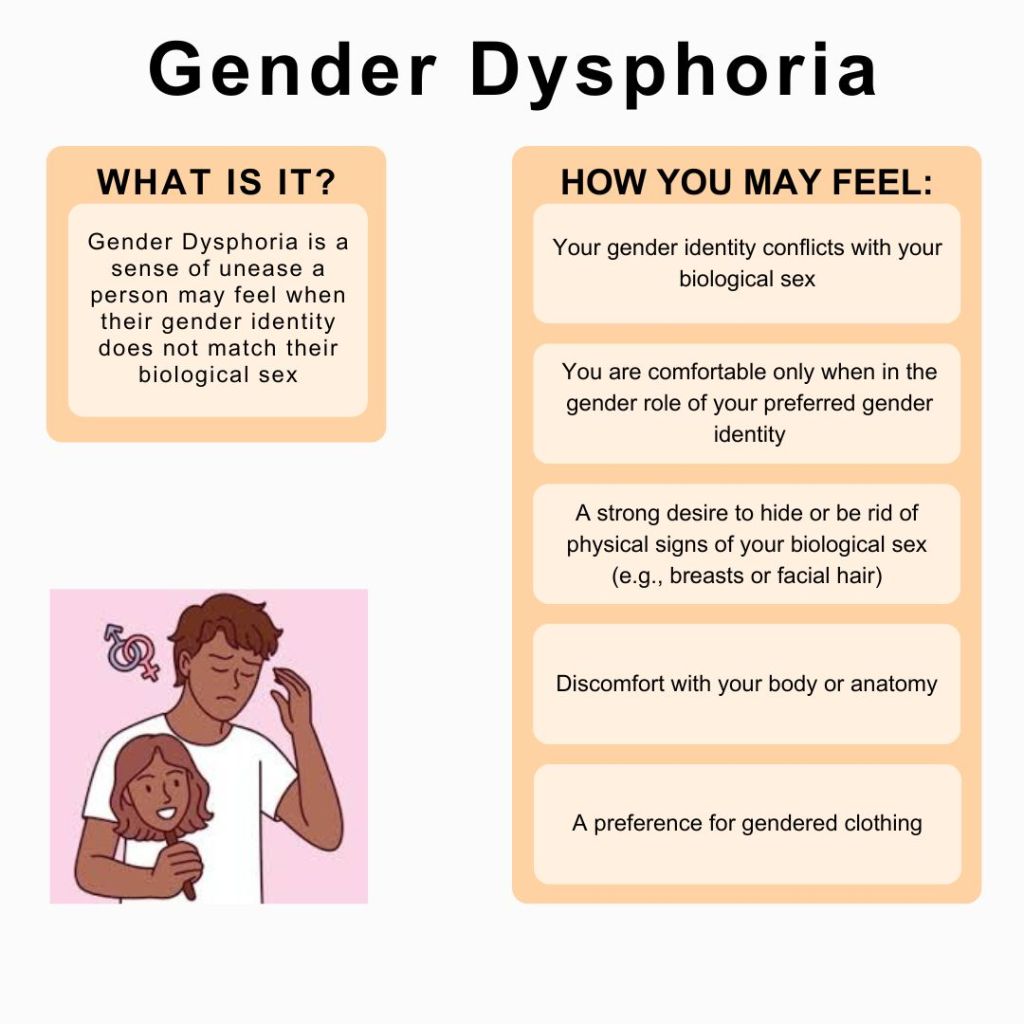
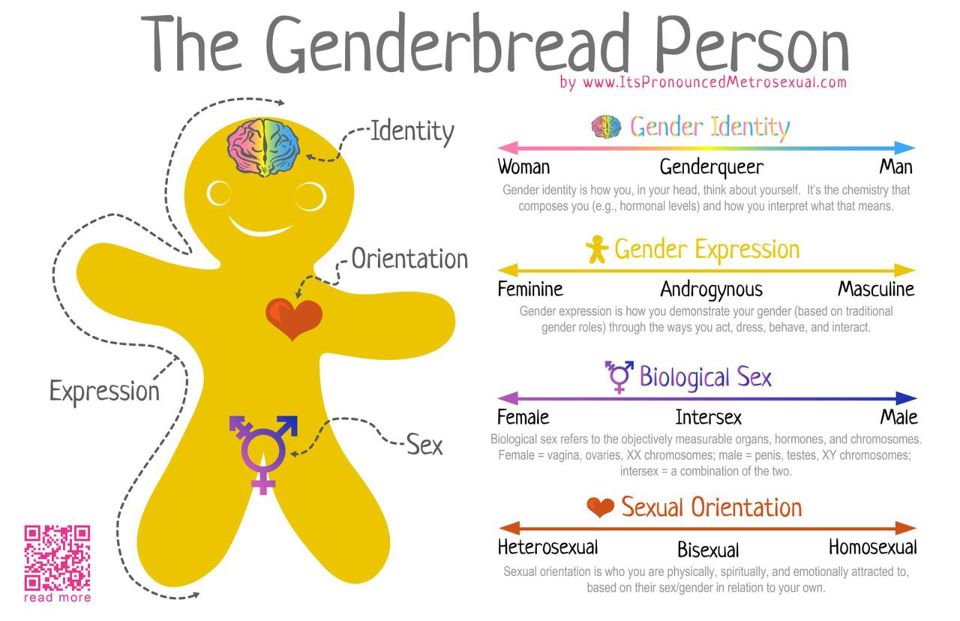
Sometimes when we teach human sexuality we don’t get into issues of gender identity. Even though this can be a complicated topic it is important for individuals with autism as they are able. Sometimes individuals with autism get hung up on rules and categories. A simplistic set of rules is a disservice as it doesn’t reflect the reality of individual experience. Here we can use gender to assist with introducing more fluid thinking more generally. When we teach this, we still use the idea of “rules” or “guidelines” we just provide a set of explanations that are more complex.
Teaching with gender identity is also important because you shouldn’t assume that you understand the gender identity of your students. It opens the door for students to understand their own gender identity and gives them tools for discussing it.
Most educators discussion gender identity with sexuality, and physical sex. Here’s a quick and simple video about the differences between gender identity, sexuality, and sex. There’s also a good intro to sexual orientation and romantic orientation. Like many videos for general guidance, it goes a little fast for novices so you may want to have them watch it once and then watch it again with starting and stopping. You can watch it here.
*In the video, Hank refers to a person named “John.” John Green (author) is Hank’s brother and this is part of a video series they have together where they refer to each other as their audiences.*
This can be used to explain the differences between identity, orientation, expression, and sex.
Here are some terms from the video that students may need defined and some suggestions for how to explain them.
- Sex: In this video, sex is defined as the physical sex organs (genitalia). A lot of time we think that everyone who has a penis is a man and everyone who has a vulva (or vagina) is a woman. But man/boy woman/girl is bigger than that. Would you consider yourself to be a boy or a girl? What does that mean to you? This is your gender. We usually use the words male/female to refer to physical sex organs.
- Intersex: Every once an a while, the body grows male AND female sex organs. If students want more depth, you could explain that this could mean having a penis and a vagina, or just an elongated clitoris and a vagina, or even having a penis and uterus, or a vulva and testicle. To explain these two points together you could have two drawing of people and ask students to group the genitalia how people often expect it to be and then have them move things around to show how they can be different. In discussing intersex, I like to reinforce that there is nothing wrong with being intersex but sometimes people may feel uncomfortable because it’s unexpected for many people. You may want to mention that people use to use the word hermaphrodite, but now that word is considered offensive.
- Gender Identity: What gender you feel you are. Gender is a wide spectrum and includes more than just girls and boys. There are people who identify as man/woman, neither, and in between. Learn more here using the Genderbread Person graphic. To reinforce this concept, use their list from above. Look for items on the list that could be true for either a boy or a girl. Explain that for some people their gender identity matches their sex but for other people it doesn’t match.
- Cisgender: When a person’s biological sex matches their gender identity. If a person with a penis identifies as a man, then they are a cisgender person.
- Transgender: When a person’s biological sex does not match their gender identity. If a person with a penis identifies as a woman, then that person may identify as a transgender person.
- It is important to note that this can be a sensitive topic for many people who do not identify as cisgender, and it is best to allow people to share their gender identity when they are comfortable.
- Asexual: A person who does not experience sexual attraction. You can learn more at:
- Sexual Orientation: Sexual attraction. This can include heterosexuality, gay/lesbian, bisexuality, pansexuality, asexuality, demisexuality, and many more.
- Romantic Orientation: Romantic attraction. This does not have to be the same as sexual orientation. A person might be sexually attracted to men but mentally and romantically
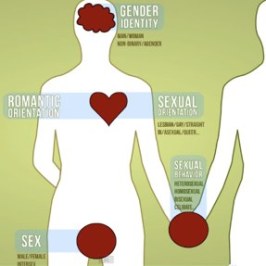 y attracted to women.
- Sexual Behavior: Sexual behavior is the physical actions that a person does to express their sexuality.
- Gender Roles: Roles that people of a certain gender are expected to act. This can mean that boys are “supposed” to play with trucks while girls are “supposed” to play dress-up.
- It is important to note that gender roles are not set in stone and it is okay to not follow gender roles.
Here you can download our Genderbread Person activity, which is a worksheet that can be used to help students in their process of understanding their own identities and the meanings of these terms. There is a copy of the Genderbread Person graphic attached so it could be used to visually help students understand these concepts.