How to Set Healthy Boundaries

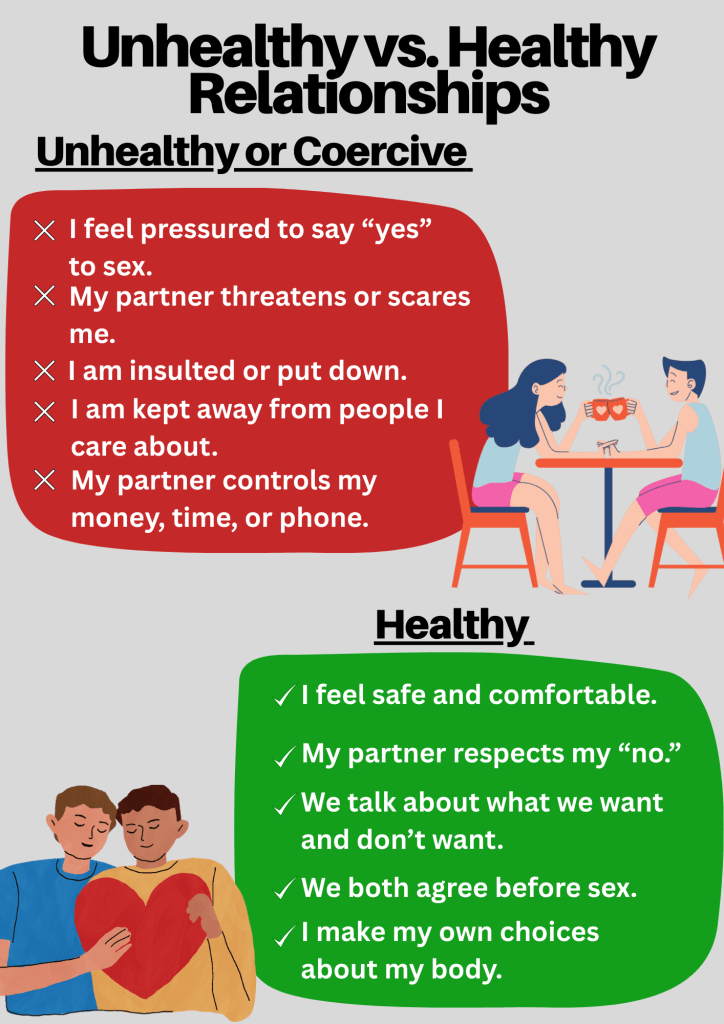
This photo contains a checklist that breaks down unhealthy vs. healthy relationships. In unhealthy or coercive relationships, a person may feel pressured to say yes to sex, they can be insulted or threatened, and kept away from people or belongings. In a healthy relationship, people feel safe and comfortable, respects when someone says no, agree before having sex, and have control over your own body. Two people are sitting at a table holding mugs in one corner while two other people are hugging and holding a heart to their chest.

Boundaries

To ensure that individuals do not experience types of coercion mentioned above, it is important that healthy boundaries are developed. Without healthy boundaries, relationships can become toxic and unsatisfying, and the individual’s well-being can suffer. Healthy boundaries are meant to [1]:

  • Encourage autonomy and reduce codependent habits
  • Set expectations when interacting with others
  • Give you a sense of empowerment and self-respect
  • Ensure your physical and emotional comfort
  • Clarity on individual responsibilities in a relationship
  • Clarify individual responsibilities in a relationship
  • Separate your wants, needs, thoughts, and feelings from those of others

Before getting into a relationship, it is imperative to develop personal boundaries and ensure that those boundaries are respected.
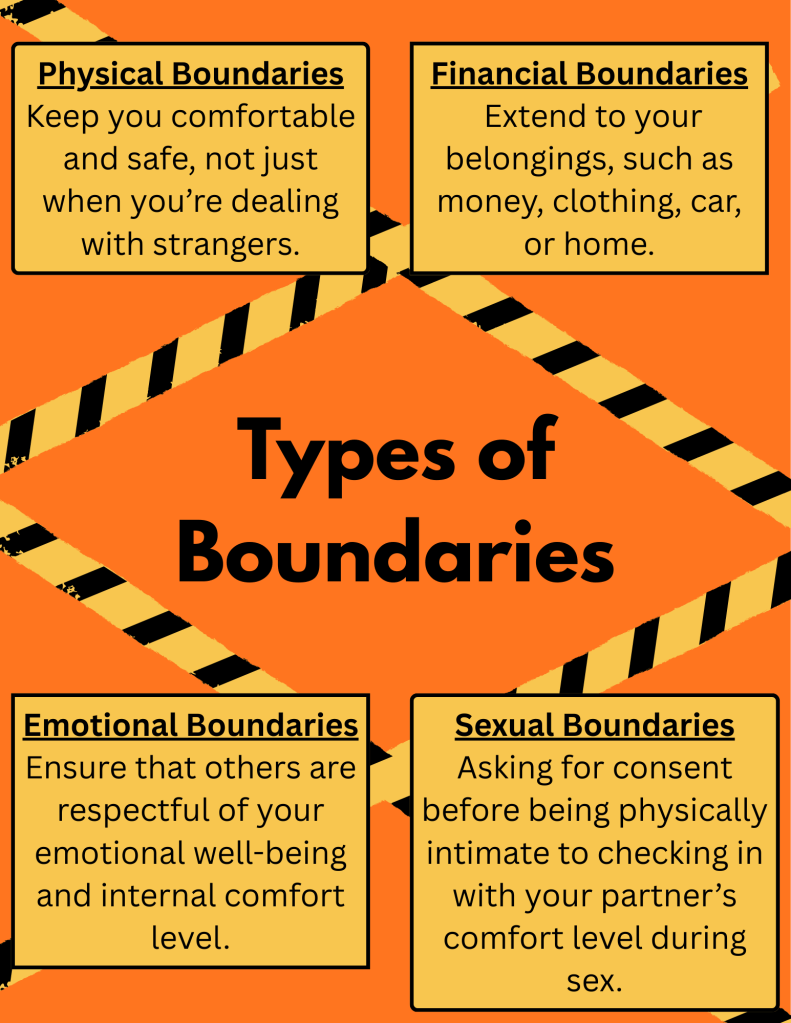
Orange box with danger tape running an "x" shape across it. The text describes the different types of boundaries: physical boundaries, financial boundaries, emotional boundaries, and sexual boundaries. Physical boundaries can be defined as those that keep you comfortable and safe. Financial boundaries are those that extend to your belongings. Emotional boundaries ensure that others are respectful of your well-being and internal comfort. Sexual boundaries require asking for consent before being physically intimate.

Sexual Readiness

An important thing to consider when discussing relationships is sexual readiness. Sexual readiness means thinking carefully about whether you are truly ready to engage in sexual activity with a partner [2].
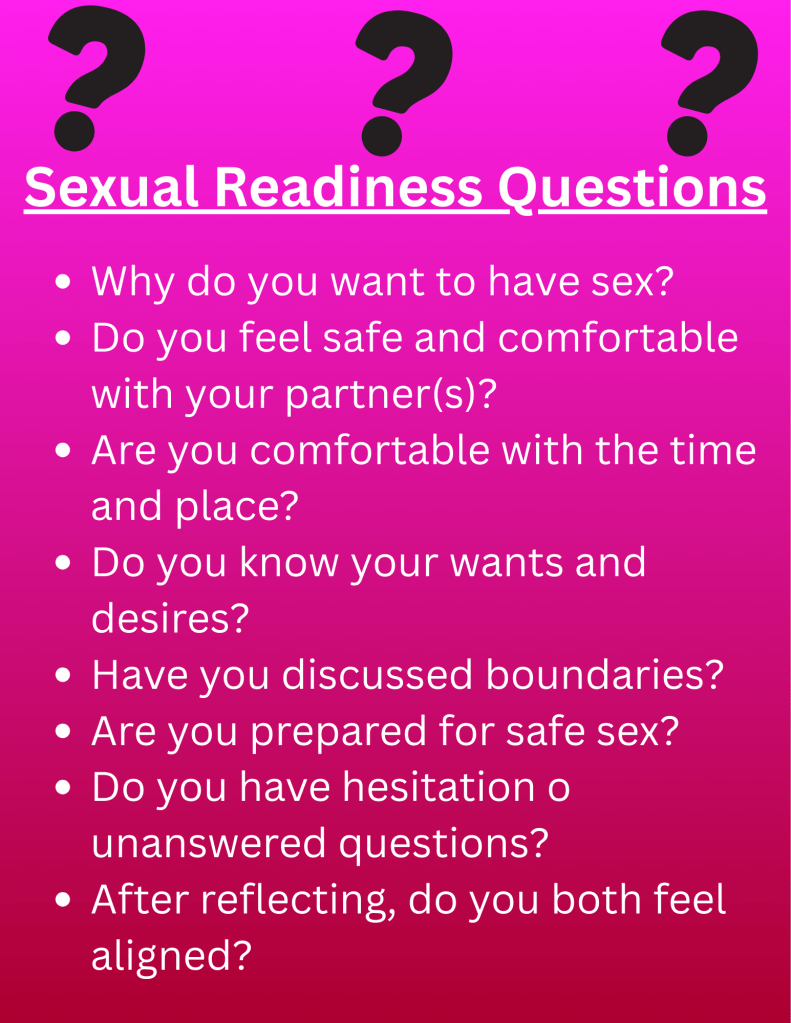
Pink infographic with a list of questions to ask how ready someone is to have sex: Why do you want to have sex? Do you feel safe and comfortable with your partner(s)? Are you comfortable with the time and place? Do you know your wants and desires? Have you discussed boundaries? Are you prepared for safe sex? Do you have hesitation or unanswered questions? Do you both feel aligned?

Coercion

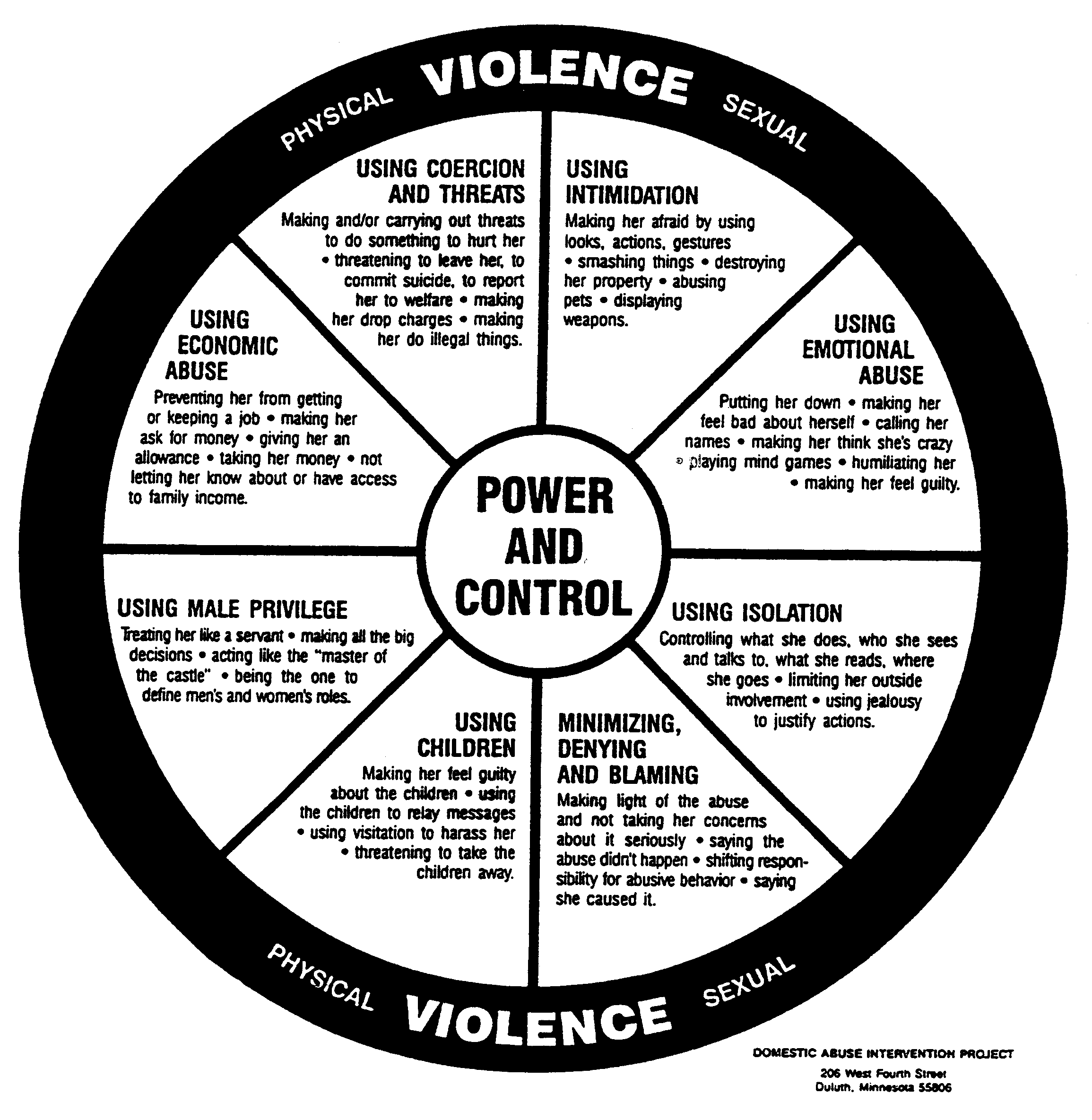
In some relationships, individuals use a tactic called ‘coercion’ to ensure their partner does not leave the relationship. According to Webster’s dictionary, coercion is “to compel an act or choice” [3]. Regarding relationships, coercive control is seen through emotional abuse in intimate partner settings and may sometimes include physical force [4]. Types of coercive control include:

  • Assault – Assault is one of the most extreme versions of coercive control, as it involves physically forcing an individual to conduct an action. Assault includes hitting, choking, slapping, kicking, biting, using weapons, and exposure to dangerous situations.
  • Threats – Threats are declarations of impending consequences intended to create fear. Example statements include, ‘That better not stay that way, or you’ll regret it’, ‘The next time you do that, the dog is going to the shelter’, and ‘You’re going to be sorry you did that’.
  • Insults or Humiliation – When a partner insults or humiliates an individual, it can be done with the intention to break down the individual’s self-esteem and make them believe they cannot function without the partner. Some examples include making jokes at your expense, calling you names, and regularly making critical comments about your appearance.
  • Isolation – When a partner forbids an individual from interacting with others, it can inhibit the individual from being able to verify abusive relationship behaviors. Examples include making excuses why you can’t attend family events or social functions, using guilt to get you to stay at home, and making fun of your interests to discourage you.
  • Activity Monitoring – Activity monitoring is a tactic utilized to subtly remind an individual that their partner is always around, judging their behaviors. Examples include whole-home surveillance technology (including private areas like the bathroom), checking your internet usage and browser history, and using tracking technology on your phone or car.
  • Financial Control – When a partner scrutinizes, controls, or limits financial control, a situation is developed where an individual depends on that partner for basic needs. Examples include being restricted to an allowance, insisting on sharing financial account information, and running up debt under your name.
  • Sexual Coercion – When a partner makes an individual feel pressured, manipulated, or tricked into sexual interaction. For example, making you feel obligated to engage in sex, offering a reward for sex, or threatening consequences if you don’t engage in a sexual act.
  • Removing Autonomy – When someone takes away the freedom of personal choice. It is a form utilized to dismiss an individual’s feelings and make them feel inferior. Examples include insisting you use certain products (shampoo, body spray, soap, hygiene items), replacing your things with versions they feel are superior, regulating your sleep, eating, or bathroom activities.

Conclusion

No matter your attachment style, it’s important to regulate your emotions, take time to think before agreeing or initiating sex, and remember sex does not equal love or commitment [6]. If someone is pressuring you into sex, and you feel safe, be direct and firm with the individual [7]. Let the individual know that pressure will not change your mind or that you are not interested. If the pursuit continues, call individuals that you trust (family, friends, police). Some individuals to help you create an exit strategy from a coercive relationship include 1-800-799-7233, thehotline.org, and texting “START” to 88788.
Beyond The Myths: Inclusive Sex Education and Mental Health Awareness

Exploring your sexuality can be confusing, especially when you start engaging in sexual acts with other people for the first time. Virginity is the term used to describe the state of never having had sex, and “losing your virginity” can be nerve-wracking. Even the word “losing” is not the best description, because you should be gaining something from your experience instead. There are many misconceptions around sex that can contribute to feeling anxious about having sex for the first time. This is a guide that debunks myths and discusses the many ways you can have sex to help you feel a little more comfortable when engaging in sexual acts, and the importance of your mental wellbeing when it comes to this.

Sex Myths

Myth Reality 
You will feel different after having sex.People often believe after having sex for the first time it will instantly change everything and bring a complete happiness in your life. The truth is there is no “right” way to feel after having it. You can feel happy, anxious, calm, excited, nervous, or even the same. All of these reactions are completely normal. 
Pain is always present.First time sex can feel uncomfortable at first. The vagina is muscle so when it is being strecthed it comes along with discomfort. But with communication, patience, and enough foreplay with your partner the discomfort will last for only a little bit. If the pain is severe or ongoing it is a good idea to talk to a healthcare professional because sex is not supposed to hurt. 
It will be perfect and magical. Watching television they depict first time sex as something magical and smooth. In reality that is not always the case. First time sex can be awkward and nervewracking and that is okay! Learning and figuring things out with your partner is completely normal. It does not have to be perfect for it to be meaningful.  
Talking about boundaries will ruin the mood.This is absolutely not true. If there is something you do not feel comfortable with when about to have sex with your partner, make sure you say it. You saying it will not ruin the mood whatsoever. It will just make sure that you are being treated with respect and that you are not uncomfortable during the experience. When both partners feel safe and heard, it will create a more positive experience. 
Penetration is required. This is a myth because that statement limits the definition of sex to only penis-in-vagina orientation. Intimacy includes many forms such as oral sex, touching, mutual stimulation, and many other experiences. 

Diving Deeper into Inclusive Sex

As mentioned above, “penetration is required” for sex is a myth because of the many ways to be sexual, and based on your pain or mobility restrictions, sensory sensitivities, gender identity, and sexual orientation, sex may be different than how you imagined it. There is no one or “real” way to have sex; it is whatever you and your partner are comfortable with, so it’s important to talk to your partner about boundaries and what sex you would like to have.

There are many different ways people have sex:

  • Anal sex – a penis is inserted into another person’s anus
  • Oral sex – a person licks a person’s vulva, vagina, or clitoris or a person kisses/sucks a person’s penis
  • A person kisses and sucks the other person’s nipples
  • A person masturbates with another person
  • A person touches another person’s vagina or penis
  • Sex toys (ex: dildos…) are used

This fact sheet provides more information on having sex.

Being comfortable in your sexuality and expressing yourself sexually can help you understand yourself better and be in control of your own life. It can also give you confidence to have sex successfully (based on your own personal view of what “successful” sex is) and deepen your connection with your partners.

Resources To Promote Positive Mental Health

For LGBTQ+ individuals with disabilities, the LGBTQ+ community and spaces can act as a protective factor as it helps foster a sense of belonging, reduce isolation, and supports positive self-identity. However, LGTBQ+ people with disabilities also report higher rates of mental health concerns. The Trevor Project has a guide on their website for supporting LGBTQ+ people with disabilities, including direct links to resources that can be found on page 14 on the PDF format.

We wanted to attach some resources if you or someone you know is struggling with mental health concerns. The Cleveland Clinic provides more information about suicide and its warning signs on its website at https://my.clevelandclinic.org/health/articles/suicide.

The Never a Bother campaign is a youth suicide prevention awareness and outreach campaign for young people and their parents, caregivers, and allies. To get involved, please visit https://neverabother.org/

Are Individuals with ASD (and other disabilities) at Increased Risk for Sexual Abuse?

It is difficult to determine the exact risk of sexual abuse for individuals with ASD.  For one thing, reports of sexual abuse in the general population can vary widely.   The first national survey reports victimization rates of 27% for women and 16% of men (Finkelhor et al., 1990)*- and many studies seem to report findings similar to this.  A study has shown that children with disabilities are 1.7 times more likely to experience sexual abuse (Crosse, Kaye & Ratnofsky, 1993)*. In this study all children with disabilities were examined, not just individuals with ASD . Individuals who are caregiver dependent may be at the highest risk as family members, family acquaintances, and paid caregivers are the most likely to commit sexual abuse (Mansell et al., 1996)*. Difficulties communicating, lack of knowledge of sexual norms and activities, and isolation may contribute to increased risk of sexual abuse among individuals with ASD.

So what can you so?  Here are 5 places to start.

  1. Have a clear reporting procedure of any suspected incidences of abuse or neglect and  use it!
  2. Don’t hug, kiss, hold hands, snuggle or in other ways compromise professional boundaries.  Not only does this potentially mask dangerous “grooming” by sexual predators, it also communicates that individuals with disabilities are asexual.
  3. Sexuality education 🙂 may provide opportunities to for individuals to be better able to communicate and better understand social norms and activities thus giving them tools to better understand if abuse may be taking place.
  4. Teach folks to say no!  When we don’t provide structured opportunities for people to say no, then when they need to they don’t know how.
  5. Don’t let sex be a taboo.  If everyone is afraid to talk about it, they will be afraid when there is a problem also.  Also, perpetrators will be deterred by the open communication.

The Department of Human Services in Illinois is targeting ending violence against women with disabilities.  Click here to learn more!

*Link takes you to an abstract of the original article.

Online Dating Websites

Online dating has become popular in the community, and we’re here to share some good dating websites with our readers!

**Please note that for all of these websites, you must be 18+ to use**

Spectrum Singles: This dating website is exclusively for people who are on the autism spectrum. This website goes past the two-gender (male/female) belief and offers many gender identities for its users to use to identify themselves, such as transgender, androgyne, agender, intersex, and genderfluid. There is also the option to search for others using these options. Spectrum Singles is not just for people looking for dating, but also friendship.

Whispers4U: This dating site has been around since 2002, and is designed to help “differently abled individuals” find love! This website offers video tutorials, virtual flirting, webcam chatting, 24/7 support, and many other features! On top of this, the site doesn’t discriminate based on ability. Everyone is allowed to join this site to find relationships and friendships. This site constantly checks for scammers, and is a top rated disabled dating site!

Special Bridge: This is a family owned dating site that allows users to build relationships, friendships, and find pen pals! They mostly focus on match-making. It’s users can take a match-making quiz that connects them with other users across the country. They also offer support forums, run background checks on users (to ensure they’re real people!), is monitored for inappropriate behavior, and is an overall safe choice.

Disabled Passions: This site is a good mix between social networking and dating. This site consists of a lot of forums that are organized by interests. Users can go onto the forums and find other people that they identify with. The site also uses math-making services and offers many options for virtual flirting and chatting.

For even more sites, check out this article: Best Disabled Dating Sites

Parent Tip Sheets

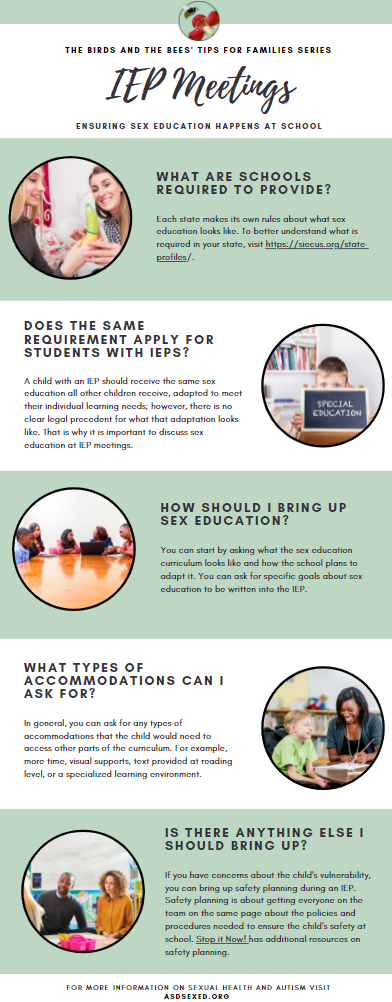
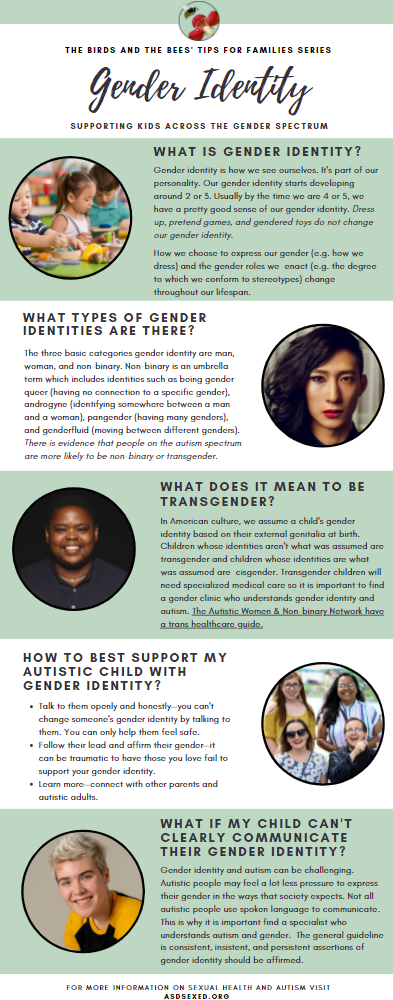
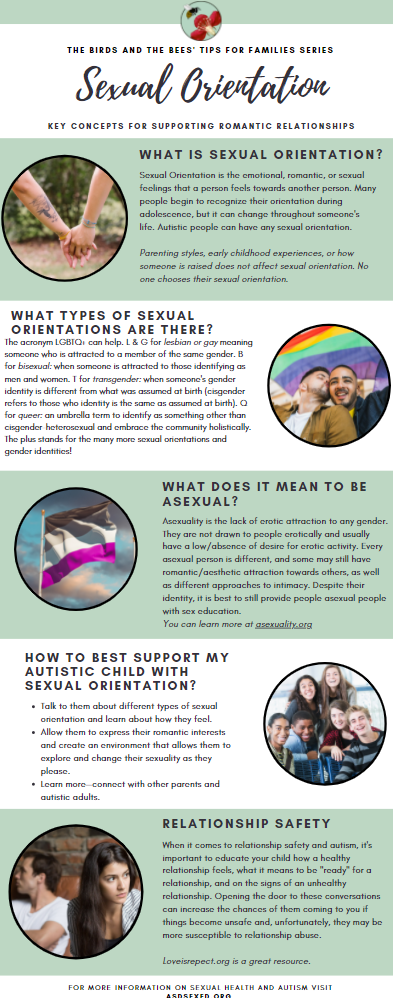
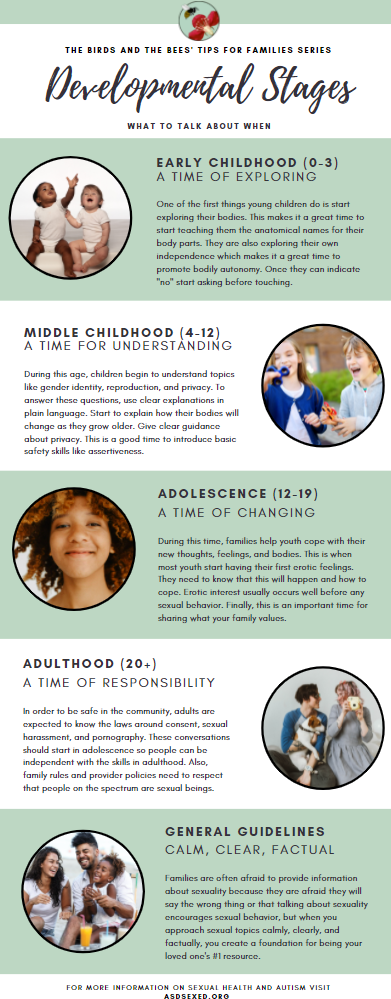
Navigating developmental stages, education, and sex education can be extremely difficult. The Birds & The Bees team put together a parent tip sheet that offers basic information and resources for parents of autistic children. View the tip sheets in the slide show and download below.

  • In Script, a title reads "The Birds and The Bees Tips for families Series" The first picture shows two babies happily sitting on the floor, looking up towards the sky. The second pictures shows two laughing children playing with fidget spinners. The next picture shows an young African American girl smiling. The following picture shows a young couple, each holding a dog.

Sex Ed for Self-Advocates

The Organization for Autism Research (OAR) was founded by parents and grandparents. OAR strives to use science to address social, educational, and treatment concerns in the Autism community. Their mission is to fund research, provide useful information and resources to the community, as well as hold programs to improve quality of life for individuals with Autism.

The OAR has put together an online guide for sexuality and sex ed. This guide is self-paced and intended for people on the Autism Spectrum aged 15 and older. This guide consists of nine modules: Public vs Private, Puberty, Healthy Relationships, Consent, Dating 101, Sexual Orientation/Gender Identity, Am I Ready?, Sexual Activity, Online Relationships and Safety. Each module consists of a video overview and 10-15 smaller sections.

This guide is completely free and can be accessed at the link below:

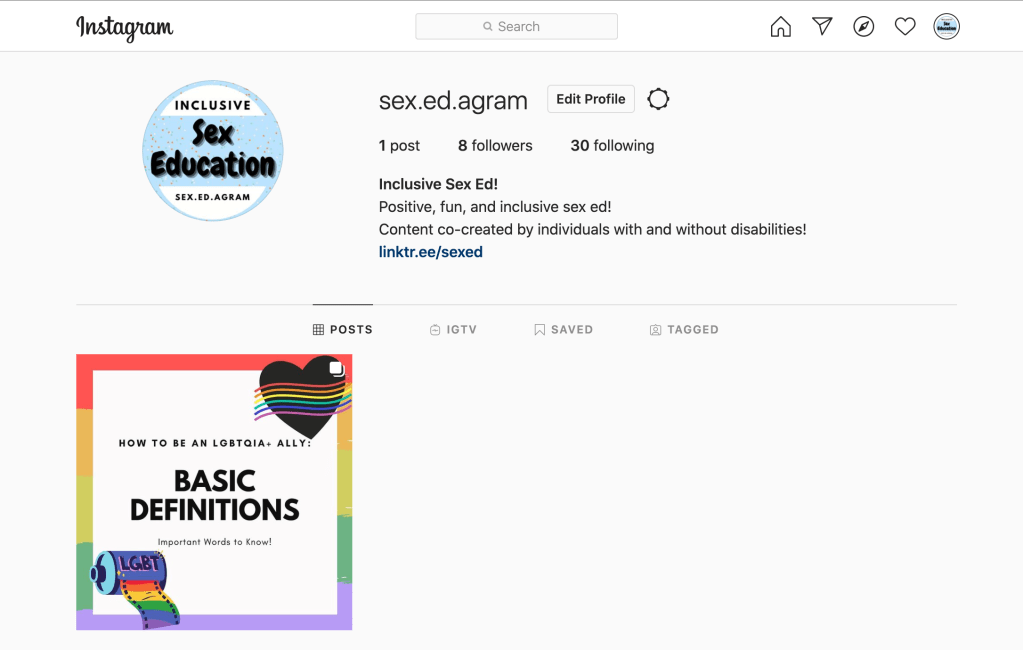
Inclusive Sex Education on Instagram: “Sex.ed.agram”

The sex ed instagram project is an inclusive project started in Fall 2020 to create resources for all groups of people about sexuality! The information we post is co-created in small groups containing individuals with and without disabilities. We ask important questions, become informed ourselves, and post the information for others to access. Our team commits 2+ hours a week to make and review posts, learn more about how to use different forms of social media, and become a good sex educator. The project allows for individuals to personally expand their understanding of sexuality and sexual health, have a creative outlet, and build their research experience. The project offers a safe, educational, and fun environment for all types of individuals. Our team continues to grow and work to produce information in a co-created and inclusive way. Check out our instagram page: https://www.instagram.com/sex.ed.agram/

More Info. Less Weird. AMAZE Takes the Awkward Out of Sex Ed

These days, it is hard to find an age appropriate content about sex, dating and abuse. Children have questions about their bodies, gender and reproduction. Teenagers worry if their bodies are developing normally or not while older adolescents struggle with peer pressure, changing relationships and emerging sexual feelings. AMAZE is an amazing website for parents and educators which helps them to expose their child to age appropriate content about sex through short videos. The website provides an insight to young people to successfully understand puberty, healthy body image, distinguish between healthy and unhealthy relationships, concepts of consent and mutual respect. Video topics are designed to meet the learning objectives outlined in the National Sexuality Education Standards.

Parents are the primary sexual educators of their children. By answering children’s questions, a parent let them know that you are “askable” and establishes an open line of communication that will serve you and your children well as they mature into sexually healthy young adults.

AMAZE also has resources for younger children like the parents’ playlist from amaze jr. It is designed to help parents become comfortable and confident talking to their children openly and honestly at any age.

https://amaze.org/

There are some videos for parents reference.

This video will help parents to know when to talk about sexuality with their kids.

Do you think so playing “doctor – doctor” is safe or not? Check this video out which helps you to communicate your thinking and others about this game.

This video will model to the adolescents with disabilities to learn about manage their relationships with person they like or have attractions. This video guide them to deal with peer pressure and make healthy relationship.

This video helps your child to understand their body parts, difference between a male and female, and similarities between boy and girl.

https://youtu.be/wW627gpkWbw

Anatomical Puzzles for Children

Both Hape and Melissa & Doug have made anatomically correct body puzzles.

Hape sells boy and girl puzzles separately for around $20.00 each.  The children are pre-pubescent and European American.  The video below shows a child completing the puzzle. The toys are distributed by Hape but are actually made by a company called Beleduc out of Holland. Beleduc also has a great pregnant mother puzzle that is a little difficult to find.

Melissa & Doug make a magnetic human body play set that includes children of both genders for about 13.00.  The children are early adolescents and European American.

Healthy Realationships and Autism

healthy relationships and autismA new curriculum called “Healthy Relationships and Autism” is now available from Wesley Spectrum (a behavioral health organization with several locations in the Pittsburgh, PA area). It was designed to teach skills to adolescents and young adults with Autism Spectrum Disorder or cognitive challenges in the areas of self care, sexuality, and relationship development.  Their website has an example lesson to help you determine if it would be right for your students.  They do not publish their pricing information (you have to email them for more information but they will send you a sample packet).

I have not used this curriculum but there is some evidence of it’s effectiveness.  A study published in School and Educational Psychology evaluated this program with six students.  These students showed increases in sexual knowledge which they retained one month after completing the class.