 Songs for Your Body is a curriculum comprised of, you guessed it, songs. They cover hygiene, abuse, masturbation, contraception, sexually transmitted infections, and sexual health. You can preview the songs on their website- I liked the masturbation songs. In general, they’re a little hokey but I think it’s a good example of thinking outside the box. The CD is $15.41 including shipping and handling and comes with a booklet of lyrics and activities.
Autism
Facilitated Sex
What is facilitated sex? This brief video explains what facilitated sexual activity is and some of the considerations.
Dr. Mitchel Tepper is an expert in the area of sexual health, disabilities, and medical conditions with a specific focus on physical disabilities. His website can connect you with a lot of great information (I especially like his blog).
Some things to keep in mind about facilitated sex…
- Facilitated sex is a continuum. Dr. Sarah Earle suggests it might include providing sex education, fostering an environment that allows intimacy, the procurement of sexual goods, and arranging for paid-for sexual services.
- Many individuals with disabilities would be unable to participate in many parts of sexual expression without some level of facilitation.
- It’s not that abuse and victimization aren’t concerns- they are! It is also important to consider how to support individuals with exploring sexual pleasure and sexual facilitation is part of that picture.
YAI Online Resource Center

YAI is a agency out of New York that has a relationship video series I really like. They also have developed a determining sexual consent manual (which you can get through their online resource center).
Unfortunately, this is not a free service, but as far as somethings go, it’s not too bad. For $150 a year you can buy membership to the YAI’s online resource center. You then get to download tons of materials. They have a lot on relationships and sexuality. Some of it is geared toward staff/educator preparedness but they also have lesson plans. Many of the items are available to purchase separately without buying membership to the resource center (and other items, like the relationship videos, aren’t available to download).
You can check out some of the resources available during a free trial.
Human Sexuality 101 Week 8: Wrap Up and Review
 For the final session of Human Sexuality 101 we reviewed what we learned during the class. Overall, students seemed to enjoy the class and learn something. The students also seemed to like each other. Sexuality is a social topic, so I was excited that students were able to share and connect throughout the class.
Activities
Vote with Your Feet: We printed ‘true’ and ‘false’ on sheets on the opposite sides of the room. When presented with true/false statements, participants chose the correct response. We specifically chose items that we knew were difficult for students. Then we switched to agree/disagree. This allowed us to touch upon the difference between facts and opinions. We also had students make their own statements. They did a great job.
Booklets: We passed out booklets to the participants that reviewed all the information we covered and had additional activities for them to do at home. We did complete an evaluation, but I don’t think it was very successful. I’d consider the evaluation to still be “under construction.”
Materials
Social Signals- Curriculum
 Social Signals ($159.oo) is a series of videos and curriculum are designed to teach adolescent students with autism and intellectual disability about safe relationship skills. There is also a parent curriculum for $23.99. They have a sample video and lesson available for free so you can preview before you purchase. I liked the video. I like to teach about expected and unexpected behaviors and I think these videos could be a good tool. There are also sample lessons that accompany the videos.
New Research Regarding Autism and Sexuality
 Sandra Byers, Shana Nicholas, Susan Voyer, and Georgianna Reilly have an paper coming out in Austim this month. They survied 141 men and women with “high functioning autism and/or Aspergers syndrome” (AQ score of 26 or greater) about their sexual wellbeing. You can read the abstract of the article for free or pay for the entire article but I’ve summarized the interesting findings below.
Gender Differences: The men had greater sexual well being but less sexual knowledge. They weren’t different in all areas; for example, they were the same in terms of sexual activity and sexual self esteem. They were different in areas such as arousability and sexual desires (this is pretty consistent with neurotypical gender differences).
Autism Symptomatology: Folks who reported less autism symptomatology had better sexual well being but not necessarily more sexual activity (both with partners and alone). The folks who reported more autism symptomatology reported more difficulty with the other parts of sexual life like assertiveness and desire.
Relationship Status: Folks in romantic relationships relationships reported better sexual well being. Everyone in the study had been in a relationship at some point so this is comparing the folks currently in a relationship from those not in a relationship at this time.
So how did they define sexual well being?
The looked at sexual well being in two main domains: dyadic (with another) and solitary (on your own). In these domains they examined affection, genital activity, sexual assertiveness, sexual satisfaction, arousability, sexual desire, sexual thoughts, sexual anxiety, and sexual problems.
One of the take home recommendations for education relates to the two domains. These reachers highlighted the importance of sexuality education that teaches about partnered sexual expression and solitary sexual expression. They also recommended that sexuality education specifically focus on developing a positive sexual self-image. I can’t disagree with them there!
“Intimate Relationships and Sexual Health” – A Curriculum
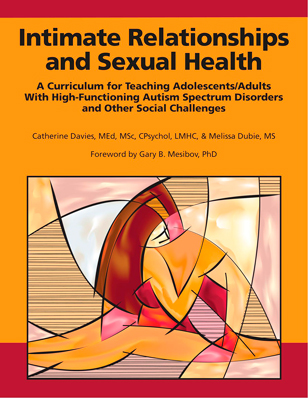
Courtesy of Indiana University
Thank you to the folks at TAP in Rockford for bringing this curriculum to my attention!
“Intimate Relationships and Sexual Health” is a curriculum written by Catherine Davies and Melissa Dubie who are affiliated with the Indian Resource Center for Autism.
“Intimate Relationships and Sexual Health” is geared toward folks who are pretty independent and have few intellectual impairments, so it’s not for everyone. But they do do a nice job of showing how to think about lesson planning that would apply to anybody. You can see a fair amount of the curriculum on Amazon to see if it might work for you.
Menstruation Plan
In preparing for the puberty section of Human Sexuality 101 I was looking at research on methods for teaching young girls with ASD about menstruation and came across an article using Social Stories (only a preview of the article is available for free).
In short, here’s the Four P Plan for Period Support
1. Prepare a period kit
2. Preinstruct (perhaps using social stories)
3. Practice
4. Plan for pain relief
Klett & Turan used a combination of three Social Stories adapted from Mary Warbol’s “Taking Care of Myself: A Hygiene, Puberty, and Personal Curriculum for Young People with Autism” (this book is not just for girls). They implemented the social stories before menarche (first period) and then planed to revisit them after menses began. These stories focused on growing up, what a period is, and how to take care of a period (I would reprint them but you have to be careful about Social Stories and their copy rights). They also used simulations with the girls using red syrup so they could practice changing a “used” menstrual pad. They reviewed the social stories over several days and completed simulations over several days. They also used different types of menstrual pads in case the girls did not always have access to the same type. They also asked the children questions about menstruation to check for comprehension (such as “What is the blood from your vagina called?” and “Do you need to wear a pad when you don’t have your period?”). This method proved effective in these case studies and the parents who implemented the plans where happy with it.
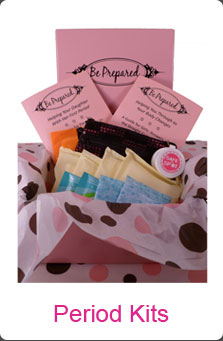 I have a good friend who made a menstrual kit for his daughter to start keeping in her book bag around age 11. In a zip lock bag he placed a change of underwear, menstrual pads, Tylenol, a change of shorts, and bathroom wipes. That way, if her first period was at school, she had everything she needed and wouldn’t need to ask for support unless she wanted to. I personally think this is a wonderful idea and wish my mom had thought of it when I was middle school! This idea has caught on because you can buy premade kits. Also, they make underwear that help keep menstrual pads in place.
I have heard that some families also preemptively use pain relief to support with discomfort and PMS. Not all girls associate the physical discomfort with their period or are able to communicate “I feel bloated” or “I have cramps.” Although these are phrases that you can teach and prompt, some families just start using an over the counter painkiller two or three days before they anticipate the start of the period. This isn’t foolproof because, especially when girls first start getting their period, they may have irregular cycles.
Autism Now- A Resource
 Autism Now isn’t specifically focused on topics related to sexuality but they do have some great resources I thought I could highlight.
They have a series of webinars related to sexuality topics. If you click on the link you’ll be taken to a registration box that you have to fill out to view the material. I’ve also included links to the slides- this is a direct link, you don’t need to register.
Slides: “Sex is when people use their bodies together to share love and pleasure.”
Slides: “Research says that the IQ has to be below 50 before you can say IQ and parenting skill are connected (Feldman& Tymchuk, 2002).”
And they just had one on May 15th, but you’ll have to keep an eye on the archive list because it’s not up yet- “Let’s Talk About Sex: Discussing the Topics of Sex, Protection, and/or Sexuality from Three Unique Viewpoints”
In addition to the webinars they have some general “fact sheet” style info that might be helpful on topics such as dating, marriage, divorce, relationships, sexuality, parenting, and friendships. These include general information as well as parent tips.
I was really impressed by the quality and quantity of ASD related resources on a variety of topics so it’s a good one to have in your tool belt.
I just wanted to link to one other power point presentation that I thought had a lot of good information. “Sexuality & Sexuality Instruction with Learners with Autism Spectrum Disorders and Other Developmental Disabilities” by Peter F. Gerhardt, Ed.D., Director The McCarton Upper School
Are Individuals with ASD at an Increased Risk of Sexual Abuse?
It is difficult to determine the exact risk of sexual abuse for individuals with ASD (it’s hard to get a good report of sexual abuse among the general population). The first national survey reports victimization rates of 27% for women and 16% of men among the general population (Finkelhor et al., 1990). A study has shown that children with disabilities are 1.7 times more likely to experience sexual abuse however all children with disabilities were examined, not just individuals with ASD (Crosse, Kaye & Ratnofsky, 1993). Individuals who are caregiver dependent may be at the highest risk because family members, family acquaintances, and paid caregivers are the most likely to commit sexual abuse (Mansell et al., 1996). Difficulties communicating, lack of knowledge of sexual norms and activities, and isolation may contribute to increased risk of sexual abuse among individuals with ASD. Sexuality education may provide opportunities to for individuals to be better able to communicate and better understand social norms and activities. Furthermore if the support systems of individuals with ASD are in openly talking about sexuality it may create a climate where this abuse is less likely to happen. The Department of Human Services in Illinois has started a project to end sexual violence against women with disabilities. I’ve gotten to meet several people working on the project and they are very knowledgeable and dedicated. I hope they succeed!

Teaching Strategies- Autism Internet Modules
 Many of the teaching strategies that you use when teaching human sexuality you also use in many other contexts. Autism Internet Modules can help you learn teaching strategies like the ones listed below (currently they have 37 modules and they are always adding more). The modules give a really complete overview (they can be a little boring but overall they are very helpful). Some these may be a review but others may be something you have heard of but aren’t quite sure what it really is. What’s especially nice is often the expert who developed the technique is the one teaching the module. Just a little warning- you do have to set up a log in. Many of these interventions have been specifically developed for people with Autism Spectrum Disorders- but not all of them!
Antecedent-Based Interventions (ABI) – Differential Reinforcement – Extinction – Functional Communication Training – Language and Communication – Naturalistic Intervention – Overview of Social Skills Functioning and Programming – Parent-Implemented Intervention – Peer-Mediated Instruction and Intervention (PMII) – Picture Exchange Communic ation System (PECS) – Pivotal Response Training (PRT) – Preparing Individuals for Employment – Prompting – Reinforcement – Repetitive Patterns of Behavior, Interests, and Activities – Response Interruption/Redirection – Rules and Routines – Self-Management – Social Narratives – Social Skills Groups – Social Supports for Transition-Aged Individuals – The Incredible 5-Point Scale – Visual Supports
For those of you who attended the workshop, in the workbook starting on page 34 there is a table with examples of strategies. Some of the strategies come from Autism Internet Modules.
A Thinking Person’s Guide to Autism
 “A Thinking Person’s Guide to Autism” is a wonderful resource and online community. They have a blog, facebook page, and book so you can check them out in what ever way is most comfortable to you. Although they deal with many topics related to Autism Spectrum Disorders, they often touch on topics of sexuality.
I especially would recommend checking out this post, “Talking About Sex with Young Adults with Autism” Here’s an excerpt.
“Amy looked nice, but the grown-ups wouldn’t let us go in Amy’s room and shut the door.”
“Did Amy want to go in her room with you and shut the door?”
“Not really. So we went outside and the parents kept watching us.”
“Did Amy want to be alone with you outside?”
“I’m not sure.”
“Did you touch Amy?”
“I wanted to. I wanted her to lie down on the grass so we could do sex.”
“Have you ever had sex with anyone else?”
“Probably not.”

