LGBTQIA+ Definitions Plain Language Guide

Below is a plain language guide. This resource allows for individuals to easily access and understand LGBTQIA+ identities, and can be used for educational purposes. The definitions were sourced from @IncludedUD on Instagram, as well as the Human Rights Campaign (HRC). These two links will take you to the Instagram and to the HRC’s glossary of LGBTQIA+ terms respectively.

***plain text language***
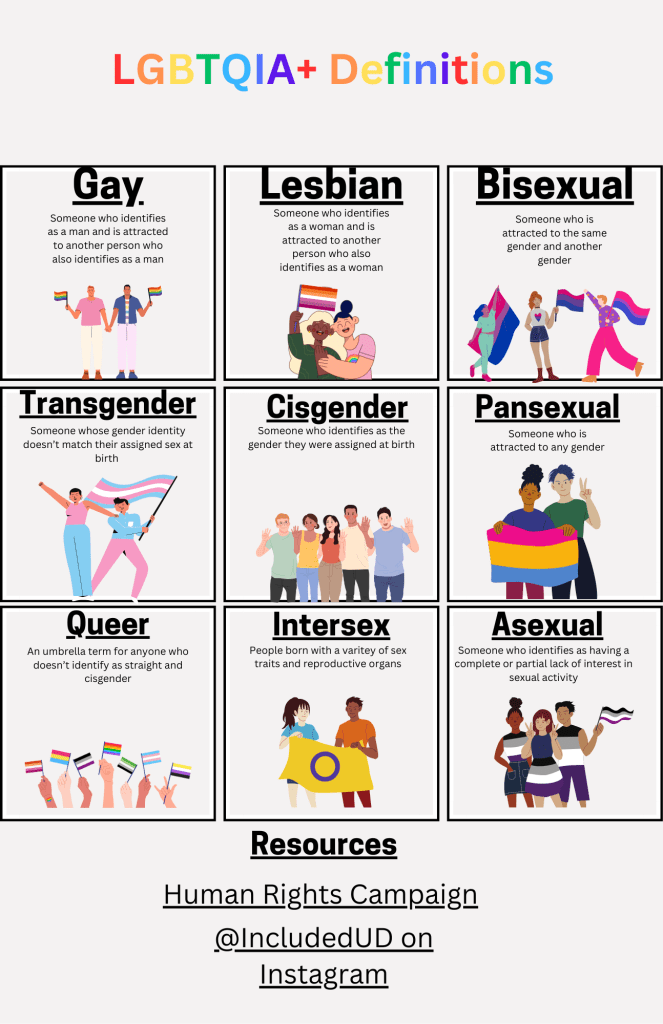
Image text is duplicated below. Pictures show happy queer individuals, couples, and groups with symbolic LGBTQIA+ flags

Below is an screen-reader friendly Plain Language Guide without images.

LGBTQIA+ Plain Language Guide

Gay
Someone who identifies as a man and is attracted to another person who also identifies as a man.

Lesbian
Someone who identifies as a woman and is attracted to another person who also identifies as a woman.

Bisexual
Someone who is attracted to the same gender and another gender.

Transgender
Someone whose gender identity doesn’t match their assigned sex at birth.

Cisgender
Someone who identifies as the gender they were assigned sex at birth.

Pansexual
Someone who is attracted to any gender.

Queer
An umbrella term for anyone who doesn’t identify as straight and cisgender.
Intersex
People who are born with a variety of sex traits and reproductive organs.
Asexual
Someone who identifies as having a complete or partial lack of interest in sexual activity.

Rewire News Group

Rewire News Group is a news website that is focused on sexual health and social justice. They are looking to “reshape the national dialogue on all things sex by making it more inclusive, positive, and centered on social justice.” The website itself is not focused on intellectual disabilities, however, they do offer some amazing articles about issues in the disability community.

Disabled People Are Still Being Forcible Sterilized- So Why Isn’t Anyone Talking About It?

The Fight for Reproductive Rights Too Often Excludes Disabled Parents

Discussing Disabled Sexuality Is a Radical Act

Privacy Activity

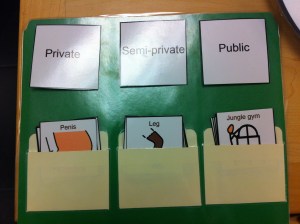
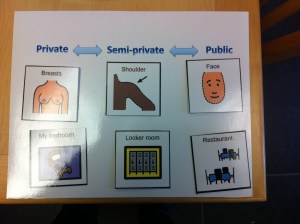
Teaching and learning about privacy can be difficult and confusing. This activity uses a continuum of privacy  (using private, semi-private, and public) to help differentiate privacy levels. There are two topics: body parts and places. You can use this activity to explain different privacy levels and explain contextual differences (i.e. a stomach can be a public body part at the beach, but a private body part at school) . Download the privacy activity places and body parts here!

privacy pocketsprivacy continuum