How to Set Healthy Boundaries

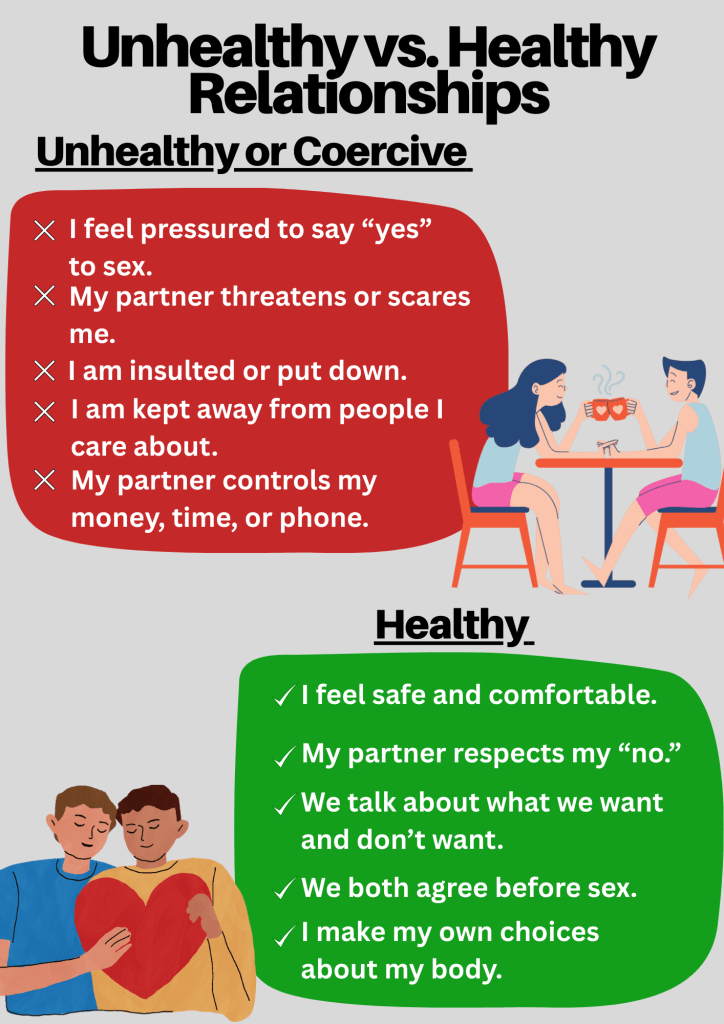
This photo contains a checklist that breaks down unhealthy vs. healthy relationships. In unhealthy or coercive relationships, a person may feel pressured to say yes to sex, they can be insulted or threatened, and kept away from people or belongings. In a healthy relationship, people feel safe and comfortable, respects when someone says no, agree before having sex, and have control over your own body. Two people are sitting at a table holding mugs in one corner while two other people are hugging and holding a heart to their chest.

Boundaries

To ensure that individuals do not experience types of coercion mentioned above, it is important that healthy boundaries are developed. Without healthy boundaries, relationships can become toxic and unsatisfying, and the individual’s well-being can suffer. Healthy boundaries are meant to [1]:

  • Encourage autonomy and reduce codependent habits
  • Set expectations when interacting with others
  • Give you a sense of empowerment and self-respect
  • Ensure your physical and emotional comfort
  • Clarity on individual responsibilities in a relationship
  • Clarify individual responsibilities in a relationship
  • Separate your wants, needs, thoughts, and feelings from those of others

Before getting into a relationship, it is imperative to develop personal boundaries and ensure that those boundaries are respected.
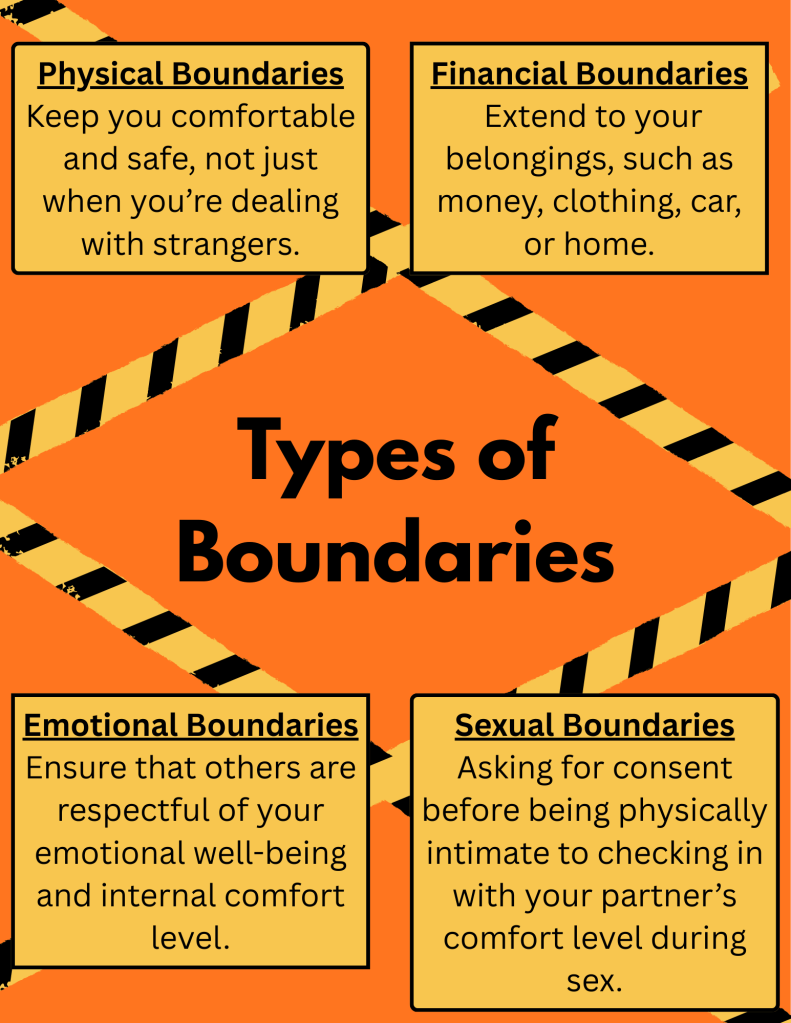
Orange box with danger tape running an "x" shape across it. The text describes the different types of boundaries: physical boundaries, financial boundaries, emotional boundaries, and sexual boundaries. Physical boundaries can be defined as those that keep you comfortable and safe. Financial boundaries are those that extend to your belongings. Emotional boundaries ensure that others are respectful of your well-being and internal comfort. Sexual boundaries require asking for consent before being physically intimate.

Sexual Readiness

An important thing to consider when discussing relationships is sexual readiness. Sexual readiness means thinking carefully about whether you are truly ready to engage in sexual activity with a partner [2].
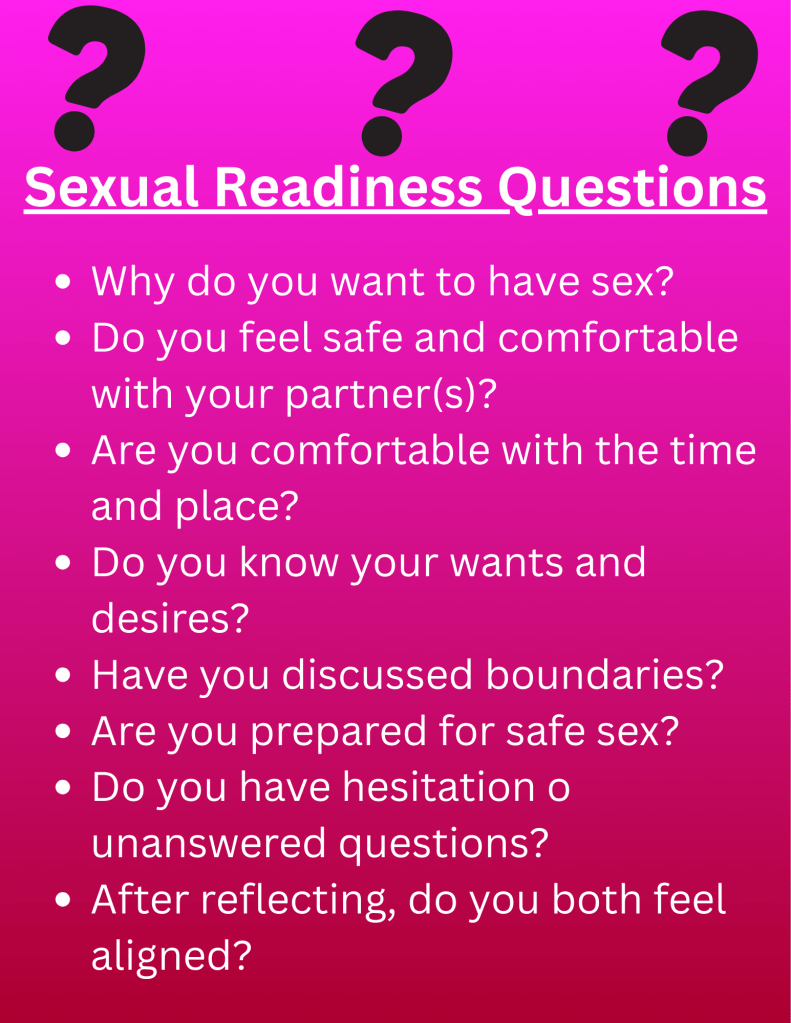
Pink infographic with a list of questions to ask how ready someone is to have sex: Why do you want to have sex? Do you feel safe and comfortable with your partner(s)? Are you comfortable with the time and place? Do you know your wants and desires? Have you discussed boundaries? Are you prepared for safe sex? Do you have hesitation or unanswered questions? Do you both feel aligned?

Coercion

In some relationships, individuals use a tactic called ‘coercion’ to ensure their partner does not leave the relationship. According to Webster’s dictionary, coercion is “to compel an act or choice” [3]. Regarding relationships, coercive control is seen through emotional abuse in intimate partner settings and may sometimes include physical force [4]. Types of coercive control include:

  • Assault – Assault is one of the most extreme versions of coercive control, as it involves physically forcing an individual to conduct an action. Assault includes hitting, choking, slapping, kicking, biting, using weapons, and exposure to dangerous situations.
  • Threats – Threats are declarations of impending consequences intended to create fear. Example statements include, ‘That better not stay that way, or you’ll regret it’, ‘The next time you do that, the dog is going to the shelter’, and ‘You’re going to be sorry you did that’.
  • Insults or Humiliation – When a partner insults or humiliates an individual, it can be done with the intention to break down the individual’s self-esteem and make them believe they cannot function without the partner. Some examples include making jokes at your expense, calling you names, and regularly making critical comments about your appearance.
  • Isolation – When a partner forbids an individual from interacting with others, it can inhibit the individual from being able to verify abusive relationship behaviors. Examples include making excuses why you can’t attend family events or social functions, using guilt to get you to stay at home, and making fun of your interests to discourage you.
  • Activity Monitoring – Activity monitoring is a tactic utilized to subtly remind an individual that their partner is always around, judging their behaviors. Examples include whole-home surveillance technology (including private areas like the bathroom), checking your internet usage and browser history, and using tracking technology on your phone or car.
  • Financial Control – When a partner scrutinizes, controls, or limits financial control, a situation is developed where an individual depends on that partner for basic needs. Examples include being restricted to an allowance, insisting on sharing financial account information, and running up debt under your name.
  • Sexual Coercion – When a partner makes an individual feel pressured, manipulated, or tricked into sexual interaction. For example, making you feel obligated to engage in sex, offering a reward for sex, or threatening consequences if you don’t engage in a sexual act.
  • Removing Autonomy – When someone takes away the freedom of personal choice. It is a form utilized to dismiss an individual’s feelings and make them feel inferior. Examples include insisting you use certain products (shampoo, body spray, soap, hygiene items), replacing your things with versions they feel are superior, regulating your sleep, eating, or bathroom activities.

Conclusion

No matter your attachment style, it’s important to regulate your emotions, take time to think before agreeing or initiating sex, and remember sex does not equal love or commitment [6]. If someone is pressuring you into sex, and you feel safe, be direct and firm with the individual [7]. Let the individual know that pressure will not change your mind or that you are not interested. If the pursuit continues, call individuals that you trust (family, friends, police). Some individuals to help you create an exit strategy from a coercive relationship include 1-800-799-7233, thehotline.org, and texting “START” to 88788.
Beyond The Myths: Inclusive Sex Education and Mental Health Awareness

Exploring your sexuality can be confusing, especially when you start engaging in sexual acts with other people for the first time. Virginity is the term used to describe the state of never having had sex, and “losing your virginity” can be nerve-wracking. Even the word “losing” is not the best description, because you should be gaining something from your experience instead. There are many misconceptions around sex that can contribute to feeling anxious about having sex for the first time. This is a guide that debunks myths and discusses the many ways you can have sex to help you feel a little more comfortable when engaging in sexual acts, and the importance of your mental wellbeing when it comes to this.

Sex Myths

Myth Reality 
You will feel different after having sex.People often believe after having sex for the first time it will instantly change everything and bring a complete happiness in your life. The truth is there is no “right” way to feel after having it. You can feel happy, anxious, calm, excited, nervous, or even the same. All of these reactions are completely normal. 
Pain is always present.First time sex can feel uncomfortable at first. The vagina is muscle so when it is being strecthed it comes along with discomfort. But with communication, patience, and enough foreplay with your partner the discomfort will last for only a little bit. If the pain is severe or ongoing it is a good idea to talk to a healthcare professional because sex is not supposed to hurt. 
It will be perfect and magical. Watching television they depict first time sex as something magical and smooth. In reality that is not always the case. First time sex can be awkward and nervewracking and that is okay! Learning and figuring things out with your partner is completely normal. It does not have to be perfect for it to be meaningful.  
Talking about boundaries will ruin the mood.This is absolutely not true. If there is something you do not feel comfortable with when about to have sex with your partner, make sure you say it. You saying it will not ruin the mood whatsoever. It will just make sure that you are being treated with respect and that you are not uncomfortable during the experience. When both partners feel safe and heard, it will create a more positive experience. 
Penetration is required. This is a myth because that statement limits the definition of sex to only penis-in-vagina orientation. Intimacy includes many forms such as oral sex, touching, mutual stimulation, and many other experiences. 

Diving Deeper into Inclusive Sex

As mentioned above, “penetration is required” for sex is a myth because of the many ways to be sexual, and based on your pain or mobility restrictions, sensory sensitivities, gender identity, and sexual orientation, sex may be different than how you imagined it. There is no one or “real” way to have sex; it is whatever you and your partner are comfortable with, so it’s important to talk to your partner about boundaries and what sex you would like to have.

There are many different ways people have sex:

  • Anal sex – a penis is inserted into another person’s anus
  • Oral sex – a person licks a person’s vulva, vagina, or clitoris or a person kisses/sucks a person’s penis
  • A person kisses and sucks the other person’s nipples
  • A person masturbates with another person
  • A person touches another person’s vagina or penis
  • Sex toys (ex: dildos…) are used

This fact sheet provides more information on having sex.

Being comfortable in your sexuality and expressing yourself sexually can help you understand yourself better and be in control of your own life. It can also give you confidence to have sex successfully (based on your own personal view of what “successful” sex is) and deepen your connection with your partners.

Resources To Promote Positive Mental Health

For LGBTQ+ individuals with disabilities, the LGBTQ+ community and spaces can act as a protective factor as it helps foster a sense of belonging, reduce isolation, and supports positive self-identity. However, LGTBQ+ people with disabilities also report higher rates of mental health concerns. The Trevor Project has a guide on their website for supporting LGBTQ+ people with disabilities, including direct links to resources that can be found on page 14 on the PDF format.

We wanted to attach some resources if you or someone you know is struggling with mental health concerns. The Cleveland Clinic provides more information about suicide and its warning signs on its website at https://my.clevelandclinic.org/health/articles/suicide.

The Never a Bother campaign is a youth suicide prevention awareness and outreach campaign for young people and their parents, caregivers, and allies. To get involved, please visit https://neverabother.org/

Resources for Conversations about Consent

What is consent?

According to Planned Parenthood, sexual consent is “an agreement to participate in sexual activity. Consent lets someone know that sex is wanted.”

Sexual activity can be a lot of different types of activities, from kissing to sexual intercourse to oral sex.

Judging consent between partners, as well as self-reflection about consent, is crucial for sexual activity. This article will provide resources for accessing and reflecting on consent, and ensure that consent is an easier conversation.

A very helpful tool to gauge consent is the Verbal Informed Sexual Consent Assessment Tool. This source shares important reflection questions to analyze whether someone can give consent, giving a checklist as well as examples of questions to ask.

For more information about legality and restrictions about consent, refer to our webpages article about the Capacity to Consent to Sexual Activity.

The Conversation of Consent

Consent can be a very simple conversation. Once you know that you and your partner are capable, informed, and confident in making decisions about sexual behaviors, have a conversation with your partner. Ask your partner what their boundaries are, and what sexual behaviors are okay with them. Sexual behaviors are a continuous conversation, that is that the conversation will continue to come up, and the result of the conversation can change. If you or your partner consents to kissing one day, and says “no” to kissing the next day, consent is being taken away and kissing shouldn’t continue to happen until consent is given again. For tools about how to revoke consent, refer to our webpage graphic about Ways to Say No .

This website from Planned Parenthood gives more examples of how to talk with your partner about consent, including examples such as how to check in on consent.

These two videos explain consent and boundaries. The second video also gives an example!

Parent Tip Sheets

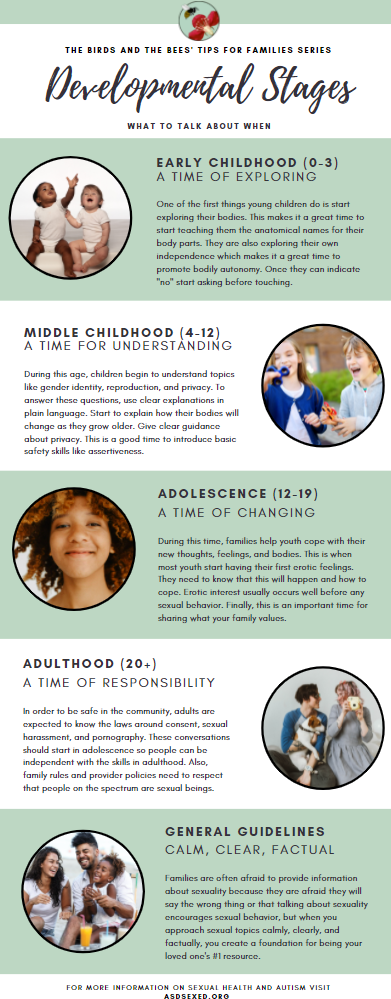
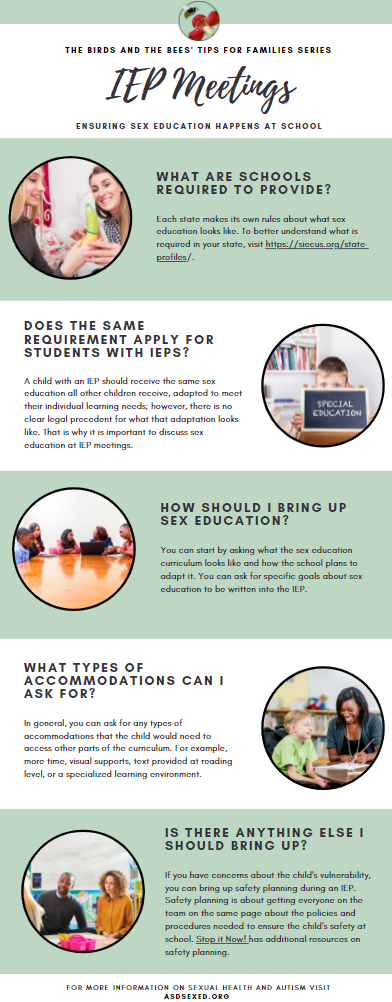
Navigating developmental stages, education, and sex education can be extremely difficult. The Birds & The Bees team put together a parent tip sheet that offers basic information and resources for parents of autistic children. View the tip sheets in the slide show and download below.

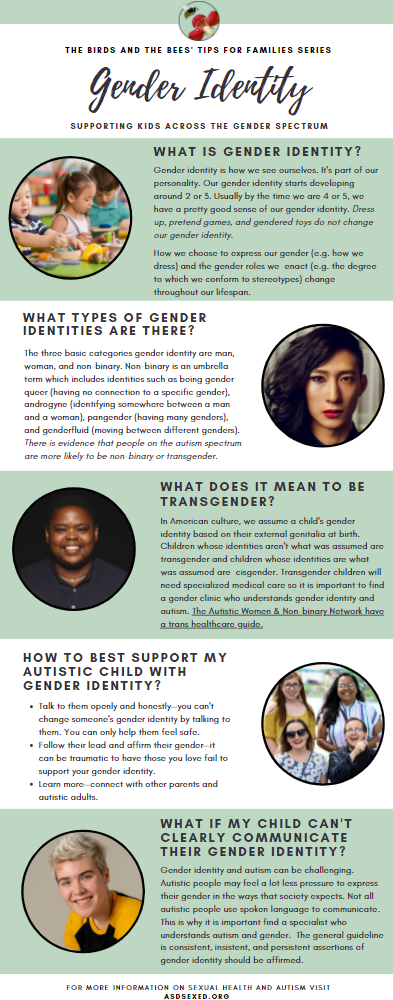
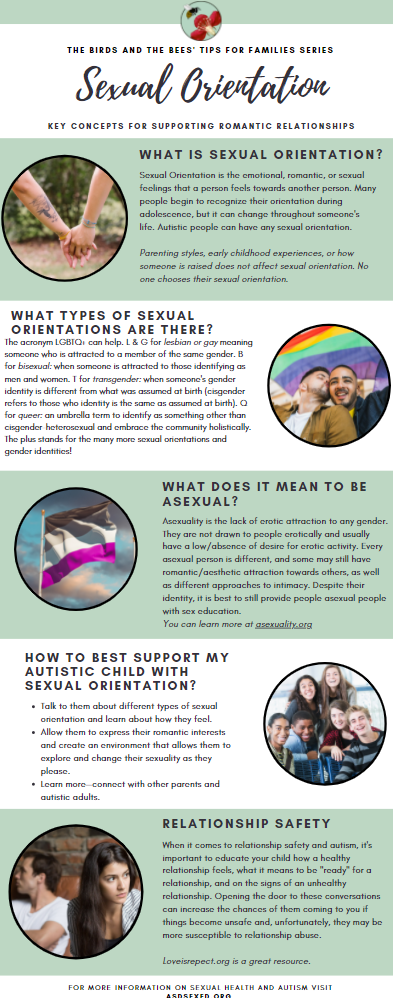
  • In Script, a title reads "The Birds and The Bees Tips for families Series" The first picture shows two babies happily sitting on the floor, looking up towards the sky. The second pictures shows two laughing children playing with fidget spinners. The next picture shows an young African American girl smiling. The following picture shows a young couple, each holding a dog.

Erotic Audios

While many people are familiar with pornography, it’s not always suited for everybody. Some people may become overstimulated, overwhelmed, or just downright uncomfortable when trying to enjoy an adult film. While there are some alternatives, like erotic scripts and stories, there is still an increasing amount of people looking for more options. An increasingly popular alternative is erotic audios, which are recordings of actors engaging in sexual activity.

PsstAudio is a website that is dedicated to erotic audios, scripts, and texts. This website allows users to listen to a library of audios, as well as upload their own. It’s easy to navigate, search, listen to and save audios, and it’s completely free to users. You must be over the age of 18 to create and account. The website’s homepage can be found here: https://psstaudio.com/

@LingerieLitClub is both a Twitter account and a Discord server that promotes erotic audios. They constantly post links to new audios, as well as hold events on their Discord server. They hold Intimate Poetry Nights, Q&A nights with audio performers and authors, as well as large group calls where you can speak to other people a part of the server. All of their events are completely free and the audios they post are accessible to everyone! Their links can be found below:

Twitter: https://twitter.com/lingerielitclub?lang=en

Discord: https://discord.com/invite/llc

Erotic audios offer a new way for people with Intellectual disabilities to find sexual pleasure because they are a less stimulating alternative to pornography. These new options promote sexual health for everybody and have made pleasure more accessible!

Mad Hatter Wellness

Mad Hatter Wellness is a company that creates comprehensive sexual health programs that teach and empower people with intellectual disabilities. Their curriculum Sexuality for All Abilities, contains activities and lessons that cover many different topics regarding sexuality and relationships. This is a holistic program that combines mindfulness techniques to address sexuality topics and provides a safe environment that ensures growth and learning. They offer a student and an adult option of the curriculum and can be purchased for $375 at the link below.

On top of this, Mad Hatter Wellness also sells other tools to help teach and practice topics that are covered in the curriculum. Their Boundaries Flip Book that form sentences regarding boundaries. It created discussion for healthy boundaries, as well as highlights what is okay and what isn’t, and when these behaviors are appropriate. On top of this, they also have a Family Discussion Guide, which offers activities, information, and discussion questions that will help families discuss healthy relationships and boundaries. In addition to these, they offer self-paced online courses, and more physical resources that can be used to implement the curriculum.

Accessible Sex Toys

While many other household items are changing and being developed more accessibly, any industries regarding sex often stay avoided. Sex is such a taboo topic in general, even more so in the disabled community. There are many rumors and assumptions made about sexuality in the disabled community, the most prevalent myth is that people with any type of disabilities don’t have sex or experience sexual pleasure. However, that’s not true. Sex is a basic human function, and everyone, regardless of ability, is entitled to it. Many times, sex toys are extremely inaccessible for people with physical and intellectual disabilities. Whether they’re not easy to physically work with, or they’re too stimulating, sex toys aren’t usually designed with all types of bodies in mind.

Come As You Are is an online business specializing in high-quality, ethically sourced, and affordable sex toys for all ability levels. This company has a wide variety of sex toys that are designed to work for people with all types of disabilities. When making their toys, they keep topics like mobility, privacy, fatigue, and many others in mind when creating sex toys. They are very transparent about how their toys are made, and they take suggestions about how to better improve their toys and make them more inclusive. They say, “It’s our experience that doesn’t come ‘naturally’ to everyone. We consider it our responsibility to do the hard work that makes it easier to explore.”

On top of this, their website has many articles and resources that talk about inclusivity in the sex industry. Their articles discuss choosing the right sex toy depending on your ability, information about condoms, and many other aspects of sexuality. They encourage embracing sexuality healthily, despite your skill level, and are pushing the sex industry in a more inclusive direction!

The website’s home page is linked below:

https://www.comeasyouare.com/

Also, here’s more information from our team about the importance of affirming sexual expression! (article linked below)

https://asdsexed.org/2013/02/01/affirming-sexual-expression-accessible-sex-toys/

Sex Ed Rescue

Properly educating children on sex, puberty, and many other related topics can be challenging for parents. Many parents struggle with how they should speak to their child about these topics, and when the time is right. Sex Ed Rescue is a YouTube channel designed to educate parents on how to talk to their kids about these topics. This channel includes instructional videos, Q&A’s, children’s book reviews, and many other educational resources. It is a great resource to help parents educate their children on sex. It also helps to create a more age-appropriate environment for the child, and encourages comfortable communication between the child and the parent.

Linked below is the channel’s introduction video and the channel’s homepage.

Sex Ed Rescue: Homepage

Talking About Sex: Sexuality Education for Learners with Disabilities

From the Publishers:

Key social and emotional milestones during adolescence are often directly related to the abilities to initiate and maintain intimate relationships, maintain physically maturing bodies, and manage personal sexuality. Most adolescents with developmental disabilities have particular difficulty expressing sexuality in satisfying ways, consequently facing issues such as limited intimate relationships, low self-esteem, increased social isolation, deregulated emotional maintenance, reduced sexual functioning, and limited sexual health.
Appropriate sexual knowledge assists not only in achieving personal fulfillment, but protection from mistreatment, abuse, unplanned pregnancies, or sexually transmitted diseases (STDs). It also works to help solve problems of loneliness and problems with self-esteem.
This book will address this but also much more. Issues of physical and cognitive development will be discussed, including appropriate sexual development/urges and brain development, and innate similarities and differences of sexuality that could occur between people with autism spectrum disorders and intellectual or developmental disabilities, including the complexities of physical disabilities. The authors will also consider special considerations for group homes and recreational facilities, and specifically focus on concepts of ethics and models of consent (medical, legal, social, and educational), as well as how to deal with uncertainty.

How to Explain Sex to Someone with an Intellectual Disability

This may be more difficult than it appears at first.  I like to communicate and teach broad and complex ideas about what sex is, but this can be really difficult for folks to grasp at first.  I usually start out talking about reproduction because it’s a little more concrete and then move into sex more generally once reproductive intercourse, erection, ejaculation, and arousal have been covered.  So lets start with those (and I’ll toss in a couple other concepts that may be difficult to explain).  These are how I explain these concepts, but a curriculum you use may have other suggestions you find helpful.  I used board maker pictures here, but real pictures would also be appropriate in many cases.

Arousal: “When you have sexy feelings and you feel tingly or excited all over your body especially in your private area*.”

*You could substitute genitals, vulva, or penis for private area to be more concrete.  Sometimes with middle school students I say “you know where” to be intentionally more vague- but only if I’m confident they do know where.

Erection: “When blood fills the penis making it harder and bigger”.  I follow this up with the why it happens, “because you have sexy feelings.  You feel aroused.”

Sometimes I add, the blood fills up the spongy tissue of the penis, but other times I omit the blood part and just say the penis gets harder and bigger.  This would depend on the level of complexity the individual can handle.

Ejaculation/Orgasm: “You have sexy feelings, your body feels really good, and you get so excited that you have an orgasm- a big burst of sensation*.” If they have a penis, I add “then fluid comes out of the penis.”  If they have a vulva, I add “then some fluid may come out of the vagina”.  If they ask what kind of fluid you could add, “a sticky milky fluid” and then if they have a penis, “with sperm in it.”

*If sensation is an inappropriate word you could replace it with feelings.

Reproductive Intercourse: “When a person put their penis in another person’s vagina and releases sperm, ejaculates.  If the sperm meets with an egg then the person might get pregnant.  A baby might grow inside the uterus.”

As students are first learning I do call this sex but once they have this I build that sex is bigger than just one act.  It is heteronormative* to present reproductive intercourse as if it was sex.  It could make students who are not interested in vaginal intercourse feel as if their form of sexual expression is less valid.  At the same time, the students that I work with are often overwhelmed by all the new information and have difficulty navigating all the nuances.  When I call this form of sex, “sex”, I do match it with vaginal sex, reproductive intercourse, or intercourse to allude to the idea that there are other forms of sex.

*If you’re not familiar with the term heteronormative, it refers to when heterosexuality is used as the default.  It also refers to other lifestyles that are considered the default.  For example, a heteronormative definition of family would be if you used, implicitly or explicitly, a husband, a wife, and children as the definition of family.

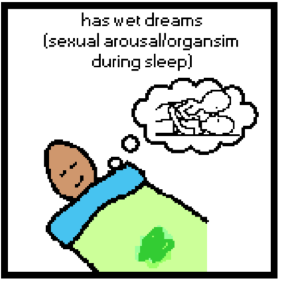
Wet Dream: “Sometimes when you’re sleeping you have have sexy feelings.  These feelings can be so good that you may get really excited in your sleep.  You may feel so good that fluid comes out of your body.”

If they know erection and ejaculation, you can use those words too but I try to limit my use of those words if I’m not confident they have a full conception of the terms.

People with vulvas can have wet dreams too! Regardless of whether there is ejaculation, having organisms and arousal during sleep can be scary. It is an important thing to prepare children for as their bodies change with puberty.

Sex: “Sex is when two people have sexy feelings they want to share with each other so they touch each other’s private parts to make each other feel good.”  You can expand it further, “A person might put their penis inside a person’s vagina.  Sometimes people kiss and lick each other’s vulva or penis.  A person might put their penis inside a person’s anus*.”  If they ask why someone has sex, I would answer “Either because they want to have a baby, because they love each other and they want to share those feelings, or because they want to have fun.”

*I would use butthole if I thought that was a word the person understood better.  In this definition, I’ve defined sex as anal, vaginal, or oral intercourse.

Sperm/Egg: The cells inside a persons body that have genetic information.

Not all folks will grasp the concept of genetic information but they will probably know that it means scientific or medical information.

Next week, well be covering reproduction in Human Sexuality 101 so look check out the curriculum for that section for more information.