Guide For Gynecology and Testicular Exams

Testicular and gynecological exams are very important to the health of your reproductive organs. These exams help to play a critical role in early detections of cancer which can help to increase chances of successful treatment. Testicular exams are used to check for lumps, swelling or changes in the testicles and identify other issues like infections or injuries. Gynecological exams are used to examine the uterus, ovaries, and cervix for any abnormalities along with screening for cancers, infections or other health issues. Overall, these exams are an important part of sexual health. Make sure you are going to get one around once a year. Here is a step-by-step guide of what to expect during these exams.

Testicular Exams:

Purpose: The reason you should get one done is to help detect changes in the testicles early on such as lumps, swelling, or anything that is out of the normal that could indicate cancer or other conditions.

Who should be getting one: A person who has biological male reproductive parts. Men should start getting these around age 15 every year with a healthcare provider.

What to expect during this exam: First you will talk to the doctor. They will ask you questions such as family history and if you are sexually active. They will also ask if you have any concerns that you would like to address. After they will give you privacy to undress from the waist down. You are able to keep your shirt on during this. After the doctor will do a visual check of the scrotum and groin area. Lastly, they will feel each testicle using their fingers to check size, shape, tenderness, or if there are any lumps.

Always remember that at any time during this if you feel uncomfortable you can ask the doctor to stop. You are able to ask any questions you make like and have the doctors explain these steps to you as well.

Gynecology exam:

Purpose of these exams: These exams are important for maintaining reproductive health and catching early problems such as cervical or ovarian cancer. Gynecologists can also help you show your options for different birth control methods such as the pill, IUD, the patch and many others. 

Who should be getting one: Anyone with female reproductive organs should see a gynecologist. Most should start getting exams starting at 21 or sooner if you are sexually active. You can also start going younger if you have any concerns or irregular periods.

What to expect during these exams: Starting off the doctors will come in and discuss any general health concerns or questions you might have. They will ask if your menstrual cycle is regular or if you have concerns about this.

  1. External exam: the docotor will look at the outside of your vagina area to check for irritation, swelling, or any other visible concerns.
  2. Pelvic exam: The doctor will gently examine the internal organs (uterus and ovaries) They do this by inserting one or two gloved fingers while genetly pressing on the abdomen to feel for anything out of the normal.
  3. Speculum exam: It is a medical tool that is used to open the vaginal walls so the doctor can see the cervix. This should not be painful. It can be a little uncomfortable or have some pressure. During this the doctors may collect a small sample of cells from the cervis to screen for early signs of cervical cancer. This is called a pap smear and only takes a few seconds. 

Always remember that at any time during this if you feel uncomfortable you can ask the doctor to stop. You are able to ask any questions you make like and have the doctors explain these steps to you as well.

How to set up an appointment:
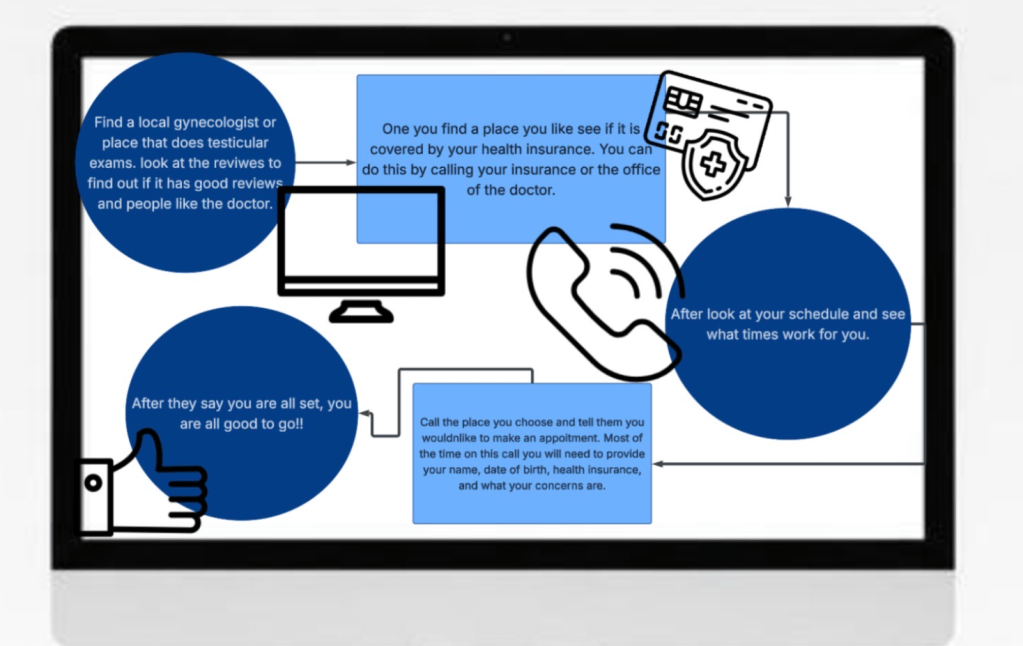
Find a local gynecologist or place that does testicular exams. look at the reviews to find out if it has good reviews and people like the doctor. One you find a place you like see if it is covered by your health insurance. You can do this by calling your insurance or the office of the doctor. Look at you schedule and see what times work for you. Call the place you choose and tell them you would like to make an appoitment. Most of the time on this call you will need to provide your name, date of birth, health insurance, and what your concerns are. After they say you are all set, you are all good to go!

Common concerns 

  1. They are painful: these exams should not be painful at all. If they are painful make sure you let your doctor know so they can help figure out what is going on.
  2. Only get these exams when you are sexually active: you definitely should get these exams while you are sexually active but you should also get them before if you have any concerns. Also get them if testicular or cervix/ovary cancer runs in your family. 

For more information about these exams click on the links below:

Testicular exam – Mayo Clinic

What Happens During a Gyno Exam, From Start to Finish – ScienceInsights

Overall testicular and gynecological exams are an important part of maintaining overall sexual and reproductive health. These exams help you have a peace of mind in early detection of cancers, infections, and any other concerns you may have. Although this can feel nerve-wracking to do, they are very quick, safe, and not painful. Make sure you talk to your doctor if you feel uncomfortable at any time.
Gender Dysphoria in Adolescents

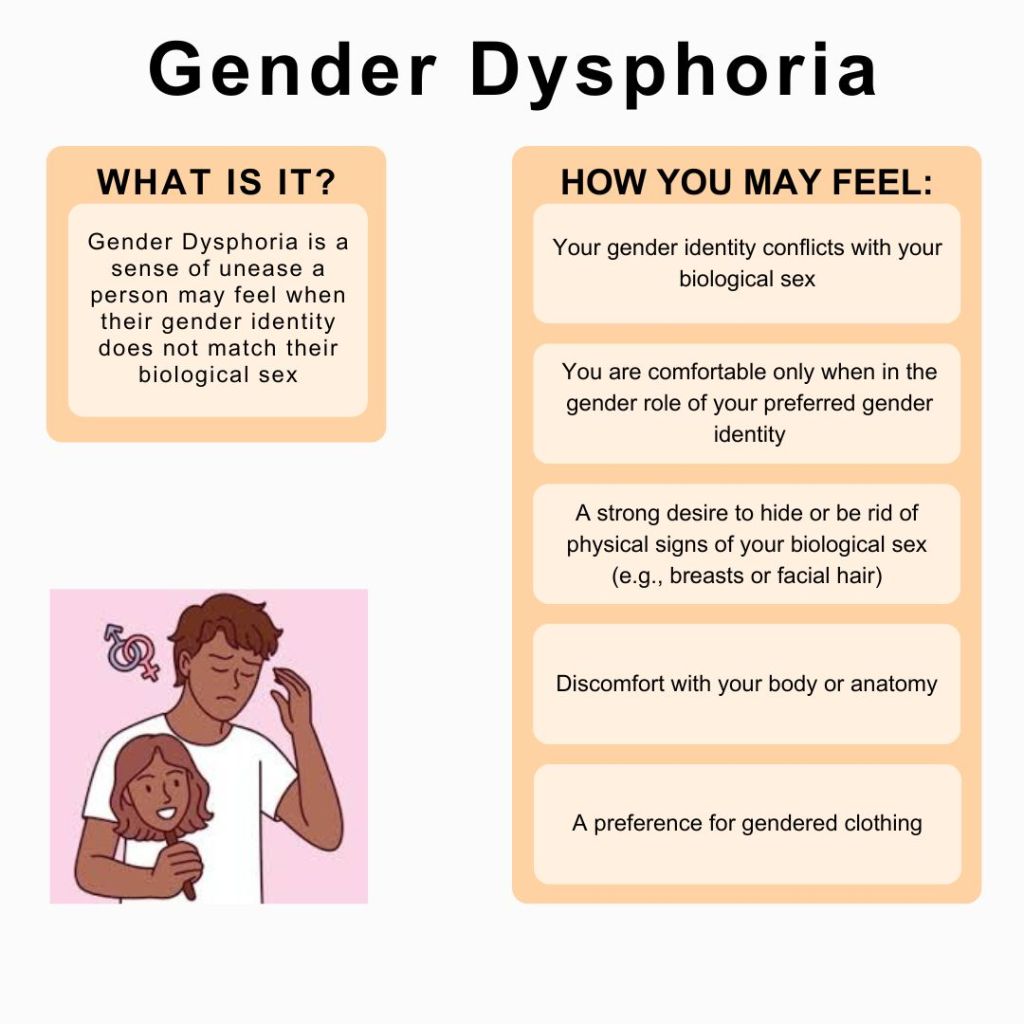
Gender dysphoria is a sense of unease that a person may have because of a mismatch between their sex assigned at birth and gender identity. In adolescence, especially around puberty when young teenagers’ bodies are changing, and they begin exploring their sexual and romantic identities, gender dysphoria typically increases around this time. Included below are some helpful definitions to include in discussions around gender dysphoria, a visual aid tool to discuss how someone may feel if they experience gender dysphoria, and helpful resources from transgender people talking about their gender identity.

Definitions to incorporate while discussing gender dysphoria:

  • Biological sex – label assigned at birth based on physical characteristics (e.g., chromosomes, hormones, and reproductive organs)
  • Primary sex characteristics – changes in the reproductive organs (males: growth of testes, penis, scrotum, and spermarche; females: growth of the uterus and menarche)
  • Secondary sex characteristics – visible physical changes that occur during puberty (males: broader shoulders, a lower voice; females: breast development, hips broaden)
  • Gender Expression – learned roles, behaviors, and actions of women/girls and men/boys (i.e., how society expects certain genders to act and look like)
  • Gender identity – our sense of who we are and how we see and describe ourselves
  • Transgender – people whose gender identity does not match their sex assigned at birth

*For clarification: based on your biological sex (what physical characteristics you are born with), society assigns you a gender (how you should act, what you should be interested, and your role in the world)*

Title: Gender Dysphoria. A single text box titled "What is it?" with the definition below: gender dysphoria is a sense of unease a person may feel when their gender identity does not match their biological sex. A single-column table titled "How you may feel:" In descending order: your gender identity conflicts with your biological sex, you are comfortable only when in the gender role of your preferred gender identity, a strong desire to hide or be rid of physical signs of your biological sex (e.g., breasts or facial hair), discomfort with your body or anatomy, and/or a preference for gendered clothing.

Helpful Resources:

Teen Vogue has an article discussing what it’s like to be transgender and living with gender dysphoria.

The Guardian also has an article where people who identify as transgender discuss their experience with exploring their gender identity. Although gender dysphoria is not the main focus, it is thoroughly discussed in the experiences of the transgender people featured.

This article from BuzzFeed includes people with disabilities exploring their gender identity and how it intersects with their disability. Gender dysphoria is mentioned, but the article mainly focuses on how society has created barriers for transgender people with disabilities. It would still be beneficial to use, as it brings attention to an often overlooked area of the disability and transgender community.

Accessible Mental Health Services

Accessible mental health services can be a challenge for people with disabilities, as there can be a lack of specialized provider training and difficulties with financial costs. We are defining accessibility in terms of disability and financial costs. This post provides a few mental health services for people with disabilities, with some services offering in-person services and others offering both in-person and online services.

Envision Unlimited

Mission Statement: “Envision Unlimited is a certified Community Mental Health Provider offering a full complement of behavioral health services to people with a variety of mental health concerns. We are committed to assisting clients in their best and meaningful lives.”

  • Offers outpatient therapy services to adults and adolescents, both in person and via telehealth
  • Based in Chicago, Illinois

Envision Unlimited emphasizes that no one will be denied access to services due to an inability to pay, and a discount is available.

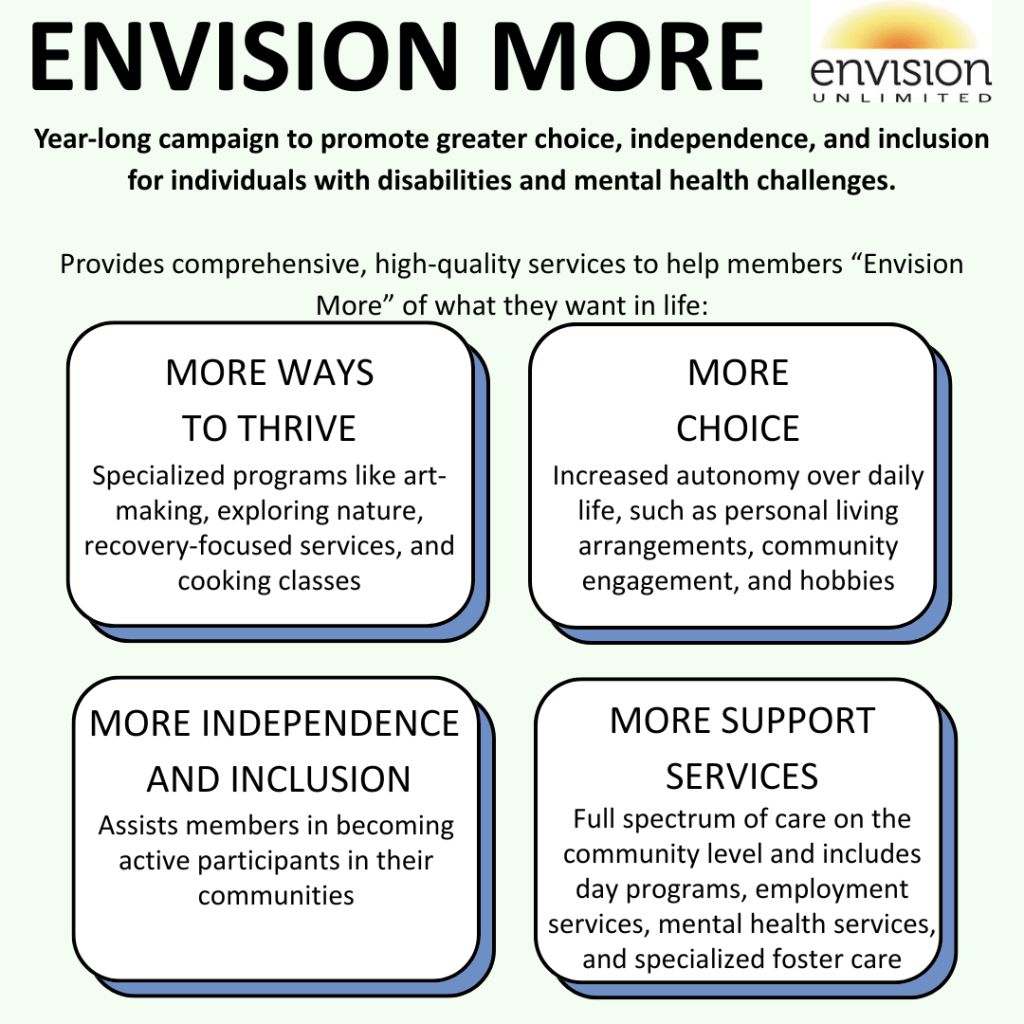
There is also a program called ENVISION MORE for people with disabilities.

Title: ENVISION MORE. Year-long campaign to promote greater choice, independence, and inclusion for individuals with disabilities and mental health challenges. Provides comprehensive, high-quality services to help members "Envision More" of what they want in life. Box 1: More Ways to Thrive; Specialized programs like art-making, exploring nature, recovery-focused services, and cooking classes. Box 2: More Choice; Increased autonomy over daily life, such as personal living arrangements, community engagement, and hobbies. Box 3: More Independence and Inclusion; Assists members in becoming active participants in their communities. Box 4: More Support Services; Full spectrum of care on the community level, and includes day programs, employment services, mental health services, and specialized foster care. The logo for Envision Unlimited is in the upper right-hand corner.

NYSTART (New York Systemic, Therapeutic, Assessment Resources and Treatment)/CSIDD (Crisis Services for Individuals with Intellectual and/or Developmental Disabilities)

Goal: “…to build relationships and support across service systems to help people remain in their homes and communities and enhance the ability of the community to support them.”

  • Offers crisis prevention and response services to people who have both developmental disabilities and complex behavioral needs, as well as to their families and those who provide supports
  • Services are available 24 hours a day, 7 days a week to OPWDD (The New York State Office for People with Developmental Disabilities) eligible individuals age 6 and over who meet NYSTART/CSIDD eligibility
  • Based in New York, must be a New York resident 

The Arc

The Arc company logo.

Mission Statement: “Promoting and protecting the human rights of people with intellectual and developmental disabilities and actively supporting their full inclusion and participation in the community throughout their lifetimes.”

Delaware Disability Resources and Advocacy Organizations

  • All of the following services are based in Delaware

NAMI (National Alliance on Mental Illness)

Mission Statement: “NAMI Delaware supports, educates, and advocates for an improved quality of life for individuals and families affected by mental health conditions.”

  • Offers a variety of signature programs, an annual education conference, and special events (for individuals, families, and professionals to receive support and information)
  • Shapes public policy, has a toll-free NAMI Delaware Helpline, and works with media, educators, healthcare professionals, and elected and appointed officials (to raise awareness, fight stigma, and encourage understanding)
  • This link is for Delaware’s NAMI program, however, there are more than 650 NAMI State Organizations and Affiliates across the country

Division of Substance Abuse and Mental Health

Mission Statement: “To improve the quality of life for Delaware’s citizens by promoting health and well-being, fostering self-sufficiency, and protecting vulnerable populations.”

  • Offers help for mental health issues (in which all services are free, and any referrals are available regardless of insurance), support groups and one-on-one counseling, suicide prevention resources, and other additional resources. 

Mental Health Association in Delaware

Mission Statement: “The Mental Health Association in Delaware strives to strengthen knowledge, resources and support around mental health and recovery.”

  • Offers education, support, and advocacy
  • Support: Offers wellness groups (one is a disability & chronic illness haven wellness group), mental health screening, and a peer support program with the mental health court (mental health court is available for people who have been charged with crimes because of a behavioral health disorder)

LGBTQIA+ Definitions Plain Language Guide

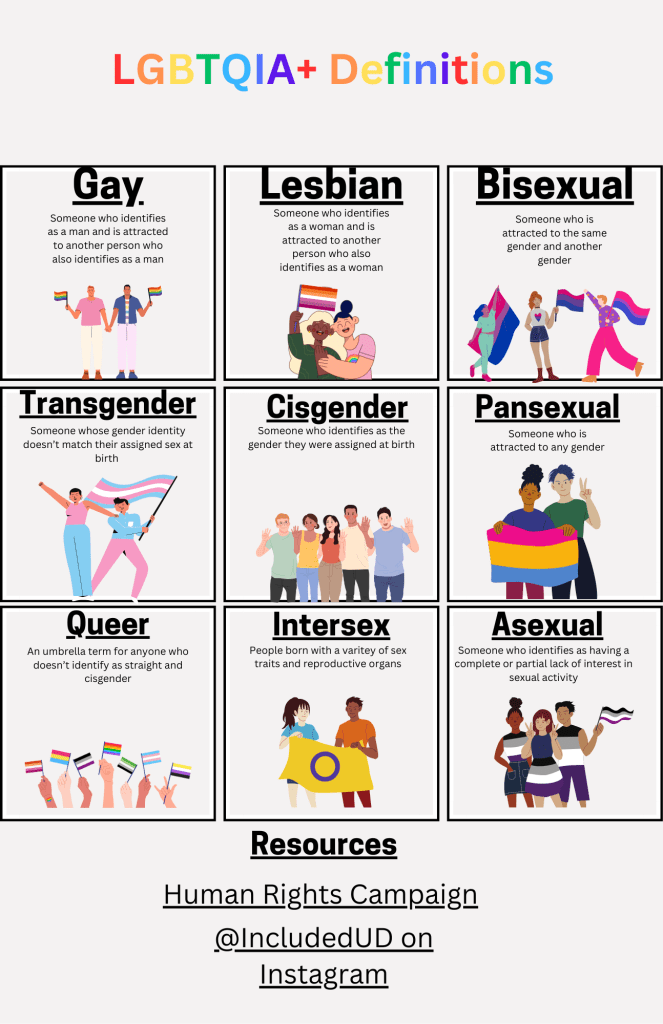
Below is a plain language guide. This resource allows for individuals to easily access and understand LGBTQIA+ identities, and can be used for educational purposes. The definitions were sourced from @IncludedUD on Instagram, as well as the Human Rights Campaign (HRC). These two links will take you to the Instagram and to the HRC’s glossary of LGBTQIA+ terms respectively.

***plain text language***

Image text is duplicated below. Pictures show happy queer individuals, couples, and groups with symbolic LGBTQIA+ flags

Below is an screen-reader friendly Plain Language Guide without images.

LGBTQIA+ Plain Language Guide

Gay
Someone who identifies as a man and is attracted to another person who also identifies as a man.

Lesbian
Someone who identifies as a woman and is attracted to another person who also identifies as a woman.

Bisexual
Someone who is attracted to the same gender and another gender.

Transgender
Someone whose gender identity doesn’t match their assigned sex at birth.

Cisgender
Someone who identifies as the gender they were assigned sex at birth.

Pansexual
Someone who is attracted to any gender.

Queer
An umbrella term for anyone who doesn’t identify as straight and cisgender.
Intersex
People who are born with a variety of sex traits and reproductive organs.
Asexual
Someone who identifies as having a complete or partial lack of interest in sexual activity.

Sex Ed Rescue

Properly educating children on sex, puberty, and many other related topics can be challenging for parents. Many parents struggle with how they should speak to their child about these topics, and when the time is right. Sex Ed Rescue is a YouTube channel designed to educate parents on how to talk to their kids about these topics. This channel includes instructional videos, Q&A’s, children’s book reviews, and many other educational resources. It is a great resource to help parents educate their children on sex. It also helps to create a more age-appropriate environment for the child, and encourages comfortable communication between the child and the parent.

Linked below is the channel’s introduction video and the channel’s homepage.

Sex Ed Rescue: Homepage

Elevatus Training: Online and In-Person Training to be a Sexuality Educator

Elevatus offers a variety trainings staff, direct support professionals, educators, self-advocates and parents to teach sexuality education to children and adults with developmental disabilities. In addition to their trainings, Elevatus has a sex education curriculum that can be purchased.

Here are examples of some of their trainings and the costs:

  • For Staff and Professionals – Developmental Disabilities and Sexuality 101 ($397)
  • For Parents/Guardians – Talking With Your Kids: Developmental Disability and Sexuality ($47)
  • In-service/live workshops and a 3-Day Certificate Training ($725) for anyone who wants to lead sexuality education classes with people with developmental disabilities.

To get more information about Elevatus Training:-https://www.elevatustraining.com/

More Info. Less Weird. AMAZE Takes the Awkward Out of Sex Ed

These days, it is hard to find an age appropriate content about sex, dating and abuse. Children have questions about their bodies, gender and reproduction. Teenagers worry if their bodies are developing normally or not while older adolescents struggle with peer pressure, changing relationships and emerging sexual feelings. AMAZE is an amazing website for parents and educators which helps them to expose their child to age appropriate content about sex through short videos. The website provides an insight to young people to successfully understand puberty, healthy body image, distinguish between healthy and unhealthy relationships, concepts of consent and mutual respect. Video topics are designed to meet the learning objectives outlined in the National Sexuality Education Standards.

Parents are the primary sexual educators of their children. By answering children’s questions, a parent let them know that you are “askable” and establishes an open line of communication that will serve you and your children well as they mature into sexually healthy young adults.

AMAZE also has resources for younger children like the parents’ playlist from amaze jr. It is designed to help parents become comfortable and confident talking to their children openly and honestly at any age.

https://amaze.org/

There are some videos for parents reference.

This video will help parents to know when to talk about sexuality with their kids.

Do you think so playing “doctor – doctor” is safe or not? Check this video out which helps you to communicate your thinking and others about this game.

This video will model to the adolescents with disabilities to learn about manage their relationships with person they like or have attractions. This video guide them to deal with peer pressure and make healthy relationship.

This video helps your child to understand their body parts, difference between a male and female, and similarities between boy and girl.

https://youtu.be/wW627gpkWbw

Sexuality Resources for Parents

Raising an individual with a disability presents a different set of obstacles then an abled individual may, but one topic that all parents must address is sexuality. Individuals with disabilities are sexual beings and therefore deserve an education on sexuality. While parents may acknowledge this need, finding resources and strategies to present the information may be more difficult if you are raising an individual who requires a different method of learning.

The Sexuality Resource Center for Parents provides a well rounded variety of information pertaining to sexuality. The website includes a section of information labeled “for all parents” that contains subjects they believe are useful for all children. In addition, they provide sections titles “For parents of children of typical development”, “For parents of children with developmental disabilities”, and “For parents of children with physical disabilities”. In each section, you can find a variety of information such as basics, specifics, activities, and additional resources. They also include tip guides!

The Sexuality Resource Center for Parents works to provide a better, comprehensive information base for parents to use when addressing sexuality to their child. The variety of knowledge is extremely useful when trying to find information to meet your child’s specific needs. In their own words, their mission statement claims “It’s time to acknowledge that children with developmental disabilities will become adults with sexual feelings, and as such, we must provide them with the information and skills they’ll need to become sexually healthy adults.

http://www.srcp.org/index.html

Guest Room

Guest Room is a short film Written & Directed by Joshua Tate and starring Lauren Potter (“Glee”) and Michael Iovine.  It won the Audience Award (Competition Short) at SXSW 2015.

I think you are going to love this movie.  It’s beautiful, emotional, and honest.  I could easily see this being used in a human sexuality classroom to help discuss parenting, consent, and support from families.  It follows the story of a young couple who are faced in a situation many young couples find themselves in, an unexpected pregnancy.  Like many young couples, the response of their families  is shock and disappointment and this makes it difficult to determine their own feelings, hopes, and wants.

There was one statistic that was mentioned in the film that I had not heard before.  It said that a women with Down Syndrome has a 50% chance of having a child with Down Syndrome.  I did a little digging to see if I could find out more and received some help from The Tech Geneticist a  project from the University of Stanford which seeks to increase the public understanding of genetics.  About half of the eggs of a women with Down Syndrome will have an extra 21st chromosome (similar to what is described in this post http://genetics.thetech.org/ask/ask296).  Her actual chance of having a child with Down Syndrome is less than 50% because fetuses with extra 21st chromosomes are at increased risk of complications.  According to the National Down Syndrome Society only about 50% of women with Down Syndrome are fertile (ovulate).

It’s trickier when it comes to thinking about the father.  Much less is known about the heritability (chance of passing a genetic trait on) of Down Syndrome for men with Down Syndrome, but it may be that their sperm that carry two 21st chromosomes would be less viable than their sperm that only have one.  Both the Tech Geneticist and the National Down Syndrome Society suggested men with Down Syndrome seem to have much lower fertility rates than their same age peers with two 21st chromosomes.