Discover Intimacy Coaching: Reclaiming Connection and Pleasure

Intimacy coaching is a specialized type of relationship coaching that focuses on helping emotional and physical intimacy. Intimacy and connection are essential parts of being human. Everyone deserves the chance to experience it fully. Intimacy coaching offers a supportive, judgement-free space to help individuals or couples explore and deepen their capacity for emotions, physical, and even spiritual intimacy. An intimacy coach helps you reconnect with your desires and communicate your needs. If you’re looking to bring back the spark, try something new, or simply understand your needs/desires better, intimacy coaching is the perfect way to go. 

To learn more about what intimacy coaching does, watch this video.

Here are some intimacy coaches that have great reviews and cater towards people with disabilities. 

Joslyn Nerdahl: Certified Sex Coach and Clinical Sexologist, Physical Disabilities

Joslyn Nerdahl is an intimacy coach who specialize in working with people with physical disabilities. She believes that communication and consent are the foundation of healthy intimacy. She has a passion for helping people learn how to talk about sex openly and provides a safe space for her clients to explore their needs and desires. Her services include intimacy coaching, sex education, and sexual rehabilitation. Learn more about her: Services – Joslyn Nerdahl

Grace Myhill: Intimacy Coach, Neurodiverse Couples Coaching

Grace Myhill is a couples coach and educator who specializes in working with couples where on or both partners are a person with autism. She focuses on each partner experience and validating each other their perspectives. She wants to help both partners work together to build emotional and relation skills. If you want to know more about her work visits her website: https://www.gracemyhill.com/

Dr. Mitchell Tepper: Sex Coach and Educator for People with Physical Disabilities

Dr. Mitchell Tepper is an educator who specializes in working with individuals with disabilities and chronic conditions to help reclaim pleasure and intimacy. His approach focuses on empowerment, inclusion, and accessibility. He emphasizes that everyone, regardless of physical ability deserves access to intimacy, pleasure, and love. To explore his work and resources visit his website: Coaching – Dr. Mitchell Tepper

Amy Gravino: Autism and Sexuality Advocate, Speaker, and Relationship Coach

While Amy Gravino is not an intimacy coach, she still advocates for autism sexuality. She is an educator who empowers autistic adults to embrace healthy relationships, self-advocacy, and sexual expression. If you want to learn more about her advocacy or watch one of her videos visit: A.S.C.O.T Consulting

I think intimacy coaching is a great way to explore yourself, your relationship, and spice things up.

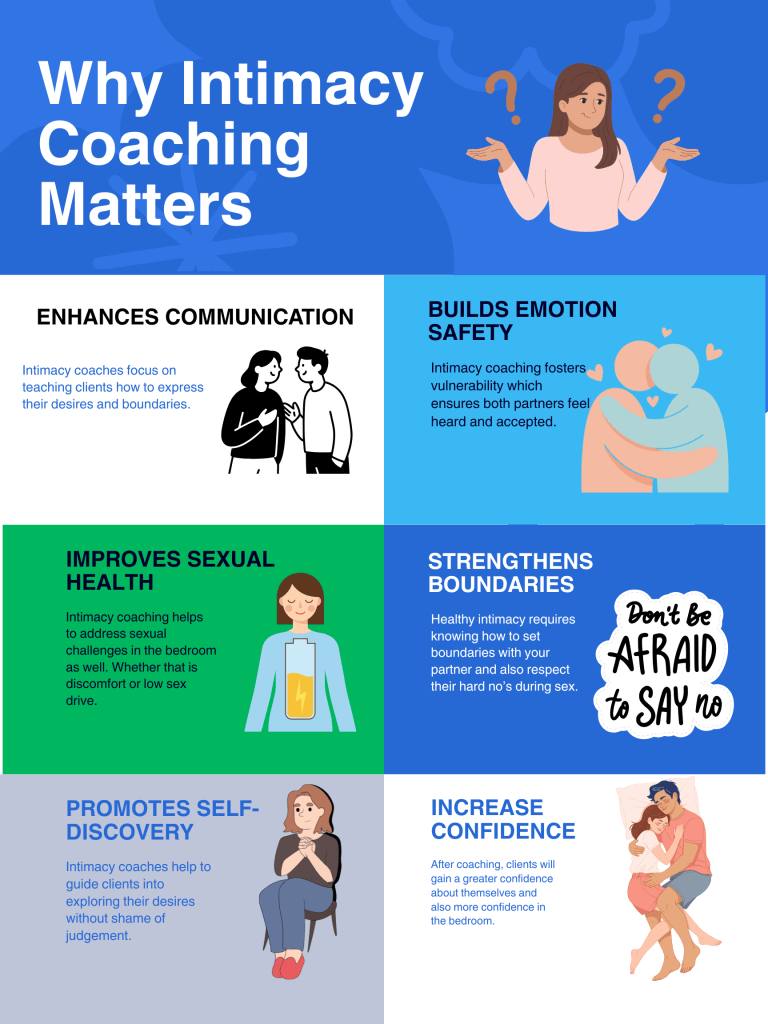
Why intimacy coaching matters. Enhances communication. Intimacy coaches focus on teaching clients how to express their desires and boundaries. Builds emotion safety. Intimacy coaching fosters vulnerability which ensures both partners feel heard and accepted. Improves sexual health. Intimacy coaching helps to address sexual challenges in the bedroom as well. Whether that is discomfort or low sex drive. Strengthen boundaries. Healthy intimacy requires knowing how to set boundaries with your partner and also respect their hard no’s during sex. Promote self discovery. Intimacy coaches help to guide clients into exploring their desires without shame of judgement. Increase confidence. After coaching, clients will gain greater confidence about themselves and also more confidence in the bedroom.

How to Guide on Flirting Online

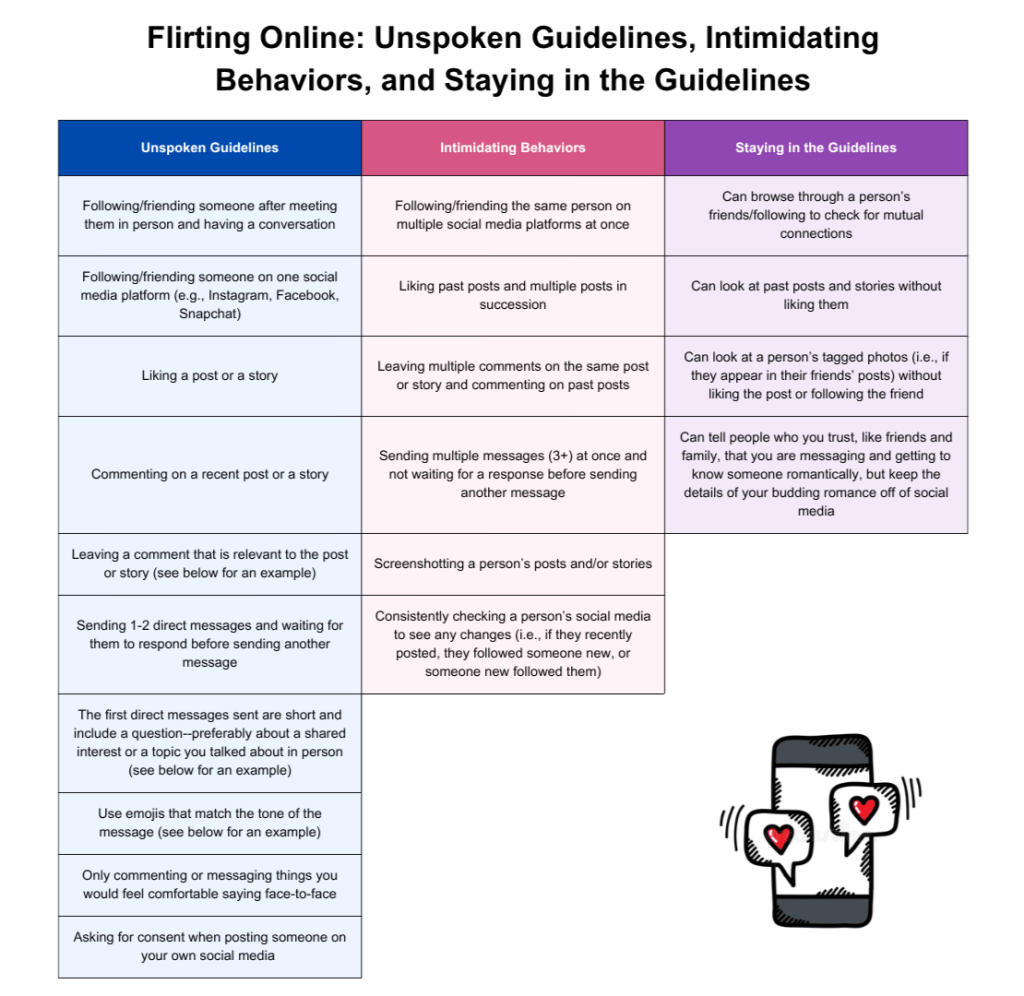
Social media can be difficult to navigate as there are unknown “rules” and behaviors that are widely followed when first interacting with others, especially those you are interested in romantically. This aid demonstrates several unspoken guidelines, intimidating behaviors, and tips on staying within the guidelines on social media when trying to flirt. It is worth mentioning that this is not a comprehensive list of all guidelines and intimidating behaviors, but rather a guide to help you talk to your crush online in a fun, respectful way that keeps everyone comfortable. As a 21-year-old who has been online from a young age, some of these guidelines are based on my own experiences and knowledge.

Table of unspoken guidelines, intimidating behaviors, and tips on staying in the guidelines. From top going down, unspoken guidelines: following/friending someone after them meeting in person, following/friending someone on one social media platform, liking a post/story, commenting on recent post/story, leaving relevant comments on posts/stories, sending 1-2 direct messages and waiting for a response before sending another message, the first direct messages are short and include a question, use emojis that match message tone, only commenting/messaging things you can say face-to-face, and ask for consent when posting someone. From top going down, intimidating behaviors: following/friending someone on multiple social media platforms at once, liking past posts and multiple posts in succession, leaving multiple comments and commenting on past posts, sending multiple messages at once and not waiting for a response before sending another message, screenshotting posts and stories, and consistently checking a person's social media for any changes. From top going down, staying in the guidelines: can browse through a person's friends/following, can look at past posts and stories without liking them, can look at a person's tagged photos without liking the post or following the friend, and can tell people who you trust, like friends and family, that you are getting to know someone, but keeping the details of your budding romance off of social media.

Example of a relevant comment: Someone posts a photo of them graduating school and you comment, “Congratulations!”

Example of a direct message: You talked to someone last week about a book series and sent this message: “Hi! It’s [your name], we talked last week about [book series]. I started reading it and really liked it. Do you have any other recommendations?”

Examples of using emojis: (1) You are messaging your crush about a movie that you both recently watched and talking about a scene that left you in disbelief: “I can’t believe that happened 😭 I was not expecting it at all!” (2) You made plans to hang out with your crush in person and sent this message: “I’m excited to hang out on Saturday 😊 See you then!”

Teen Vogue has a list of questions to keep the conversation going with your crush, whether you’re looking for something low-pressure, flirty, deep, random, interesting, or just plain fun.

The Napoleon Cat Blog gives some tips for commenting on someone’s post, showing different examples for different post scenarios. Some of them are intended for friends, but can still be used for your crush’s posts. Their 35 Short Comments for Instagram section is best used when you first start commenting, as they are simple, not intimidating, and friendly.

Guide to Romantic Boundaries

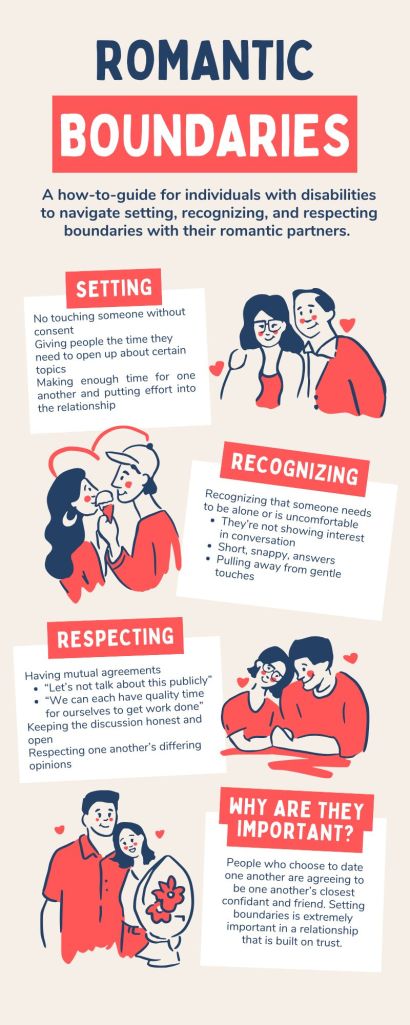
Red and white infographic: a how-to-guide for individuals with disabilities to navigate setting, recognizing, and respecting boundaries with their romantic partners.

We have created a how-to-guide for individuals with disabilities to navigate setting, recognizing, and respecting boundaries with their romantic partners.

The setting in which you touch someone matters. Do not touch someone without their consent. It is also important to give people time to open up about certain topics and give people time to put in effort into a relationship.

Recognizing that someone needs to be alone or is uncomfortable can take time to learn. If someone is not showing interest in a conversation, if they are giving short, snappy answers, or if someone is pulling away from gentle touches are all signs that someone may be uncomfortable or want to be left alone.

Respecting one another’s differing opinions is very important. Keep a discussion honest and open, and have mutual agreements on when and were to have certain conversations.

Finally, setting boundaries are important because you want to build trust in a relationship. This post includes an infographic that can support someone’s quest in finding and maintaining romantic relationships and boundaries.

To support teaching these concepts, we have created a presentation and lesson plan that are free to use.

Self-Advocacy in Sexual Health Appointments

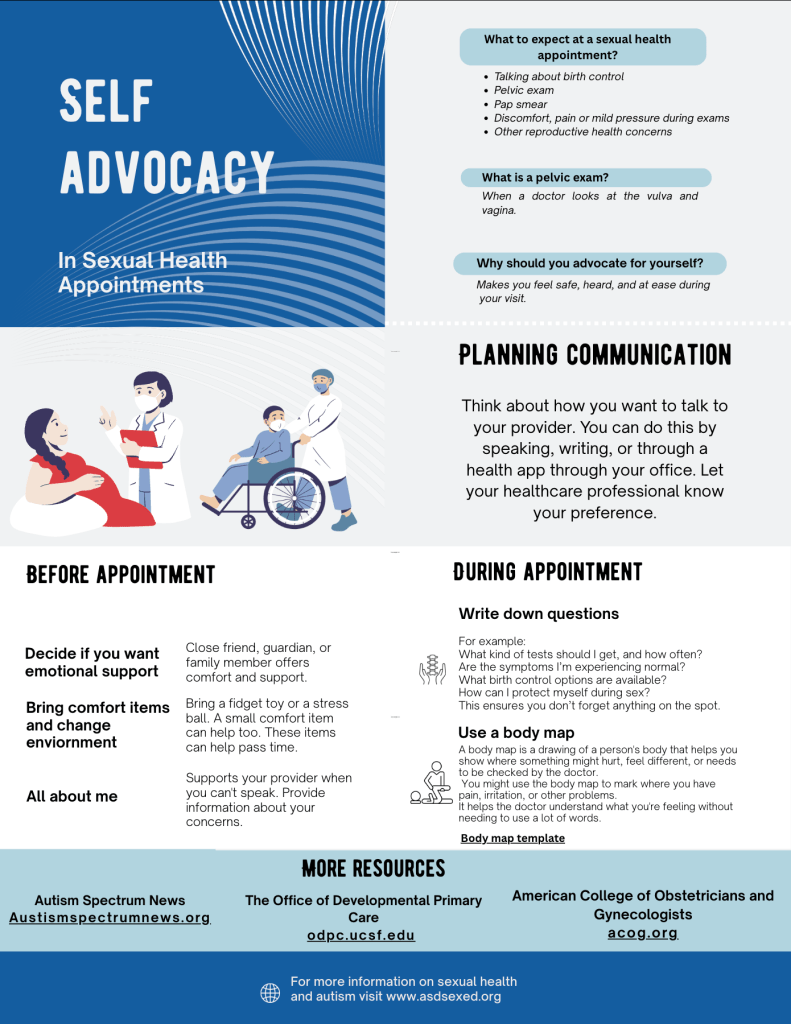
Pelvic exams and sexual health appointments can feel like a lot to handle. A pelvic exam is when a doctor looks at the vulva and vagina. You can calm your nerves by preparing ahead of time. Setting boundaries beforehand also helps. Speaking up for yourself will make you feel safe, heard, and at ease during your visit.

First, what to expect at a sexual health appointment:

  • Routine checkup
  • Discomfort, pain or mild pressure
  • Talking about birth control
  • Pelvic exam
  • Pap smear
  • Reproductive health concerns
    • Infertility
    • Sexual transmitted infections
    • Pregnancy complications

Before your appointment:

  1. Decide if you want emotional support.
    • A close friend, guardian, or family member offers comfort and support.
  2. Bring comfort items.
    • If waiting rooms make you anxious, bring a fidget toy or a stress ball. A small comfort item can help too. These items can help pass time.
  3. Planning Communication
    • Think about how you want to talk to your provider. You can do this by speaking, writing, or using a patient portal. Let your healthcare professional know your preference.
  4. Adjust the environment.
    • Share your lighting preferences. Should it be bright or dim? This will help you feel at ease.
    • If the noise or lights bother you, you can wait in the car until the professionals are ready for you.

During Appointment:

  1. Write down questions.
    • It’s easy to forget questions you had before the professional sees you. Writing or typing them first helps you cover everything you want.
  2. Visuals
    • A body map is a visual tool, a drawing of a persons body. You can show areas of interest on your body by simply pointing. It helps you show where something can hurt or feel different. It also indicates where something needs to be checked by the doctor.
    • If you’re visiting a doctor focused on private parts or sexual health, you can use the body map. For example, it helps show specific areas of concern. Without needing to use a lot of words.
    • Point to or circle areas you want to discuss
    • Use colors or symbols to show pain (ex: red for pain)
    • Write how it feels (sharp, dull, tingly)
    • Check out this Body map template.
  3. Use resources

To prepare for your sexual health appointment, follow these simple steps. It also ensures that all your concerns are covered and helps you feel at ease. Your comfort and well-being are always a number one priority.

Infographic on self-advocacy in sexual health appointments, featuring a doctor, a patient, and medical staff, with sections detailing what to expect during appointments and tips for preparation.

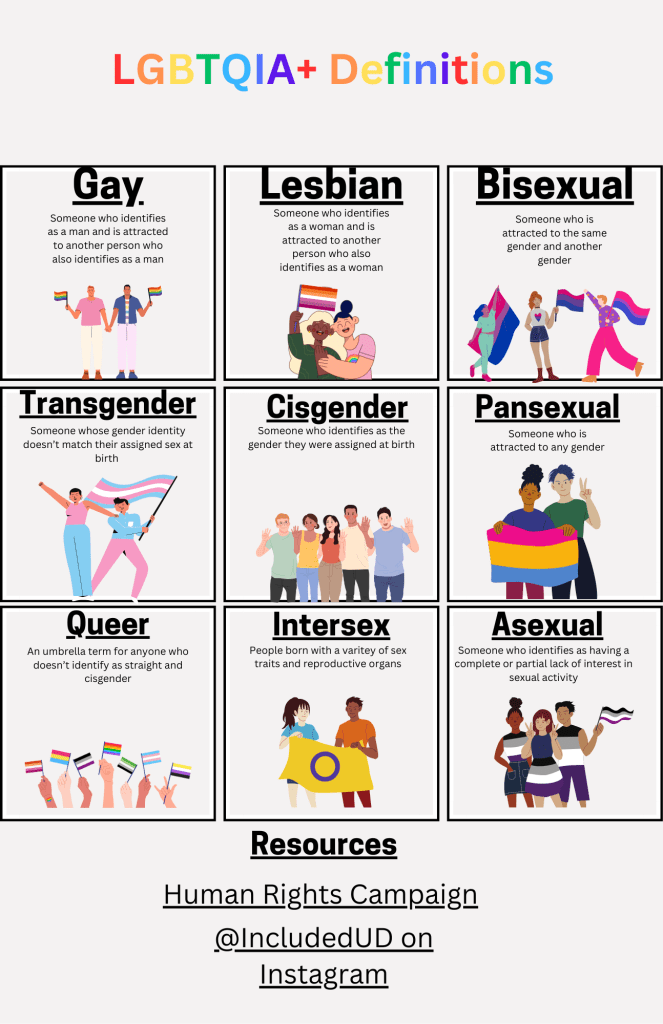
LGBTQIA+ Definitions Plain Language Guide

Below is a plain language guide. This resource allows for individuals to easily access and understand LGBTQIA+ identities, and can be used for educational purposes. The definitions were sourced from @IncludedUD on Instagram, as well as the Human Rights Campaign (HRC). These two links will take you to the Instagram and to the HRC’s glossary of LGBTQIA+ terms respectively.

***plain text language***

Image text is duplicated below. Pictures show happy queer individuals, couples, and groups with symbolic LGBTQIA+ flags

Below is an screen-reader friendly Plain Language Guide without images.

LGBTQIA+ Plain Language Guide

Gay
Someone who identifies as a man and is attracted to another person who also identifies as a man.

Lesbian
Someone who identifies as a woman and is attracted to another person who also identifies as a woman.

Bisexual
Someone who is attracted to the same gender and another gender.

Transgender
Someone whose gender identity doesn’t match their assigned sex at birth.

Cisgender
Someone who identifies as the gender they were assigned sex at birth.

Pansexual
Someone who is attracted to any gender.

Queer
An umbrella term for anyone who doesn’t identify as straight and cisgender.
Intersex
People who are born with a variety of sex traits and reproductive organs.
Asexual
Someone who identifies as having a complete or partial lack of interest in sexual activity.

Resources for Conversations about Consent

What is consent?

According to Planned Parenthood, sexual consent is “an agreement to participate in sexual activity. Consent lets someone know that sex is wanted.”

Sexual activity can be a lot of different types of activities, from kissing to sexual intercourse to oral sex.

Judging consent between partners, as well as self-reflection about consent, is crucial for sexual activity. This article will provide resources for accessing and reflecting on consent, and ensure that consent is an easier conversation.

A very helpful tool to gauge consent is the Verbal Informed Sexual Consent Assessment Tool. This source shares important reflection questions to analyze whether someone can give consent, giving a checklist as well as examples of questions to ask.

For more information about legality and restrictions about consent, refer to our webpages article about the Capacity to Consent to Sexual Activity.

The Conversation of Consent

Consent can be a very simple conversation. Once you know that you and your partner are capable, informed, and confident in making decisions about sexual behaviors, have a conversation with your partner. Ask your partner what their boundaries are, and what sexual behaviors are okay with them. Sexual behaviors are a continuous conversation, that is that the conversation will continue to come up, and the result of the conversation can change. If you or your partner consents to kissing one day, and says “no” to kissing the next day, consent is being taken away and kissing shouldn’t continue to happen until consent is given again. For tools about how to revoke consent, refer to our webpage graphic about Ways to Say No .

This website from Planned Parenthood gives more examples of how to talk with your partner about consent, including examples such as how to check in on consent.

These two videos explain consent and boundaries. The second video also gives an example!

Teaching Consent

Dr. Curtiss was invited to the Center of Disability Studies at the University of Delaware to present on Sexual Consent and Disability. Participants learned what sexual consent is from a sexual health perspective and a legal perspective. They also learned important considerations when teaching consent and how teaching consent promotes sexual safety.

When Dr. Curtiss talks about teaching sexual consent she discussed four main skills: Saying No, Recognizing No, Respecting No, and Saying Yes. To say No, you need to be able to say NO with different levels of intensity, to have multiple strategies for saying NO, a be able to say NO in a variety of contexts including online. To be able to recognize No, you need to be able to recognize verbal, non-vebal, and contextual NO as well as NO by omission. To be able to respect NO you need to have self-regulation skills to manage emotional reaction to hearing NO. To be able to say YES, you need to understand what feel comfortable.

The Bump’n Joystick: An Accessible and Gender Fluid Sex Toy

Bump’n is a brand that was created to make sexual pleasure more accessible. All of their content and products are co-created by a team who aims to inspire people to talk more openly about sexuality and disability.

The Bump’n Joystick is a sex toy that does not require you to use your hands! The Joystick has different sized holes in its base for you to insert your favorite toys. You simply hug the top of the toy or lay on it, and it does the work for you!

This toy is currently available for preorder for $249 on the Bump’n website!

Advocates for Youth – Sex Education Lesson Plans

Advocates for Youth is an organization that is dedicated to improving sexual and reproductive health among adolescents and securing the rights of young people.

Advocates for Youth recognizes that sex education should equip people with tools to make informed decisions about sex and relationships, instead of withholding information and telling young people not to have sex.

The organization works with AMAZE to publish animated videos that provide children and adolescents with accessible and age-appropriate sexual information. More information about AMAZE can be found here.

Advocates for Youth offers a K-12 sex education curriculum specifically for students with intellectual disabilities that includes all of the topics the Centers for Disease Control and Prevention has labeled as essential. The curriculum emphasizes the importance of rights, respect, and responsibility, and covers topics such as gender identity, race, and healthy relationships. This curriculum can be found on the Advocates for Youth website, linked here.

In addition to making efforts to improve sexual education in the classroom, Advocates for Youth hosts virtual and in-person events for people interested in learning more! Some of their previous events involved discussions about STIs, abortion, and consent.

Are Individuals with ASD (and other disabilities) at Increased Risk for Sexual Abuse?

It is difficult to determine the exact risk of sexual abuse for individuals with ASD.  For one thing, reports of sexual abuse in the general population can vary widely.   The first national survey reports victimization rates of 27% for women and 16% of men (Finkelhor et al., 1990)*- and many studies seem to report findings similar to this.  A study has shown that children with disabilities are 1.7 times more likely to experience sexual abuse (Crosse, Kaye & Ratnofsky, 1993)*. In this study all children with disabilities were examined, not just individuals with ASD . Individuals who are caregiver dependent may be at the highest risk as family members, family acquaintances, and paid caregivers are the most likely to commit sexual abuse (Mansell et al., 1996)*. Difficulties communicating, lack of knowledge of sexual norms and activities, and isolation may contribute to increased risk of sexual abuse among individuals with ASD.

So what can you so?  Here are 5 places to start.

  1. Have a clear reporting procedure of any suspected incidences of abuse or neglect and  use it!
  2. Don’t hug, kiss, hold hands, snuggle or in other ways compromise professional boundaries.  Not only does this potentially mask dangerous “grooming” by sexual predators, it also communicates that individuals with disabilities are asexual.
  3. Sexuality education 🙂 may provide opportunities to for individuals to be better able to communicate and better understand social norms and activities thus giving them tools to better understand if abuse may be taking place.
  4. Teach folks to say no!  When we don’t provide structured opportunities for people to say no, then when they need to they don’t know how.
  5. Don’t let sex be a taboo.  If everyone is afraid to talk about it, they will be afraid when there is a problem also.  Also, perpetrators will be deterred by the open communication.

The Department of Human Services in Illinois is targeting ending violence against women with disabilities.  Click here to learn more!

*Link takes you to an abstract of the original article.

Dating Decision Tree

Making decisions about dating can be tough, especially if you don’t really know what types of decisions to make. This graphic can be used to help steer the conversation about dating and how to make healthy decisions. It is available for download here.

Rewire News Group

Rewire News Group is a news website that is focused on sexual health and social justice. They are looking to “reshape the national dialogue on all things sex by making it more inclusive, positive, and centered on social justice.” The website itself is not focused on intellectual disabilities, however, they do offer some amazing articles about issues in the disability community.

Disabled People Are Still Being Forcible Sterilized- So Why Isn’t Anyone Talking About It?

The Fight for Reproductive Rights Too Often Excludes Disabled Parents

Discussing Disabled Sexuality Is a Radical Act

Elevatus Training: Online and In-Person Training to be a Sexuality Educator

Elevatus offers a variety trainings staff, direct support professionals, educators, self-advocates and parents to teach sexuality education to children and adults with developmental disabilities. In addition to their trainings, Elevatus has a sex education curriculum that can be purchased.

Here are examples of some of their trainings and the costs:

  • For Staff and Professionals – Developmental Disabilities and Sexuality 101 ($397)
  • For Parents/Guardians – Talking With Your Kids: Developmental Disability and Sexuality ($47)
  • In-service/live workshops and a 3-Day Certificate Training ($725) for anyone who wants to lead sexuality education classes with people with developmental disabilities.

To get more information about Elevatus Training:-https://www.elevatustraining.com/

Friendship & Dating Program: Helping Children and Adults to Acquire Relationship Skills

The Friendships & Dating Program (FDP) offers inclusive teaching plans for individuals with intellectual and developmental disabilities. A unique aspect of this program is its emphasis on preventing interpersonal violence. There is a version of this program for youth with serious emotional disturbance. The FDP focuses on skill development through experimental learning and group activities with an interactive 10-week curricular plan. Interested groups can purchase the curriculum on its own ($600) or purchase the curriculum in combination with a train the trainer support provided live online ($1,800). You can find more information about the FDP from the below link. Some module illustrations are available on the website.

https://www.fdprogram.org/

More Info. Less Weird. AMAZE Takes the Awkward Out of Sex Ed

These days, it is hard to find an age appropriate content about sex, dating and abuse. Children have questions about their bodies, gender and reproduction. Teenagers worry if their bodies are developing normally or not while older adolescents struggle with peer pressure, changing relationships and emerging sexual feelings. AMAZE is an amazing website for parents and educators which helps them to expose their child to age appropriate content about sex through short videos. The website provides an insight to young people to successfully understand puberty, healthy body image, distinguish between healthy and unhealthy relationships, concepts of consent and mutual respect. Video topics are designed to meet the learning objectives outlined in the National Sexuality Education Standards.

Parents are the primary sexual educators of their children. By answering children’s questions, a parent let them know that you are “askable” and establishes an open line of communication that will serve you and your children well as they mature into sexually healthy young adults.

AMAZE also has resources for younger children like the parents’ playlist from amaze jr. It is designed to help parents become comfortable and confident talking to their children openly and honestly at any age.

https://amaze.org/

There are some videos for parents reference.

This video will help parents to know when to talk about sexuality with their kids.

Do you think so playing “doctor – doctor” is safe or not? Check this video out which helps you to communicate your thinking and others about this game.

This video will model to the adolescents with disabilities to learn about manage their relationships with person they like or have attractions. This video guide them to deal with peer pressure and make healthy relationship.

This video helps your child to understand their body parts, difference between a male and female, and similarities between boy and girl.

https://youtu.be/wW627gpkWbw