How to Guide on Flirting Online

Social media can be difficult to navigate as there are unknown “rules” and behaviors that are widely followed when first interacting with others, especially those you are interested in romantically. This aid demonstrates several unspoken guidelines, intimidating behaviors, and tips on staying within the guidelines on social media when trying to flirt. It is worth mentioning that this is not a comprehensive list of all guidelines and intimidating behaviors, but rather a guide to help you talk to your crush online in a fun, respectful way that keeps everyone comfortable. As a 21-year-old who has been online from a young age, some of these guidelines are based on my own experiences and knowledge.
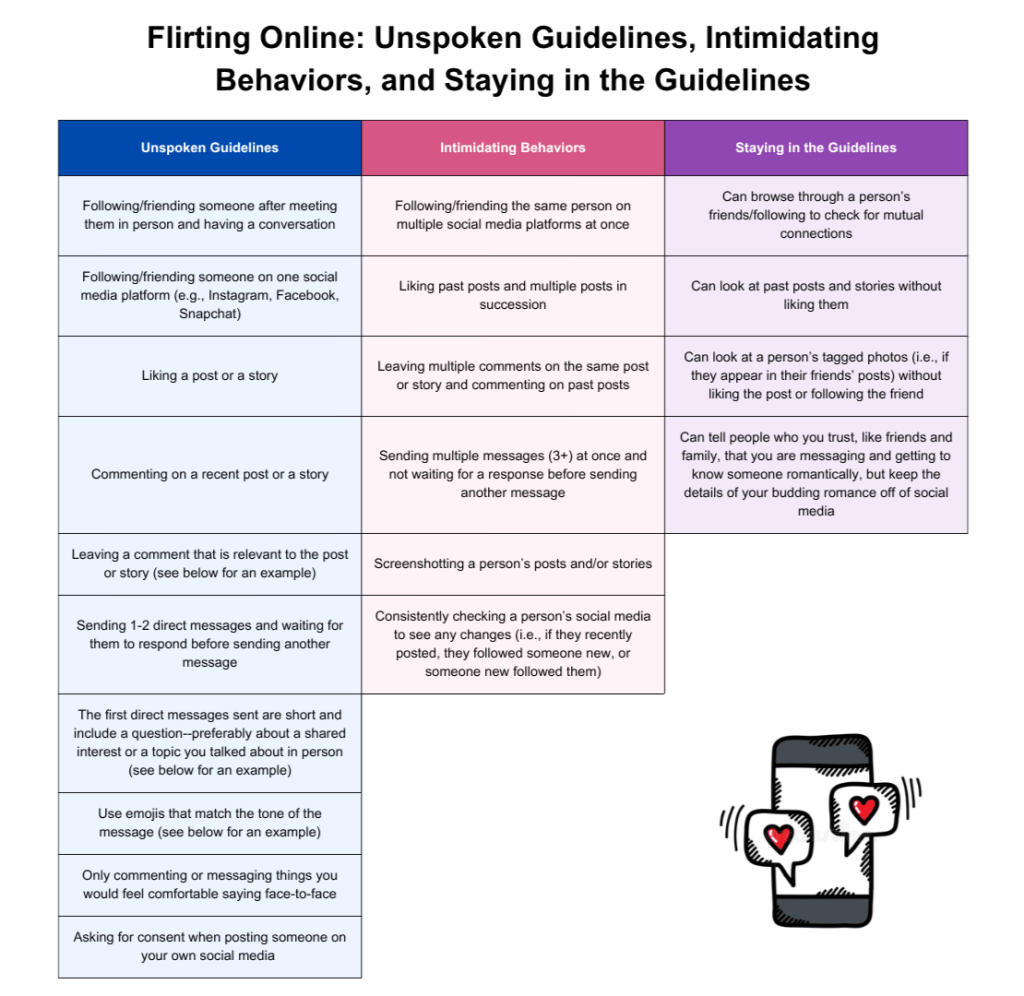
Table of unspoken guidelines, intimidating behaviors, and tips on staying in the guidelines. From top going down, unspoken guidelines: following/friending someone after them meeting in person, following/friending someone on one social media platform, liking a post/story, commenting on recent post/story, leaving relevant comments on posts/stories, sending 1-2 direct messages and waiting for a response before sending another message, the first direct messages are short and include a question, use emojis that match message tone, only commenting/messaging things you can say face-to-face, and ask for consent when posting someone. From top going down, intimidating behaviors: following/friending someone on multiple social media platforms at once, liking past posts and multiple posts in succession, leaving multiple comments and commenting on past posts, sending multiple messages at once and not waiting for a response before sending another message, screenshotting posts and stories, and consistently checking a person's social media for any changes. From top going down, staying in the guidelines: can browse through a person's friends/following, can look at past posts and stories without liking them, can look at a person's tagged photos without liking the post or following the friend, and can tell people who you trust, like friends and family, that you are getting to know someone, but keeping the details of your budding romance off of social media.

Example of a relevant comment: Someone posts a photo of them graduating school and you comment, “Congratulations!”

Example of a direct message: You talked to someone last week about a book series and sent this message: “Hi! It’s [your name], we talked last week about [book series]. I started reading it and really liked it. Do you have any other recommendations?”

Examples of using emojis: (1) You are messaging your crush about a movie that you both recently watched and talking about a scene that left you in disbelief: “I can’t believe that happened 😭 I was not expecting it at all!” (2) You made plans to hang out with your crush in person and sent this message: “I’m excited to hang out on Saturday 😊 See you then!”

Teen Vogue has a list of questions to keep the conversation going with your crush, whether you’re looking for something low-pressure, flirty, deep, random, interesting, or just plain fun.

The Napoleon Cat Blog gives some tips for commenting on someone’s post, showing different examples for different post scenarios. Some of them are intended for friends, but can still be used for your crush’s posts. Their 35 Short Comments for Instagram section is best used when you first start commenting, as they are simple, not intimidating, and friendly.
Dating Decision Tree

Making decisions about dating can be tough, especially if you don’t really know what types of decisions to make. This graphic can be used to help steer the conversation about dating and how to make healthy decisions. It is available for download here.

Parent Tip Sheets

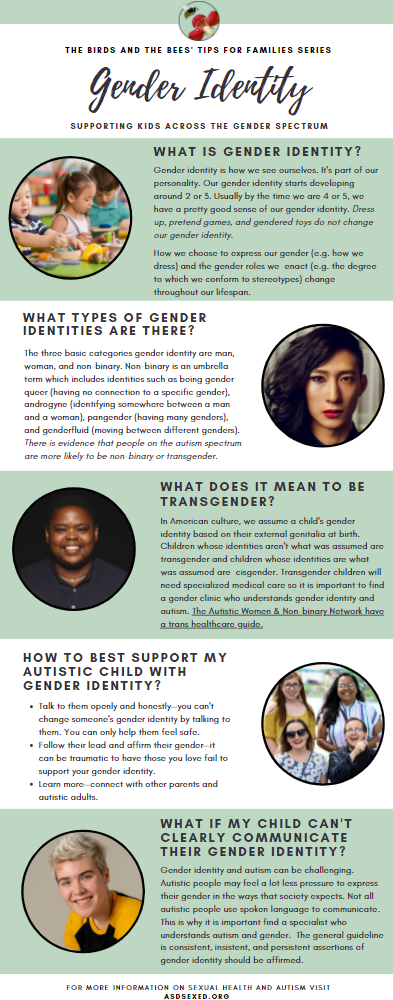
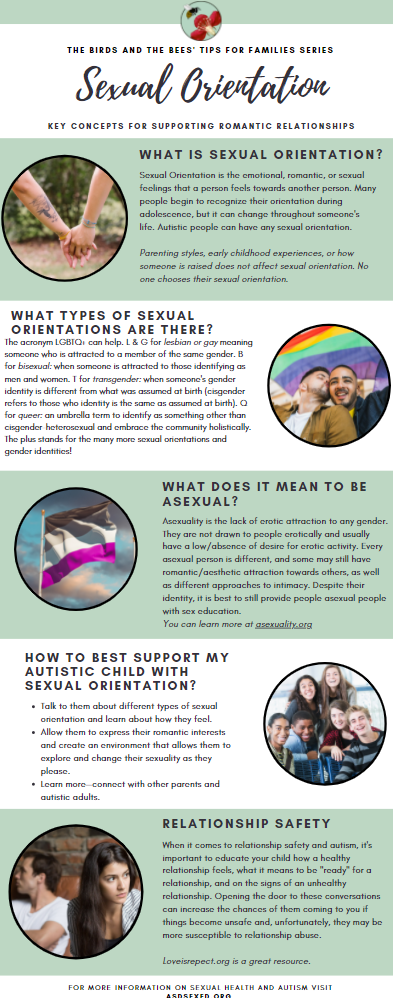
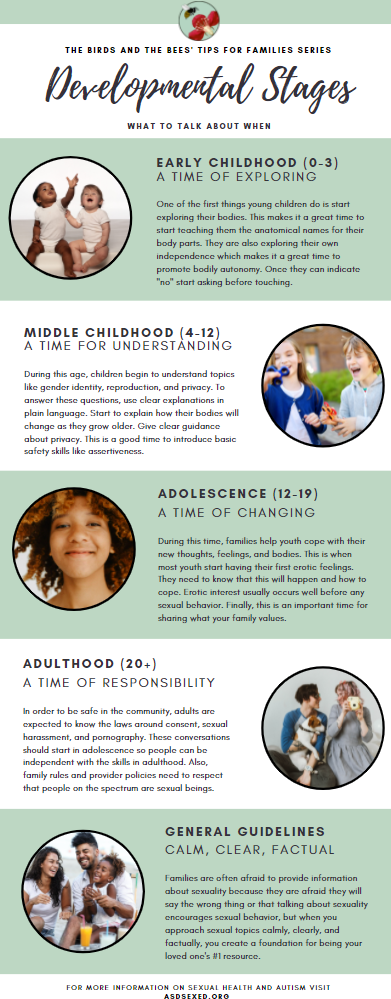
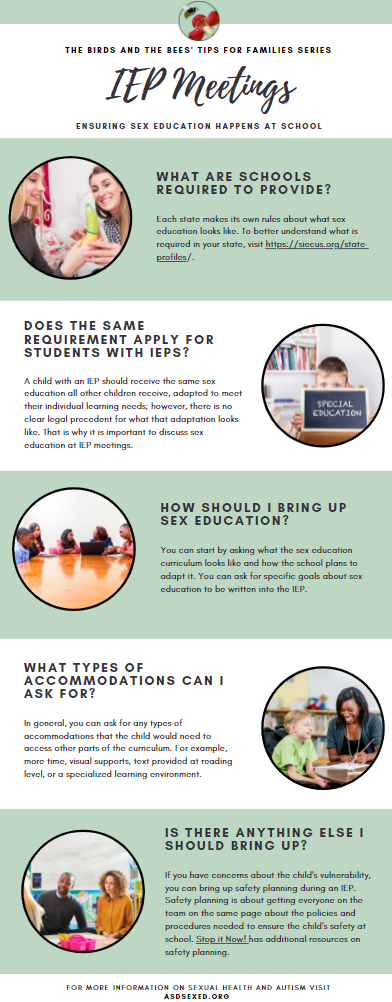
Navigating developmental stages, education, and sex education can be extremely difficult. The Birds & The Bees team put together a parent tip sheet that offers basic information and resources for parents of autistic children. View the tip sheets in the slide show and download below.

  • In Script, a title reads "The Birds and The Bees Tips for families Series" The first picture shows two babies happily sitting on the floor, looking up towards the sky. The second pictures shows two laughing children playing with fidget spinners. The next picture shows an young African American girl smiling. The following picture shows a young couple, each holding a dog.

Open Future Learning

Open Future Learning is a company that offers a wide variety of online training for staff, or anyone else working with individuals with disabilities. They offer modules in abuse prevention, communication, advocacy, and many more topics. They have staff training modules, 30 minute programs, and an audio learning module. Membership can range from $112-$2263 per month, depending on the amount of active users. Linked below is Open Future’s Homepage.

https://www.openfuturelearning.org/index.cfm?fuseaction=login.home

Sex Ed Rescue

Properly educating children on sex, puberty, and many other related topics can be challenging for parents. Many parents struggle with how they should speak to their child about these topics, and when the time is right. Sex Ed Rescue is a YouTube channel designed to educate parents on how to talk to their kids about these topics. This channel includes instructional videos, Q&A’s, children’s book reviews, and many other educational resources. It is a great resource to help parents educate their children on sex. It also helps to create a more age-appropriate environment for the child, and encourages comfortable communication between the child and the parent.

Linked below is the channel’s introduction video and the channel’s homepage.

Sex Ed Rescue: Homepage

Elevatus Training: Online and In-Person Training to be a Sexuality Educator

Elevatus offers a variety trainings staff, direct support professionals, educators, self-advocates and parents to teach sexuality education to children and adults with developmental disabilities. In addition to their trainings, Elevatus has a sex education curriculum that can be purchased.

Here are examples of some of their trainings and the costs:

  • For Staff and Professionals – Developmental Disabilities and Sexuality 101 ($397)
  • For Parents/Guardians – Talking With Your Kids: Developmental Disability and Sexuality ($47)
  • In-service/live workshops and a 3-Day Certificate Training ($725) for anyone who wants to lead sexuality education classes with people with developmental disabilities.

To get more information about Elevatus Training:-https://www.elevatustraining.com/

More Info. Less Weird. AMAZE Takes the Awkward Out of Sex Ed

These days, it is hard to find an age appropriate content about sex, dating and abuse. Children have questions about their bodies, gender and reproduction. Teenagers worry if their bodies are developing normally or not while older adolescents struggle with peer pressure, changing relationships and emerging sexual feelings. AMAZE is an amazing website for parents and educators which helps them to expose their child to age appropriate content about sex through short videos. The website provides an insight to young people to successfully understand puberty, healthy body image, distinguish between healthy and unhealthy relationships, concepts of consent and mutual respect. Video topics are designed to meet the learning objectives outlined in the National Sexuality Education Standards.

Parents are the primary sexual educators of their children. By answering children’s questions, a parent let them know that you are “askable” and establishes an open line of communication that will serve you and your children well as they mature into sexually healthy young adults.

AMAZE also has resources for younger children like the parents’ playlist from amaze jr. It is designed to help parents become comfortable and confident talking to their children openly and honestly at any age.

https://amaze.org/

There are some videos for parents reference.

This video will help parents to know when to talk about sexuality with their kids.

Do you think so playing “doctor – doctor” is safe or not? Check this video out which helps you to communicate your thinking and others about this game.

This video will model to the adolescents with disabilities to learn about manage their relationships with person they like or have attractions. This video guide them to deal with peer pressure and make healthy relationship.

This video helps your child to understand their body parts, difference between a male and female, and similarities between boy and girl.

https://youtu.be/wW627gpkWbw

Sexuality Resources for Parents

Raising an individual with a disability presents a different set of obstacles then an abled individual may, but one topic that all parents must address is sexuality. Individuals with disabilities are sexual beings and therefore deserve an education on sexuality. While parents may acknowledge this need, finding resources and strategies to present the information may be more difficult if you are raising an individual who requires a different method of learning.

The Sexuality Resource Center for Parents provides a well rounded variety of information pertaining to sexuality. The website includes a section of information labeled “for all parents” that contains subjects they believe are useful for all children. In addition, they provide sections titles “For parents of children of typical development”, “For parents of children with developmental disabilities”, and “For parents of children with physical disabilities”. In each section, you can find a variety of information such as basics, specifics, activities, and additional resources. They also include tip guides!

The Sexuality Resource Center for Parents works to provide a better, comprehensive information base for parents to use when addressing sexuality to their child. The variety of knowledge is extremely useful when trying to find information to meet your child’s specific needs. In their own words, their mission statement claims “It’s time to acknowledge that children with developmental disabilities will become adults with sexual feelings, and as such, we must provide them with the information and skills they’ll need to become sexually healthy adults.

http://www.srcp.org/index.html

Puberty and Adolescence Resource: A Guide for Parents

puberty_coverThis tool kit from ATN/AIR-P provides information on body changes; self-care and hygiene; public vs. private rules; staying safe: strangers, secrets and touch; elopement; safety planning for increased aggression; and Internet safety.

Some of my favorite features:

  • Link to underwear designed to keep menstrual pads in place (I had no idea this existed!)
  • They have parent stories throughout.
  • They have suggestions for how occupational therapy can provide support.

YouTube Educational Resources: Healthchannel, Sexplanations, and CSPH

YouTube has a lost of great sexuality education resources but it can be hard to find among all of the “not safe for work” content.  Here’s a few channels and videos that might be useful.  One of the most difficult tasks sex educators report is explaining intimate acts.  This can be uncomfortable and difficult so I’ve tried to focus on these difficult to teach topics.  The videos may not be the best fit for the person/people you’re working with, but they can give you an idea where to start.  The channels also have great resources for expanding your own education on sexuality topics.


The Center for Sexual Pleasure and Health (CSPH) has a lot of great videos.  Is one of my favorite cites.  In addition to having direct information they also have videos for parents (“Use Your Words” videos).

Healthchannel is a YouTube channel with short videos on a variety of health care issues including sexual health resources including a few I’ve listed below.  The videos aren’t prefect.  They don’t feature animations with people with disabilities and focus on heterosexual couples, but they give very precise, clear information.

Sexplanations is another YouTube channel.  They have mini episodes on human sexuality topics from shared sexual behavior to STDs to anatomy.  Again the videos aren’t perfect.  They move a little too quickly than I would like, but I’ve selected a few I think could be helpful.  They could also be good to expand your own understanding of various topics.


Social Narrative: Having a Boyfriend in Middle School

Boyfriend in Middle SchoolParents are often afraid of the day that their daughter comes home and says she has a boyfriend!  This social story having a boyfriend addresses this event to help a young girl understand what your expectations might be when it comes to having a boyfriend. We went with the strategy of instructing on how she can interact with her “boyfriend” in many age appropriate ways, for example, she can look at him, giggle, and then look away.

Human Sexuality 101 Week 3- Puberty

I have to say, the puberty session went great!  It was just at the right level.  Here are the activities we did…

Defining Puberty: This was the language we used to define puberty: puberty is your body changing from a child’s body to an adult’s body.  It causes changes to your body inside and outside. Everyone goes through puberty but it might happen at different times and people’s bodies change to look different.  Puberty is a time when you start to get sexual feelings.  You don’t have control over going through puberty, but you do have control over how you react to it.  It’s normal to have mixed feelings, some good feelings and some negative feelings.  This definition highlights several key features of puberty (it’s in some ways different and some ways the same for everyone, it’s a natural biological process, it can be an adjustment). 

They Tell Me I’m Going Through Puberty: This is a story told from the point of view of a teenager about the changes that are happening during puberty.  This exercise helps students to understand that many of the changes that are happening in puberty happen to both boys and girls.  The narrative format may help students relate to the changes that are occurring.         

Boys/Girls/Both: In this activity, participants were given a series of cards each with a change that happens during puberty.  They decide if these changes happen to boys, girls, or both.  Again, this exercise helps students to understand that many of the changes that are happening in puberty happen to both boys and girls.  Many of these changes are repeated from the first exercise although more are introduced.  Each card separates out each change as concrete steps.

Puberty Worksheet: This worksheet is a check in on the changes participants have experienced, how they feel about these changes, and changes they anticipate.  The worksheet was designed to help students anticipate some of the changes that will happen during puberty and help them to be aware of the changes that are happening in their own body. We use both open ended and multiple choice questions to stimulate different levels of thinking.

Diversity:We showed power point slides with pictures of several people showing a diversity of bodies and ages.  Students were asked, “Which ones are going through puberty?”.  This activity reinforces the concept that puberty is in some ways different and some ways the same for everyone.  One thing that became evident was that the students had difficulty understanding that children hadn’t gone through puberty but the were quick to grasp onto the idea that adults are finished going through puberty.  We used a few favorite characters to help the kids get a little excited about the topic.

Click on the Links Below to AccessMaterials

Parent Newsletters and Research about Sexual Behavior and DD

This series of parent news letters is available in English and Spanish.  They provide guidelines for families in regards to talking about sexuality topics.  They are not adapted for children with special needs, but I thought they could be useful regardless (especially the more general issues).  On this page the also have a fact sheet (English only) that has a lot of data about teens sexual behavior.  There is very little (almost no) information about the sexual behavior of adolescents or adults with developmental disabilities but I’ve summarized the research that is available below.   (You would need access to an academic library to read the full articles cited below for free).  Despite the limited research, most people (be they parents or professionals) come to my workshop because they already know people with disabilities have sexual intersts!

There have been several studies that suggest that individuals with ASD have a desire for intimate relationships (Henault & Attwood, 2002; Van Bourgondien, Reichle, & Palmer, 1997; Ousley & Mesibov, 1991). These studies may define “interest” as instances of sexual behavior.  For example, one study that reports the majority of 89 individuals with ASD living in group homes in North Carolina displayed some sort of sexual behavior (Van Bourgondien, Reichle, & Palmer, 1997).  Other studies define “interest” as self-reports of sexual activity and knowledge (Ousley & Mesibov, 1991). In both cases they are reacting to earlier studies that reported that individuals with ASD (and other disabilities) had no interest for intimate relationships with others (Despert,1971; Rumsey, Rapoport, Sceery,1985) and common myths that report individuals with ASD to be asexual (Irvine, 2005).

Despite the trend to move toward a more accepting view of sexual interest among individuals with ASD and other developmental disabilities, there remain questions as to what extent individuals with disabilities are interested in sexual activity. For example, most studies look at sexual behavior however individuals may be interested in intimate relationships even if they are not displaying sexual behavior. Some studies have shown that individuals with more knowledge are less likely to want to engage in sexual activity (Konstantareas & Lunsky,1997); however it seems that the relationship between access to sexuality education and the desire for support with relationship development remains unclear.

Developmental Messages for 0-5 Year Olds

In The Birds and the Bees workshop we talk a little bit about how we start teaching folks about sexuality from birth. We mostly teach sexuality through how we socialize and interact with infants.  SEICUS has a set of guidelines for being more intentional about promoting healthy sexual development in 0-5 year olds.  For me, some of the developmental messages and core concepts where exactly where some of the guys I’ve worked with were at, even if they were much older.  I especially like the discussions about sexual abuse prevention (pages 56-57), masturbation (45-46), and sexual curiosity (47-49).  I also think you could get some great ideas for teaching about gender roles (59-61) that you could do outside of what may be considered a sex ed class.  For each of the 19 topics they discuss they include a discussion section, key messages, additional messages for older preschool children, and how adults can help.

You can download the guidelines for free… RightFromTheStart

Free Curriculum and Parent Resources

A lot of the curriculum we used for the puberty unit of our Human Sexuality 101 group was adapted from “Teaching Sexual Health“.  They are a group out of Canada that provides support for teachers and parents.  I used their general curriculum but they also have a curriculum for students of differing ability levels.  They have great resources for parents including “webisodes” that give examples of parents talking to kids about sexuality topics.  The website is very well organized and easy to use!

Image