High School Human Sexuality 101 Week 2- Anatomy

FemaleReproductiveSystem_Lateral_250w

Anatomy and Reproduction were the topics for week 2. We started off the session with a game called “Parts and Post-it Notes” to talk about body parts with the participants. To play this game we had a giant piece of paper with the outline of a body on it. We gave the participants post-it notes to write down the body parts that they knew and asked them to place them on the outline of the body.

After this activity, the participants were told that for the rest of the class they would be focusing on body parts related to reproduction (another way to refer to sex organs or private parts). The participants were then directed to the next activity where they practiced saying terminology related to reproduction out loud and recording their responses to how saying the words made them feel.

When the participants finished the terminology activity, we spit them into two groups to start the fruit anatomical model of reproductive organs using fruit. The participants were shown a picture of the parts of the body and were giving tooth picks and flash cards to label the fruit parts and their functions. This activity was great for the participants to learn the vocabulary in a little abstract and safe way! For a more concrete example of reproduction, we used the “Miracle of Life” video to explain the process.

We ended this session by having the participants briefly summarize that they learned during the session.

For more information on anatomy view our Human Sexuality 101 Week 2- AnatomyEXPLAINING ANATOMYYOUTUBE EDUCATIONAL RESOURCES: HEALTHCHANNEL, SEXPLANATIONS, AND CSPHADULT HUMAN SEXUALITY WEEK 2- ANTATOMY & REPRODUCTION posts

This Week’s Materials

Week 2 Lesson Plan

Week 2 Slides

Parent Letter

Worksheets

Anatomy labels

High School Human Sexuality 101 Week 4- Crushes

 During week 4, we focused on understanding crushes.

There were three activities for the participants this week:

Crushes

What is a crush? 

The participants first brainstormed things that a person with a crush might feel or think. Participants had different levels of understanding on what having a crush meant to them. The purpose of this activity was to help the participants to understand that crushes are a special set of thoughts and feelings about another person. We later discussed thoughts and ideas that the group may have that may be unsafe when it comes to having a crush.

How to deal with a crush?

We used three videos to help the participants to understand how to deal with a crush. The videos covered these topics: What if you like a friend, How to tell if a guy likes you, and How to get a guys attention. These videos give concrete ways to deal with a crush.

Turning someone down

We used a video about how to say no to deal with a variety of situations when it comes to turning someone down.

For more information and activities on crushes visit our Human Sexuality 101 Week 5- Crushes and Adult Human Sexuality Week 3- Crushes curriculum

This Week’s Material

Week 4 Powerpoint

High school Human Sexuality 101 Week 5- Intimacy

Intimacy Intimacy was the focus of week 5. This concept can be difficult to understand because it is very broad so this is how we talked about it in our class.

We talked about how intimacy can be divided into two parts: physical and emotional. Physical intimacy involves expressing ones feelings for another person through a physical manner (holding hands, hugging, kissing, and sexual activity). While emotional intimacy involves the feelings towards another person. It is based on how comfortable you are with someone and how much you can share with them. It is important to understand that there are levels to intimacy and that it is not necessarily just for two people in a dating relationship.

For this week’s activities, we opened up with a discussion on the numerous ways to have intimacy with someone.  During group time, our plan was for participants to create a “Intimacy Chart”.

Intimacy Chart

We provided them with pictures displaying different types of intimacy ( holding hands, hugging, etc.) and asked them to write down how each of the pictures made them feel. After that we arranged the picture in order to what we felt would be the natural progression of relationships. To finish off the activity we categorized  each picture based on whom we are comfortable doing those actions with. The main purpose of the “Intimacy Chart” is to help the participants to visualize the different types of intimacy.

Although this was the plan, one of our students had a different idea of how she should do this activity.  She asked for a folder and then decorated it with her boyfriends name.  She then put the different acts of intimacy she felt comfortable with in the folder.  At first, she didn’t want to share which behaviors she had chosen, but then she decided that she would share.  What a great spontaneous adaption!

For more information on intimacy visit our Intimacy Activities and Adult Human Sexuality Week 6- Physical Intimacy and Human Sexual Response

This Week’s Material

Parent Letter Week 5

Intimacy Powerpoint

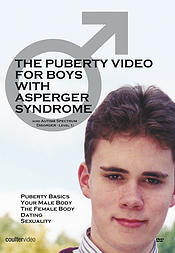
Puberty Videos for Boys & Girls

DVDB101_outHere are videos that were developed for 10 – 17 year olds on the autism spectrum regarding puberty & other sexuality topics.  They are clear, concrete, and move through the material slowly (this is one of the biggest problems with videos for a general audience- they go too fast!)

My favorite thing about the videos is that the male instructor is an individual with autism.

All of the videos can be found on www.coultervideo.com, a website that sells videos by Dan & Julie Coulter.  Dan & Julie are parents of a son with ASD who started creating educational videos on their vacation and now do it full time.

Videos that may be useful:

Intimacy Activity

This activity can be used to teach about different intimate activities, either alone or with a partner. All of the actions come in a word list form and in a visual form. The activity includes a continuum worksheet in which  activities can be classified as “less intimate” and “more intimate”.

One way to use this activity is to teach what sex is.  We often assume that people understand what sex is, but people have difficulty with understanding sex even when it is explained.  First list the acts of intimacy in a continuum and then discuss “where sex starts” or “which activities are sex and which ones are not.  This is more difficult than it seems.  For example, it is not uncommon for students to start with thinking that “kissing above the waist over the clothes” is sex. When we teach this activity, we encourage students to express their own understanding of what is more or less intimate but because the concept of a spectrum is difficult, we guide them at the anchors of what is the most inmate and least intimate.  By seeing sex in the context of different sexual activities it helps fill in some of the gaps.

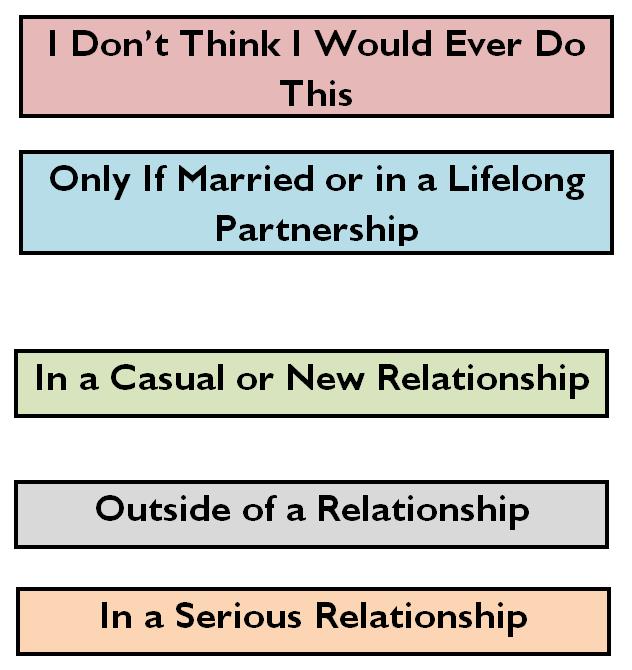
Instead of a continuum you could use categories- the categories we use help reinforce the idea of a continuum as well.  There is also a list of different levels of intimacy that can be used to classify these activities. Using the activity in this way is consistent with the concept of postponement- postponing intercourse until a relationship is more serious of formalized.

Sometimes when people see all the different acts of intimacy  they are surprised but it is important to be inclusive of all different forms of sexual expression.  We also don’t use all the different acts with every group, but we’ve given you a pretty comprehensive list that you can tailor to meet your student or child’s needs.

Download the intimacy activity intimacy activity pictures or with just words.

Levels of Intimacy

Levels of Intimacy

High School Human Sexuality 101 Week 6- Power in Relationships

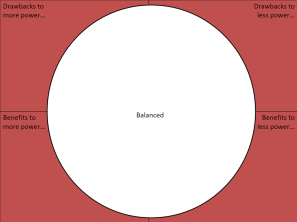
Power in Relationships The focus of week 6 was to better understand power relationships. During this week, the participants worked together on a activity that helped them to learn about power and control in relationships and specifically the benefits of having more power, benefits of having less power, drawbacks to having more power, and the drawbacks to having less power. The main concept that we were teaching with this activity is that there should be a balance when it comes to power. We first brainstormed  ideas on what it meant to have power in a relationship. After that, the participants discussed how different situations could be red flags that a relationship is not safe and we had them place those on the outside of the circle. We superimposed a circle onto our original brainstorming to reinforce this concept (using the powerpoint project and a dry erase board).

At the end of group we played a “Would you Rather” game to help them tune into how much power and control they prefer to have in relationships.  Students are asked about different relationships where there is a power difference (eg. parent-child). If they would prefer the more powerful option they take a step forward, the less and they stand still.  In my experience, individuals with disabilities are much more likely to choose a majority of less powerful positions in relationships. Food for thought.

For more information and activities on this topic see Adult Human Sexuality Week 5- Power Relationships

This Week’s Materials

Week 6 Slides

Parent Letter Week 6

YouTube Educational Resources: Healthchannel, Sexplanations, and CSPH

YouTube has a lost of great sexuality education resources but it can be hard to find among all of the “not safe for work” content.  Here’s a few channels and videos that might be useful.  One of the most difficult tasks sex educators report is explaining intimate acts.  This can be uncomfortable and difficult so I’ve tried to focus on these difficult to teach topics.  The videos may not be the best fit for the person/people you’re working with, but they can give you an idea where to start.  The channels also have great resources for expanding your own education on sexuality topics.


The Center for Sexual Pleasure and Health (CSPH) has a lot of great videos.  Is one of my favorite cites.  In addition to having direct information they also have videos for parents (“Use Your Words” videos).

Healthchannel is a YouTube channel with short videos on a variety of health care issues including sexual health resources including a few I’ve listed below.  The videos aren’t prefect.  They don’t feature animations with people with disabilities and focus on heterosexual couples, but they give very precise, clear information.

Sexplanations is another YouTube channel.  They have mini episodes on human sexuality topics from shared sexual behavior to STDs to anatomy.  Again the videos aren’t perfect.  They move a little too quickly than I would like, but I’ve selected a few I think could be helpful.  They could also be good to expand your own understanding of various topics.