Discover Intimacy Coaching: Reclaiming Connection and Pleasure

Intimacy coaching is a specialized type of relationship coaching that focuses on helping emotional and physical intimacy. Intimacy and connection are essential parts of being human. Everyone deserves the chance to experience it fully. Intimacy coaching offers a supportive, judgement-free space to help individuals or couples explore and deepen their capacity for emotions, physical, and even spiritual intimacy. An intimacy coach helps you reconnect with your desires and communicate your needs. If you’re looking to bring back the spark, try something new, or simply understand your needs/desires better, intimacy coaching is the perfect way to go. 

To learn more about what intimacy coaching does, watch this video.

Here are some intimacy coaches that have great reviews and cater towards people with disabilities. 

Joslyn Nerdahl: Certified Sex Coach and Clinical Sexologist, Physical Disabilities

Joslyn Nerdahl is an intimacy coach who specialize in working with people with physical disabilities. She believes that communication and consent are the foundation of healthy intimacy. She has a passion for helping people learn how to talk about sex openly and provides a safe space for her clients to explore their needs and desires. Her services include intimacy coaching, sex education, and sexual rehabilitation. Learn more about her: Services – Joslyn Nerdahl

Grace Myhill: Intimacy Coach, Neurodiverse Couples Coaching

Grace Myhill is a couples coach and educator who specializes in working with couples where on or both partners are a person with autism. She focuses on each partner experience and validating each other their perspectives. She wants to help both partners work together to build emotional and relation skills. If you want to know more about her work visits her website: https://www.gracemyhill.com/

Dr. Mitchell Tepper: Sex Coach and Educator for People with Physical Disabilities

Dr. Mitchell Tepper is an educator who specializes in working with individuals with disabilities and chronic conditions to help reclaim pleasure and intimacy. His approach focuses on empowerment, inclusion, and accessibility. He emphasizes that everyone, regardless of physical ability deserves access to intimacy, pleasure, and love. To explore his work and resources visit his website: Coaching – Dr. Mitchell Tepper

Amy Gravino: Autism and Sexuality Advocate, Speaker, and Relationship Coach

While Amy Gravino is not an intimacy coach, she still advocates for autism sexuality. She is an educator who empowers autistic adults to embrace healthy relationships, self-advocacy, and sexual expression. If you want to learn more about her advocacy or watch one of her videos visit: A.S.C.O.T Consulting

I think intimacy coaching is a great way to explore yourself, your relationship, and spice things up.
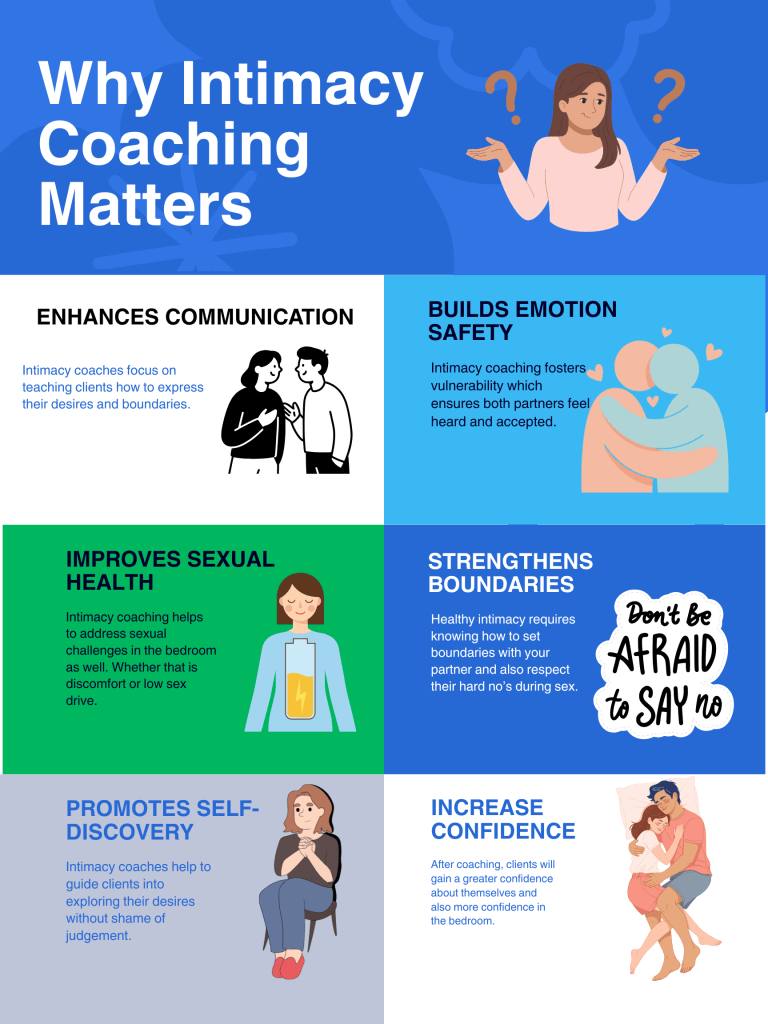
Why intimacy coaching matters. Enhances communication. Intimacy coaches focus on teaching clients how to express their desires and boundaries. Builds emotion safety. Intimacy coaching fosters vulnerability which ensures both partners feel heard and accepted. Improves sexual health. Intimacy coaching helps to address sexual challenges in the bedroom as well. Whether that is discomfort or low sex drive. Strengthen boundaries. Healthy intimacy requires knowing how to set boundaries with your partner and also respect their hard no’s during sex. Promote self discovery. Intimacy coaches help to guide clients into exploring their desires without shame of judgement. Increase confidence. After coaching, clients will gain greater confidence about themselves and also more confidence in the bedroom.

How to Guide on Flirting Online

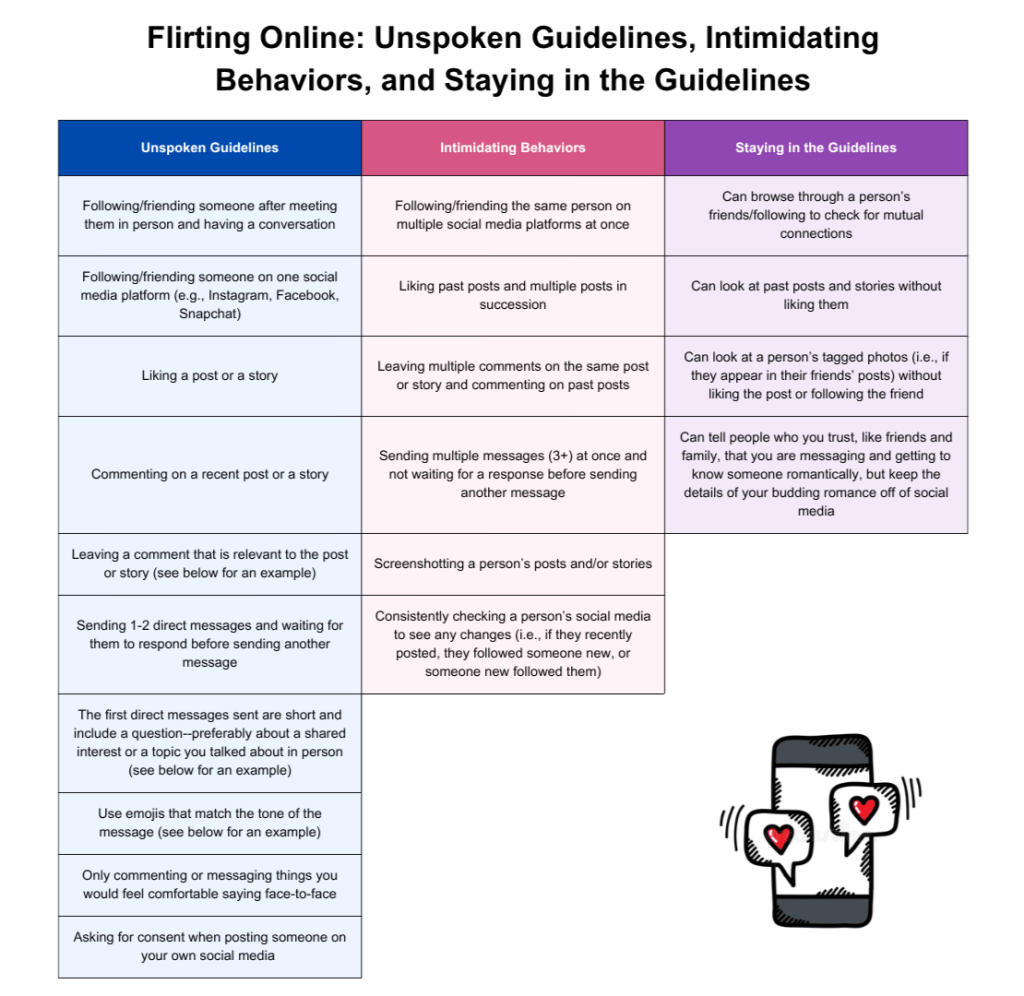
Social media can be difficult to navigate as there are unknown “rules” and behaviors that are widely followed when first interacting with others, especially those you are interested in romantically. This aid demonstrates several unspoken guidelines, intimidating behaviors, and tips on staying within the guidelines on social media when trying to flirt. It is worth mentioning that this is not a comprehensive list of all guidelines and intimidating behaviors, but rather a guide to help you talk to your crush online in a fun, respectful way that keeps everyone comfortable. As a 21-year-old who has been online from a young age, some of these guidelines are based on my own experiences and knowledge.

Table of unspoken guidelines, intimidating behaviors, and tips on staying in the guidelines. From top going down, unspoken guidelines: following/friending someone after them meeting in person, following/friending someone on one social media platform, liking a post/story, commenting on recent post/story, leaving relevant comments on posts/stories, sending 1-2 direct messages and waiting for a response before sending another message, the first direct messages are short and include a question, use emojis that match message tone, only commenting/messaging things you can say face-to-face, and ask for consent when posting someone. From top going down, intimidating behaviors: following/friending someone on multiple social media platforms at once, liking past posts and multiple posts in succession, leaving multiple comments and commenting on past posts, sending multiple messages at once and not waiting for a response before sending another message, screenshotting posts and stories, and consistently checking a person's social media for any changes. From top going down, staying in the guidelines: can browse through a person's friends/following, can look at past posts and stories without liking them, can look at a person's tagged photos without liking the post or following the friend, and can tell people who you trust, like friends and family, that you are getting to know someone, but keeping the details of your budding romance off of social media.

Example of a relevant comment: Someone posts a photo of them graduating school and you comment, “Congratulations!”

Example of a direct message: You talked to someone last week about a book series and sent this message: “Hi! It’s [your name], we talked last week about [book series]. I started reading it and really liked it. Do you have any other recommendations?”

Examples of using emojis: (1) You are messaging your crush about a movie that you both recently watched and talking about a scene that left you in disbelief: “I can’t believe that happened 😭 I was not expecting it at all!” (2) You made plans to hang out with your crush in person and sent this message: “I’m excited to hang out on Saturday 😊 See you then!”

Teen Vogue has a list of questions to keep the conversation going with your crush, whether you’re looking for something low-pressure, flirty, deep, random, interesting, or just plain fun.

The Napoleon Cat Blog gives some tips for commenting on someone’s post, showing different examples for different post scenarios. Some of them are intended for friends, but can still be used for your crush’s posts. Their 35 Short Comments for Instagram section is best used when you first start commenting, as they are simple, not intimidating, and friendly.

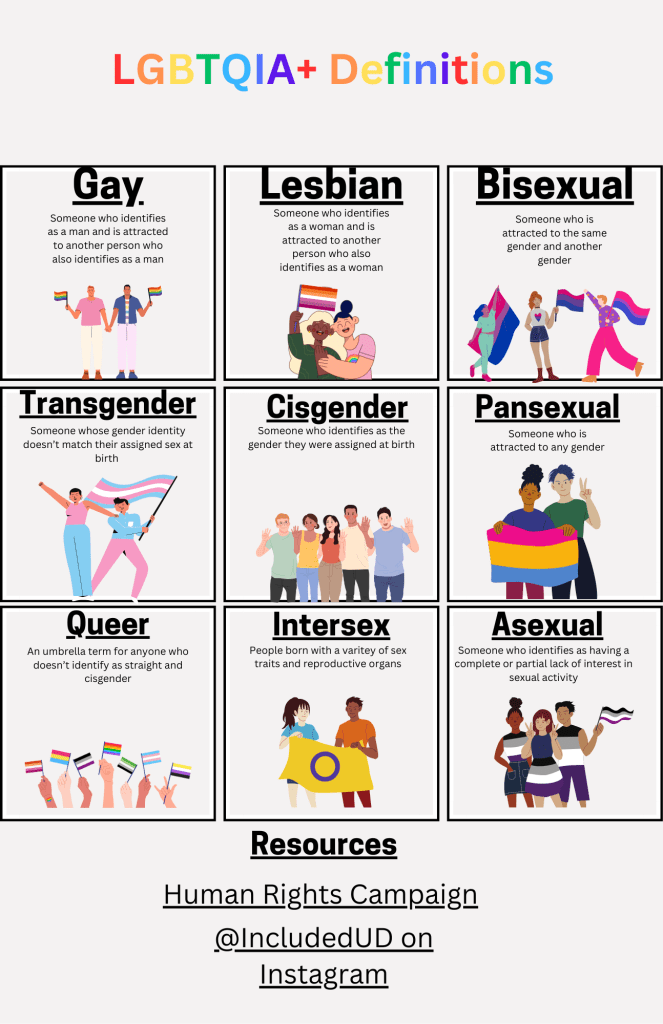
LGBTQIA+ Definitions Plain Language Guide

Below is a plain language guide. This resource allows for individuals to easily access and understand LGBTQIA+ identities, and can be used for educational purposes. The definitions were sourced from @IncludedUD on Instagram, as well as the Human Rights Campaign (HRC). These two links will take you to the Instagram and to the HRC’s glossary of LGBTQIA+ terms respectively.

***plain text language***

Image text is duplicated below. Pictures show happy queer individuals, couples, and groups with symbolic LGBTQIA+ flags

Below is an screen-reader friendly Plain Language Guide without images.

LGBTQIA+ Plain Language Guide

Gay
Someone who identifies as a man and is attracted to another person who also identifies as a man.

Lesbian
Someone who identifies as a woman and is attracted to another person who also identifies as a woman.

Bisexual
Someone who is attracted to the same gender and another gender.

Transgender
Someone whose gender identity doesn’t match their assigned sex at birth.

Cisgender
Someone who identifies as the gender they were assigned sex at birth.

Pansexual
Someone who is attracted to any gender.

Queer
An umbrella term for anyone who doesn’t identify as straight and cisgender.
Intersex
People who are born with a variety of sex traits and reproductive organs.
Asexual
Someone who identifies as having a complete or partial lack of interest in sexual activity.

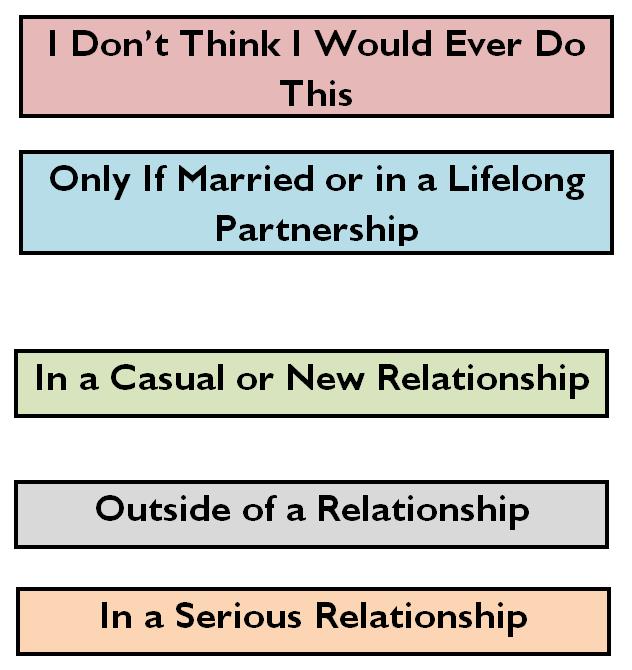
Dating Decision Tree

Making decisions about dating can be tough, especially if you don’t really know what types of decisions to make. This graphic can be used to help steer the conversation about dating and how to make healthy decisions. It is available for download here.

Anatomical Puzzles for Children

Both Hape and Melissa & Doug have made anatomically correct body puzzles.

Hape sells boy and girl puzzles separately for around $20.00 each.  The children are pre-pubescent and European American.  The video below shows a child completing the puzzle. The toys are distributed by Hape but are actually made by a company called Beleduc out of Holland. Beleduc also has a great pregnant mother puzzle that is a little difficult to find.

Melissa & Doug make a magnetic human body play set that includes children of both genders for about 13.00.  The children are early adolescents and European American.

High School Human Sexuality 101 Week 2- Anatomy

FemaleReproductiveSystem_Lateral_250w

Anatomy and Reproduction were the topics for week 2. We started off the session with a game called “Parts and Post-it Notes” to talk about body parts with the participants. To play this game we had a giant piece of paper with the outline of a body on it. We gave the participants post-it notes to write down the body parts that they knew and asked them to place them on the outline of the body.

After this activity, the participants were told that for the rest of the class they would be focusing on body parts related to reproduction (another way to refer to sex organs or private parts). The participants were then directed to the next activity where they practiced saying terminology related to reproduction out loud and recording their responses to how saying the words made them feel.

When the participants finished the terminology activity, we spit them into two groups to start the fruit anatomical model of reproductive organs using fruit. The participants were shown a picture of the parts of the body and were giving tooth picks and flash cards to label the fruit parts and their functions. This activity was great for the participants to learn the vocabulary in a little abstract and safe way! For a more concrete example of reproduction, we used the “Miracle of Life” video to explain the process.

We ended this session by having the participants briefly summarize that they learned during the session.

For more information on anatomy view our Human Sexuality 101 Week 2- AnatomyEXPLAINING ANATOMYYOUTUBE EDUCATIONAL RESOURCES: HEALTHCHANNEL, SEXPLANATIONS, AND CSPHADULT HUMAN SEXUALITY WEEK 2- ANTATOMY & REPRODUCTION posts

This Week’s Materials

Week 2 Lesson Plan

Week 2 Slides

Parent Letter

Worksheets

Anatomy labels

Intimacy Activity

This activity can be used to teach about different intimate activities, either alone or with a partner. All of the actions come in a word list form and in a visual form. The activity includes a continuum worksheet in which  activities can be classified as “less intimate” and “more intimate”.

One way to use this activity is to teach what sex is.  We often assume that people understand what sex is, but people have difficulty with understanding sex even when it is explained.  First list the acts of intimacy in a continuum and then discuss “where sex starts” or “which activities are sex and which ones are not.  This is more difficult than it seems.  For example, it is not uncommon for students to start with thinking that “kissing above the waist over the clothes” is sex. When we teach this activity, we encourage students to express their own understanding of what is more or less intimate but because the concept of a spectrum is difficult, we guide them at the anchors of what is the most inmate and least intimate.  By seeing sex in the context of different sexual activities it helps fill in some of the gaps.

Instead of a continuum you could use categories- the categories we use help reinforce the idea of a continuum as well.  There is also a list of different levels of intimacy that can be used to classify these activities. Using the activity in this way is consistent with the concept of postponement- postponing intercourse until a relationship is more serious of formalized.

Sometimes when people see all the different acts of intimacy  they are surprised but it is important to be inclusive of all different forms of sexual expression.  We also don’t use all the different acts with every group, but we’ve given you a pretty comprehensive list that you can tailor to meet your student or child’s needs.

Download the intimacy activity intimacy activity pictures or with just words.

Levels of Intimacy

Levels of Intimacy

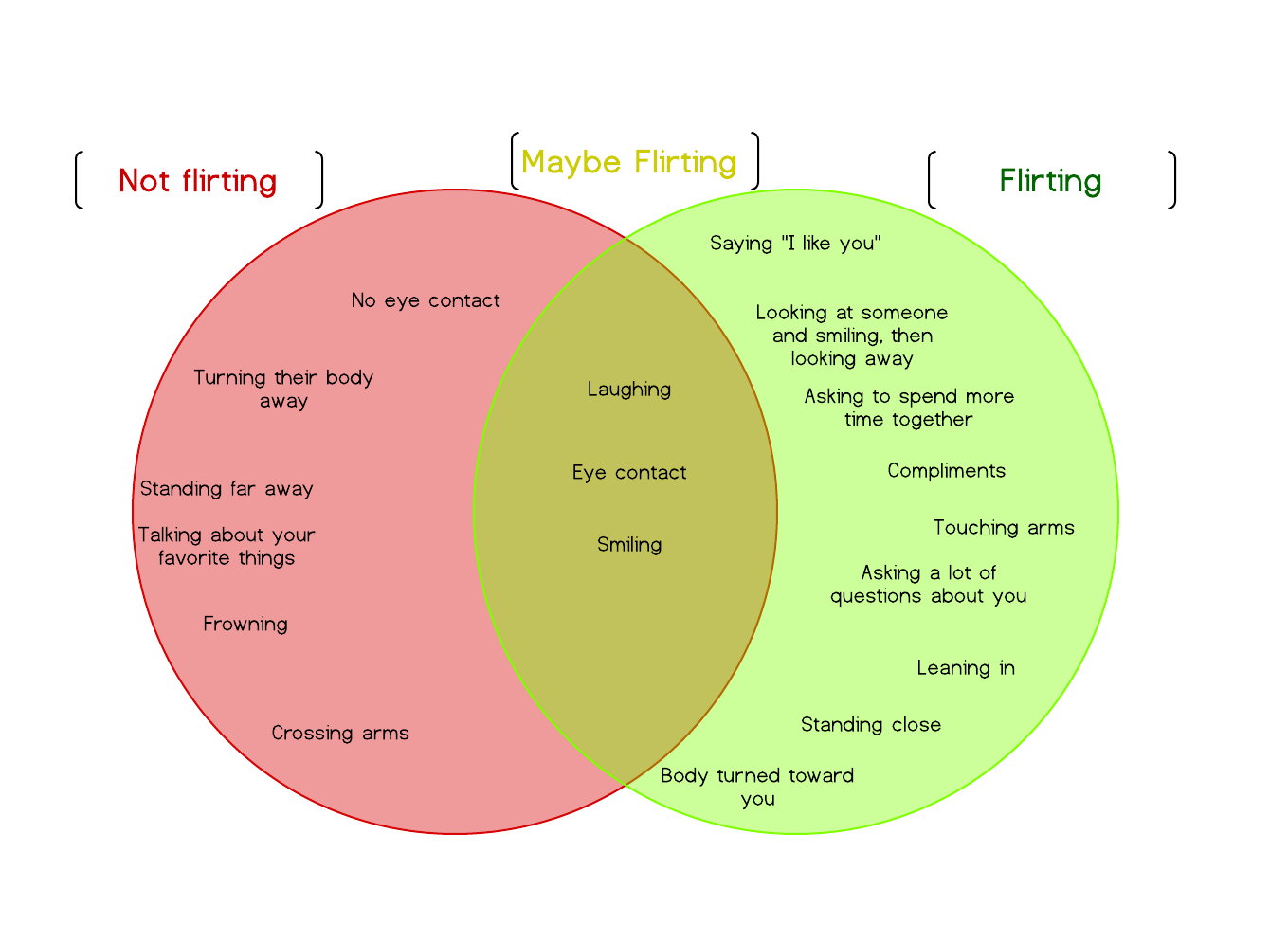
Signs of Flirting

Flirting can be a difficult subject to talk about because it always varies. This aid has some typical behaviors that are flirting, maybe flirting, and not flirting. It’s important to note that this is not a exhaustive list and that some of these behaviors are not guarantees of flirty or not flirty behavior, but it is a great place to start the conversation.  This activity can be used to steer a conversation about how and when flirting occurs, and the fluidity of these behaviors.

Download the signs of Flirting activity here.

Privacy Activity

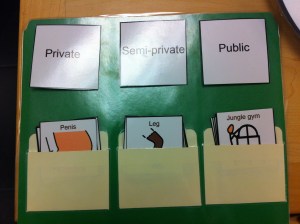
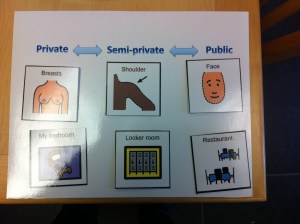
Teaching and learning about privacy can be difficult and confusing. This activity uses a continuum of privacy  (using private, semi-private, and public) to help differentiate privacy levels. There are two topics: body parts and places. You can use this activity to explain different privacy levels and explain contextual differences (i.e. a stomach can be a public body part at the beach, but a private body part at school) . Download the privacy activity places and body parts here!

privacy pocketsprivacy continuum

Social Narrative: Having a Boyfriend in Middle School

Boyfriend in Middle SchoolParents are often afraid of the day that their daughter comes home and says she has a boyfriend!  This social story having a boyfriend addresses this event to help a young girl understand what your expectations might be when it comes to having a boyfriend. We went with the strategy of instructing on how she can interact with her “boyfriend” in many age appropriate ways, for example, she can look at him, giggle, and then look away.

Symbols for Life- Picture Communication System

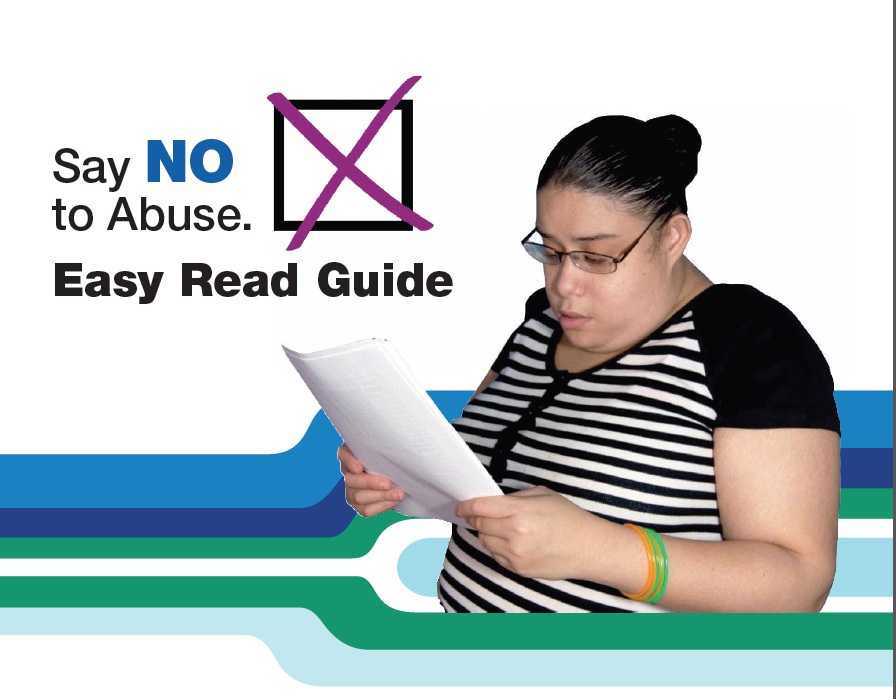
Untitled copyAn easy ready guide about abuse and neglect was forwarded along to me (thank you, Jennifer).  I think most agencies have adapted abuse and neglect information readily accessible to the individuals they serve and comparatively,  I thought this one was nicely done.  It’s made with a product called Symbols for Life.  Essentially, it’s a picture package featuring individuals with developmental disabilities.  One copy is $298.00 and then additional copies are discounted.  A lot of times, I like to make things with pictures of the individual I’m working with, but there are times when that is inappropriate/unfeasible.   I think this could be a good source for those occasions.

Here’s the Say NO to Abuse pdf if you want to check it out.

Privacy Social Stories and Notes on Language

living well with autismI wanted to put you in touch with a website called “Living Well with Autism“.  They have several Board Maker Social Stories related to privacy.

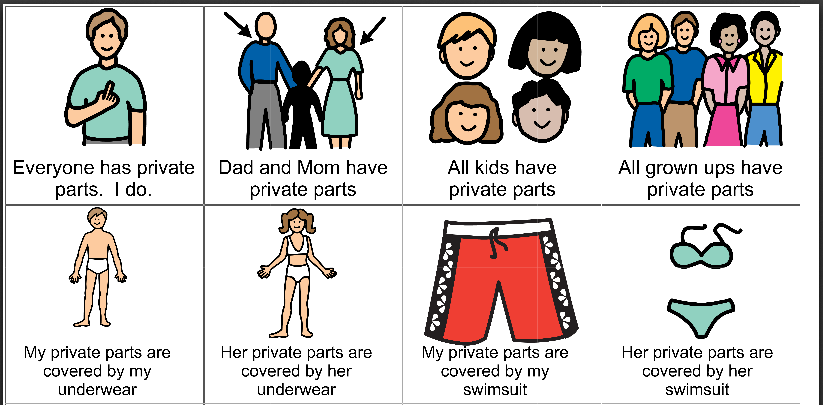
Privacy Social StoryWhile I think overall this site has some nice ideas, I’d be careful about using “Good Touch Bad Touch”.  Good/Bad may bring up feelings of guilt, could be over generalized, and might be confusing as an assault often starts with touches that feel good then moves to touches that feel bad.  Also, there are some studies that have shown that children understand the word touch differently than adults.  For example they wouldn’t categorize people kissing as touching, because well, they’re kissing.  I think this could be a problem for someone with an intellectual disability that doesn’t categorize well.  I like the terms safe and unsafe touch.  I also like saying touching makes you feel something.  If a touch feels good, it’s probably safe.  If a touch doesn’t feel good it’s probably not safe.  Then you can teach specific kinds of touches.  Having said that, the site gives you some good Social Stories to start with.  Pictured left is part of one of their  stories.

Just another note on language.  There is a movement among abuse prevention advocates to alter some our terminology when talking about sexual abuse prevention.   I mention in my workshop that we have to be careful when talking about using education to help prevent sexual abuse because it implies that the individual is responsible for reducing his or her own risk.  Alternative terminology includes personal safety skills, abuse-response skills, or self-protection skills.

Anatomical Models and Drawings

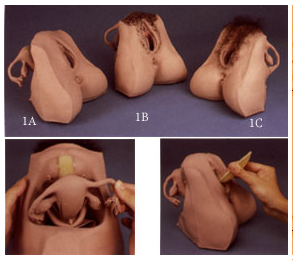
These models are from http://jimjacksonanatomymodels.com/ It can be a little difficult to find the kind of anatomical model that you want for a sexual education class.  I’ve used these models and I think they are very instructive.  They are realistic so it may not be appropriate for all audiences but a lot of folks need things this concrete.  If you’re teaching condom use, make sure to use vinyl condoms (latex condoms can hurt the models).  The cost of the models ranges from $180 – $660 depending on what you’re getting.  It’s an investment, but a great teaching tool. WebMD has nice anatomical line drawings that are okay to print for free. http://www.medscape.com/features/ald/repro Once you get into color photos, they usually ask you to pay.  You can probably find some on the internet that don’t have water marks (like on webmd or mayo clinic ) but they are usually copyrighted. This site will give you a lot of options available for purchase http://www.fotosearch.com/photos-images/reproductive-system.html  This site has more medically technical options (they also have online interactive models, but those are pretty technical too).  http://catalog.nucleusinc.com/generateexhibit.php?ID=9591

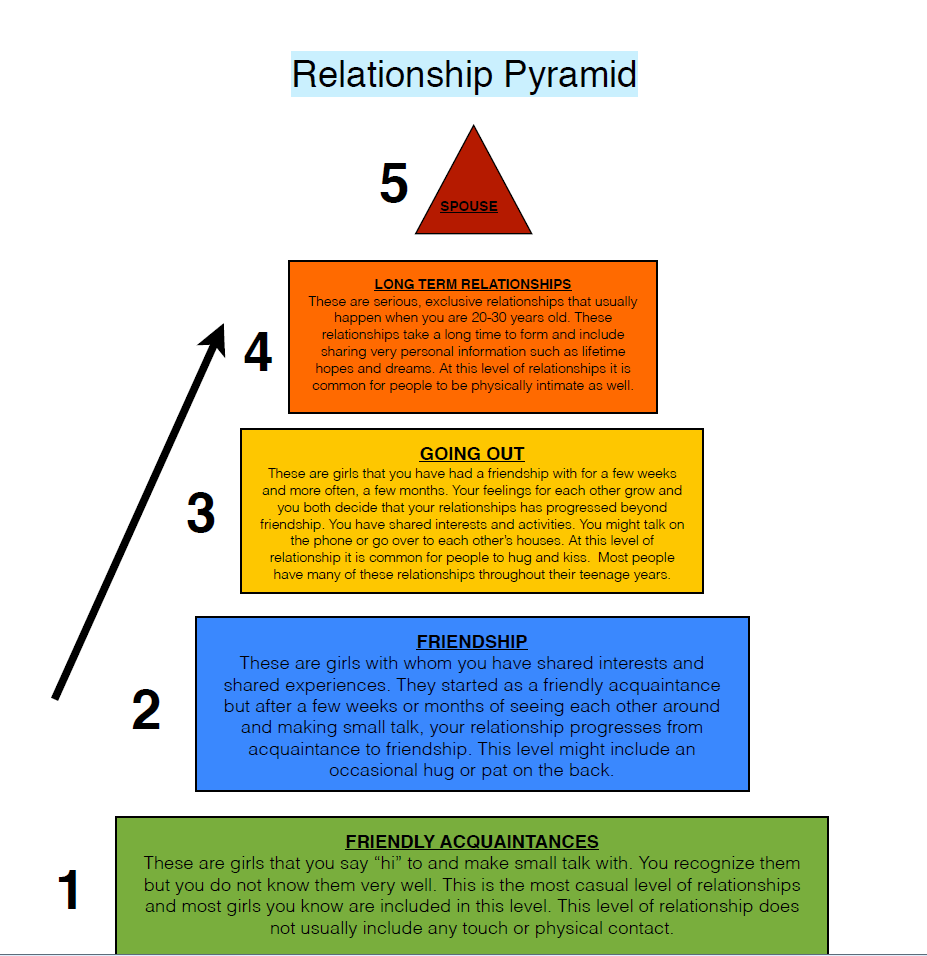
Relationship Pyramid

Here is an example of a five point scale that was developed by April Keaton, LCSW, to explain the different levels of relationships.  The pyramid shape was used to convey that you might have a lot of “friendly acquaintances” but much fewer “long term relationships”.  It was important for this person to connect the level of the relationship with the level of intimacy so you see examples of intimate behaviors at each level of the pyramid.  There’s also an element of time built into the descriptions.     You wouldn’t have to start with pyramid filled out.  You could start with a blank pyramid and support an individual with filling in the levels.  You could add names of individuals at each level.  You can download the pdf of this image by clicking here.

Teaching About Joking

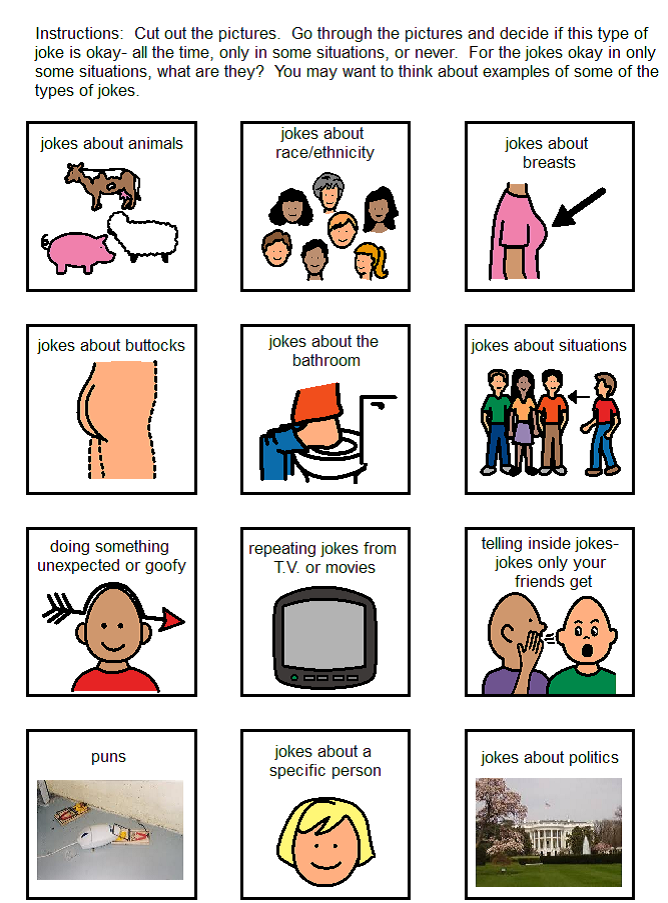
Here is an activity you may want to try out for teaching about joking in context.  Joking is really difficult because it’s very nuanced.  It can be a great way to connect with people but also hurtful.  I also think it is difficult because of the educational context- jokes that aren’t appropriate at school, work, etc. It might be okay in some places but it feels weird saying- “yeah, it’s okay to tell fart jokes with your friends.”  It really easy to cross over from actual social skills to formal social skills.