Sexual Abuse Self Protection Resources

Shirley Paceley is based out of Blue Tower Training in Decatur, Illinois.  She has been working with individuals with developmental disabilities for over 30 years and has specific expertise in abuse prevention and intervention.  She is available to do trainings and consultations.

Check out this online store for books and resources developed by Shirley and others for teaching about sexuality and sexual abuse prevention.

Human Sexuality 101- Reproduction

My favorite comment from this session was, “Can we stop working on the worksheet for a minute? I just really want to listen!”  We based the lesson the Nova’sLife’s Greatest Miracle” (you can stream for free or buy the DVD for $20).  We covered the material in one session but didn’t have time for the breakout groups and we went over our allotted time.  We could have easily split it up into two sessions.  The video is very well done and contains a lot of good information.  We had the students fill out a worksheet to help them key into important points and break down euphemisms.  It’s amazing how much they are learning but also what is slipping by.  For example, as we’re watching the sperm and the egg meet I asked, “Is this happening inside the man’s body or inside the woman’s body?” and they didn’t really have any idea.

For the parent component of the session, we manly focused on two questions. 1) What do you think about preemptive birth control? and 2) What are your hopes and fears about your child becoming a parent in the future.  Unfortunately, these are some of those questions without any easy answers.

Download the materials…

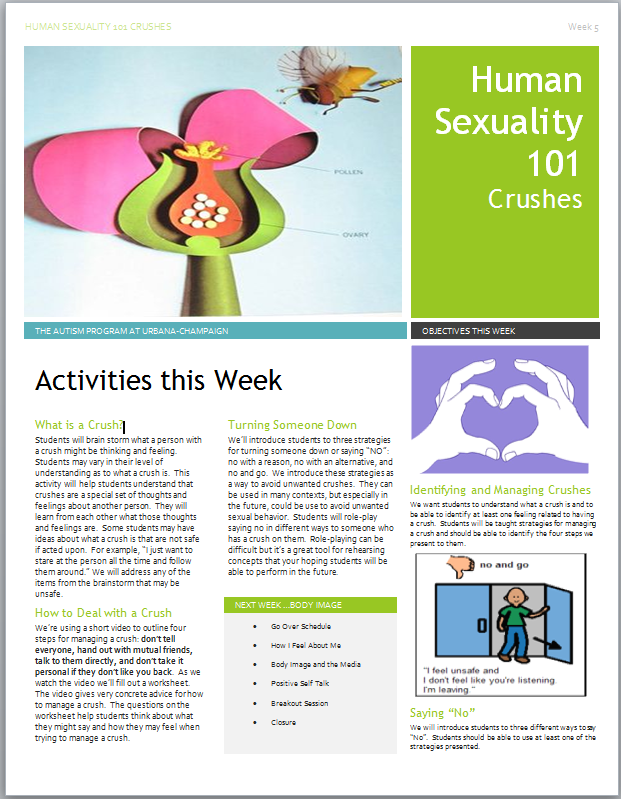
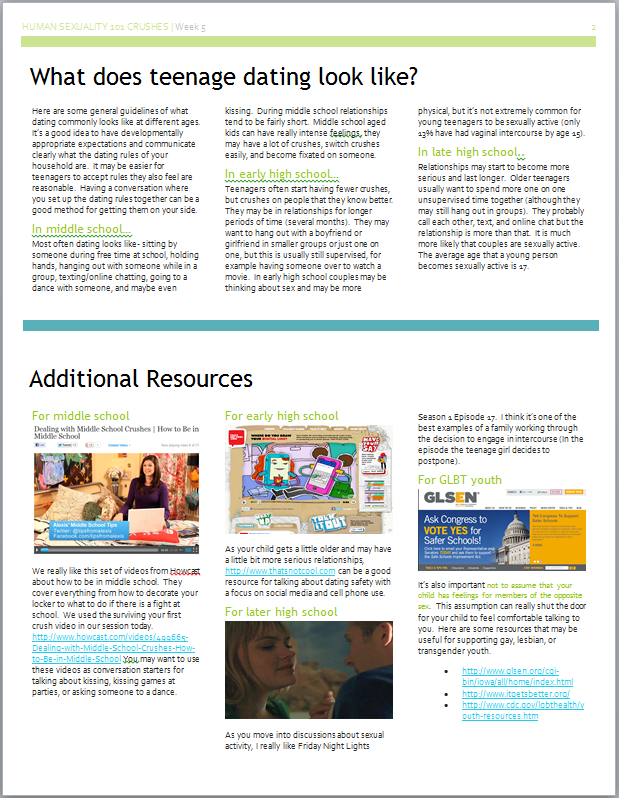
Human Sexuality 101 Week 5- Crushes

This topic generated a lot of good discussion.  Our group was a little distracted today (maybe because we had a week break).  For next week we’re going to try a few different classroom management strategies so we can try to spend more time focused.  We’re going to simplify the rights and the responsibilities and give them 3 rules (no talking when I’m talking, no hitting, and no mean comments).  We’ll also use a visual stop sign for if the group gets out of control.  I’ll keep you posted how it goes!  Having said that, despite distractions, I’m confident the group did learn a few things about crushes.

Activities this week…

What is a crush?

Students brainstormed what a person with a crush might be thinking and feeling.  Students varied in their level of understanding as to what a crush is.  This activity helped students understand that crushes are a special set of thoughts and feelings about another person.  They will learned from each other what those thoughts and feelings are.  None of the students in our group expressed ideas about what a crush is that would not be safe if acted upon (I was thinking someone might say something like, “I just want to stare at the person all the time and follow them around.”) We were ready to address any of the items from the brainstorm that were unsafe.   In later discussion we labeled some ideas as unsafe.

How to deal with a crush

We’re used a short video to outline four steps for managing a crush: don’t tell everyone, hang out with mutual friends, talk to them directly, and don’t take it personal if they don’t like you back.  As we watched the video we filled out a worksheet.  The video gives very concrete advice for how to manage a crush.  The questions on the worksheet helped students think about what they might say and how they may feel when trying to manage a crush.

This is where they got a little distracted.  In the future, I would shorten the worksheet so there is only one question per tip.  I would maybe have them work on answering the questions with a partner, then sharing with the group.

Turning someone down

We introduced students to three strategies for turning someone down or saying “NO”: no with a reason, no with an alternative, and no and go.  We introduced these strategies as a way to avoid unwanted crushes.  They can be used in many contexts, but especially in the future, could be use to avoid unwanted sexual behavior.  Students role-played saying no in different ways to someone who has a crush on them.  The role-plays worked really well!  Role-playing can be difficult but it’s a great tool for rehearsing concepts that your hoping students will be able to perform in the future. 

Materials for this week

Human Sexuality Week 6- Body Image

This week, we focused on body image.  This was probably the most difficult concept for students to grasp so far.  In other weeks we’ve focused more on content but this week was more about self expression and they could connect the expression components, however, they really struggled with what exactly body image is and their own self awareness.  For some of the students thinking about body image melted into feelings of self worth.  The strategy we introduced, positive self talk, was also difficult for them to understand.
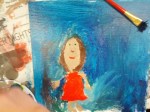
Activities this week…
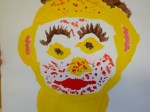
What is Body Image? We’re used a pretty simple definition of body image: how you think and feel about your body and appearance.  This definition highlights the cognitive and affective components of body image.
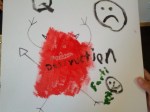
How I Feel About My Body  For this activity we asked students to write down how they feel about their body.  We then collected all the responses, redistributed them, and read them out loud.  This activity allowed students to express their feelings about body image.  It also exposed them to the thoughts and feelings of others.  For the most part students in our group expressed feeling good about their bodies.

Positive Self-Talk  We introduced positive self-talk as a strategy for managing negative ideations about body image.  Each member of the group practiced positive self-talk by using affirmation statements in the mirror.  This was very difficult for some students, even with the scripts.  This may be because they didn’t understand the “why” behind the activity.  This activity exposed them to a strategy for promoting a healthy body image and gave students an opportunity to practice that strategy.
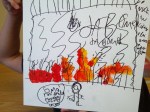
Role Play  Because we know that often, negative thoughts and feelings about body image occur while we are with groups of people, we role played using positive self-talk when in a group.  This was essentially an extension of the previous activity but we made the task slightly more difficult.
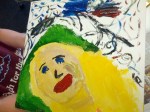
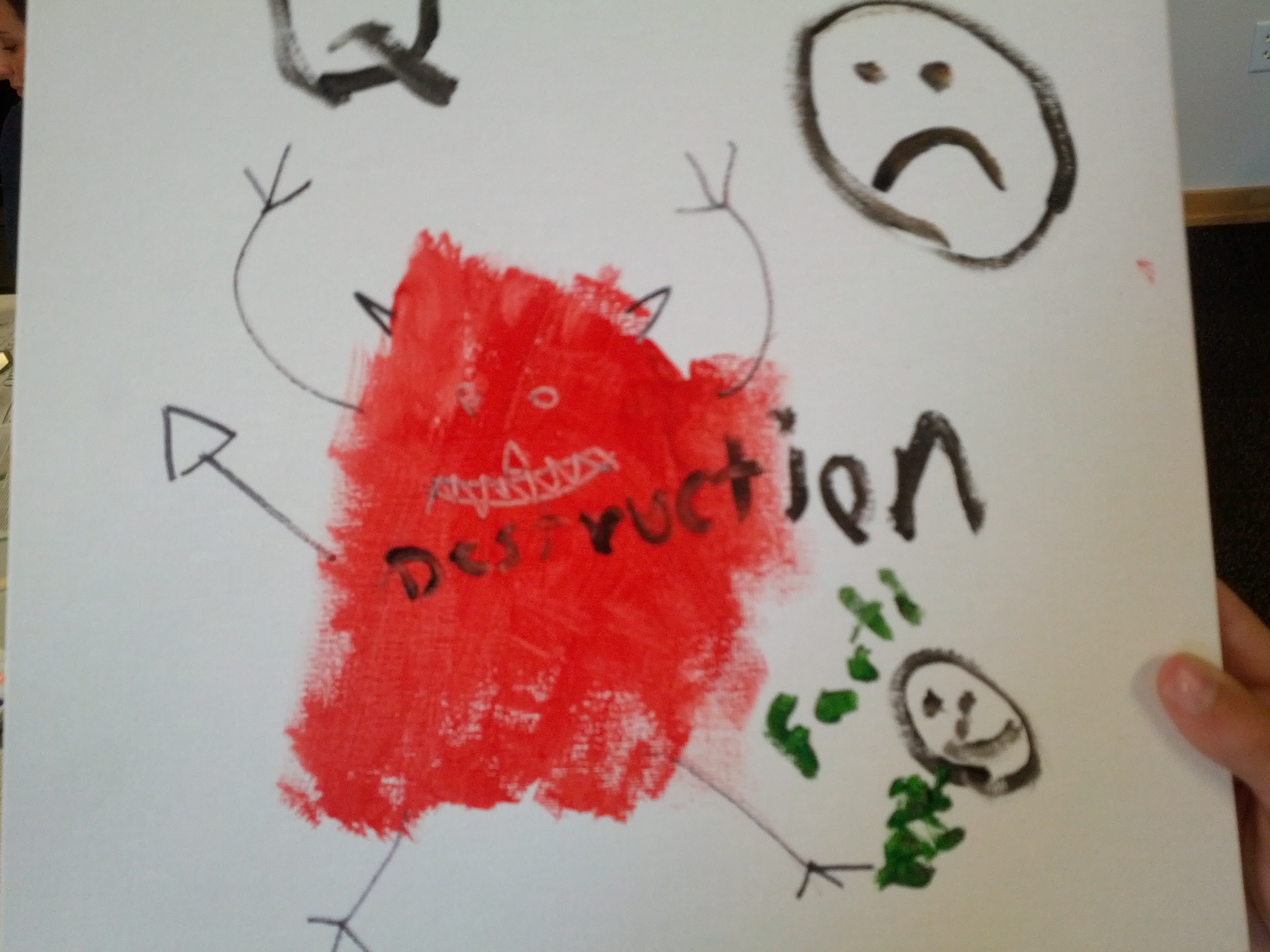
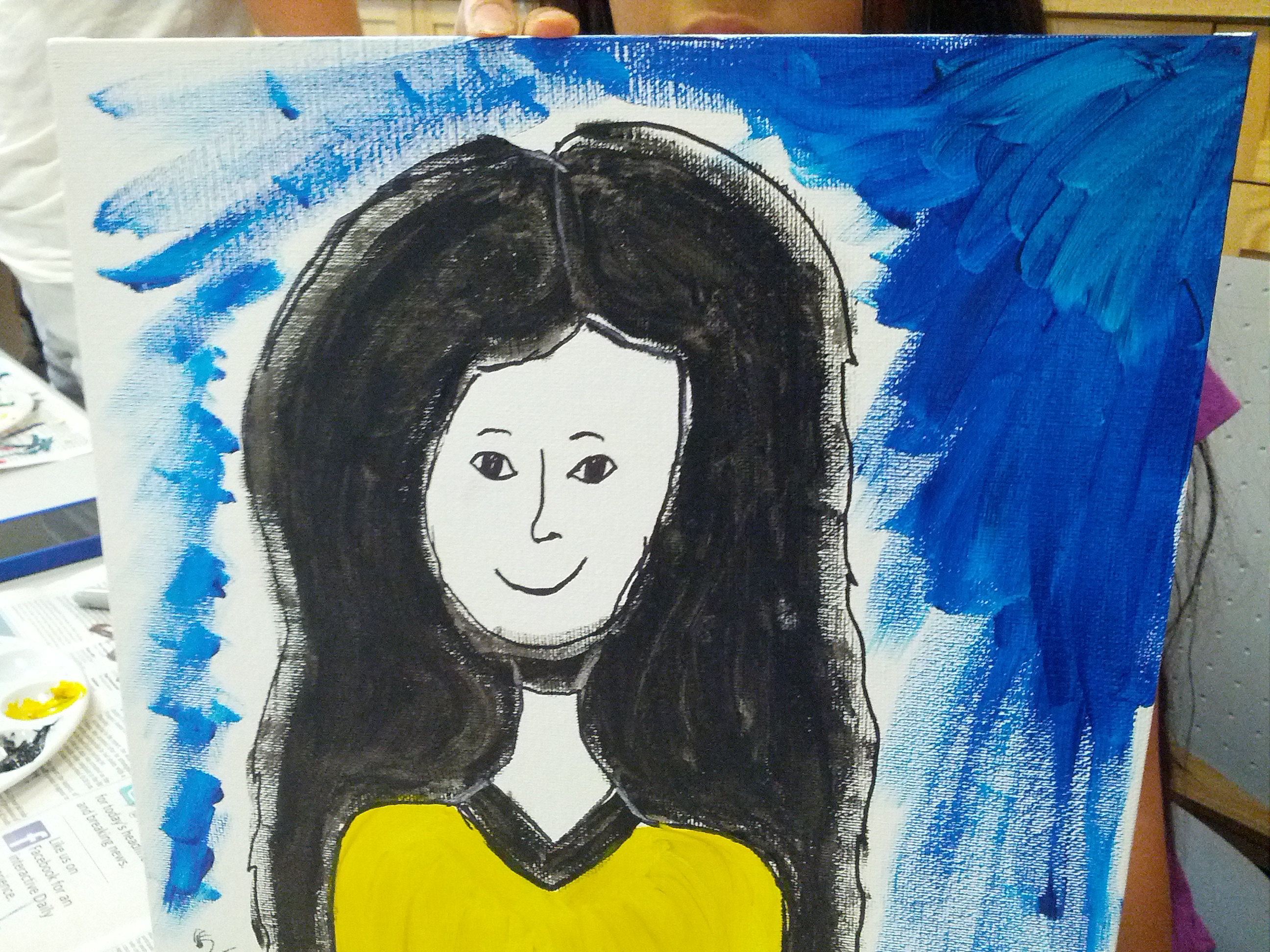
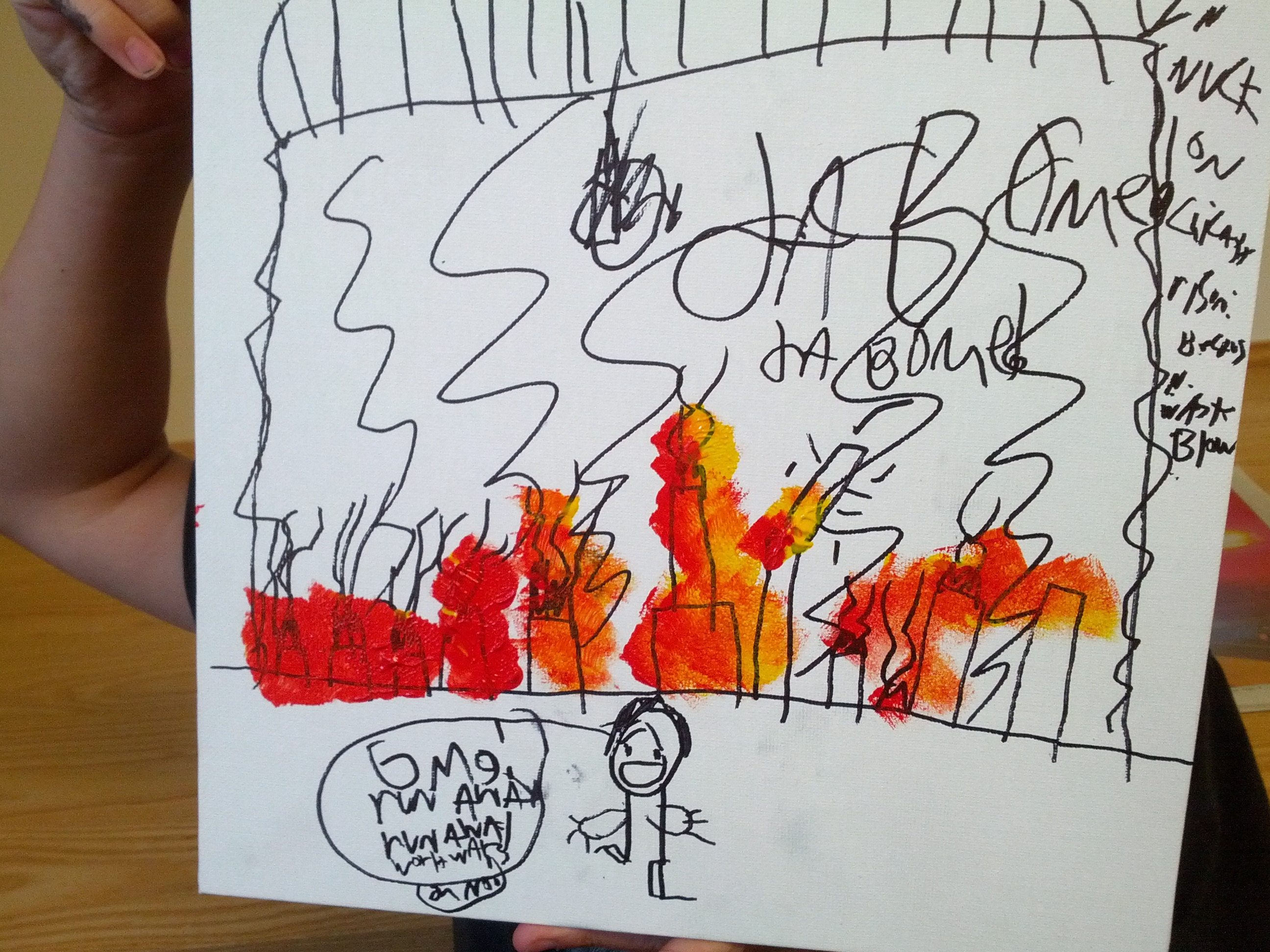
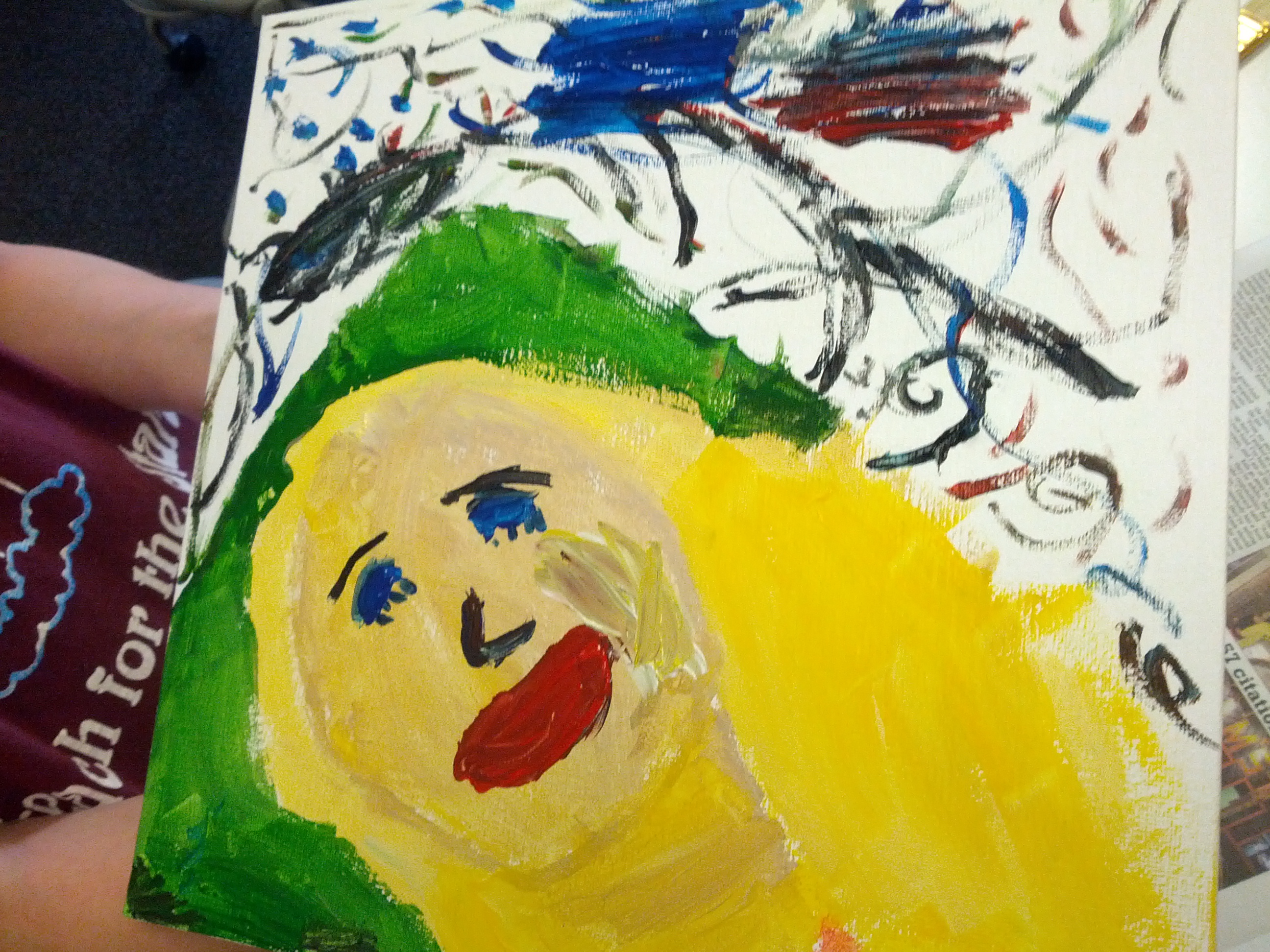
Self-Portraits  Body image is one of those topics that is not just about learning facts but mostly about self-awareness and self-expression.  In addition to teaching some concrete strategies for promoting positive body image, we also wanted to provide opportunities to explore thoughts and feelings about appearance.  The self-portraits were another strategy for helping students explore their thoughts and feelings about body image.  For the most part, the kids were really excited about this activity.  We promoted trying to reflect a positive self image, but this didn’t come naturally to all the students.  We also wanted to make sure we respected the right for students to express their genuine emotions.   

Just a note on classroom management.  Distractions were down with the implementation of our simple rights and responsibilities, more firm “nos” and the stop sign.  We did have one student who had a hard time because they had to wait until next week to take the pictures home so the paint could dry.  This is something to anticipate for the future.

Materials for this week…
Human Sexuality Week 7- Hygiene

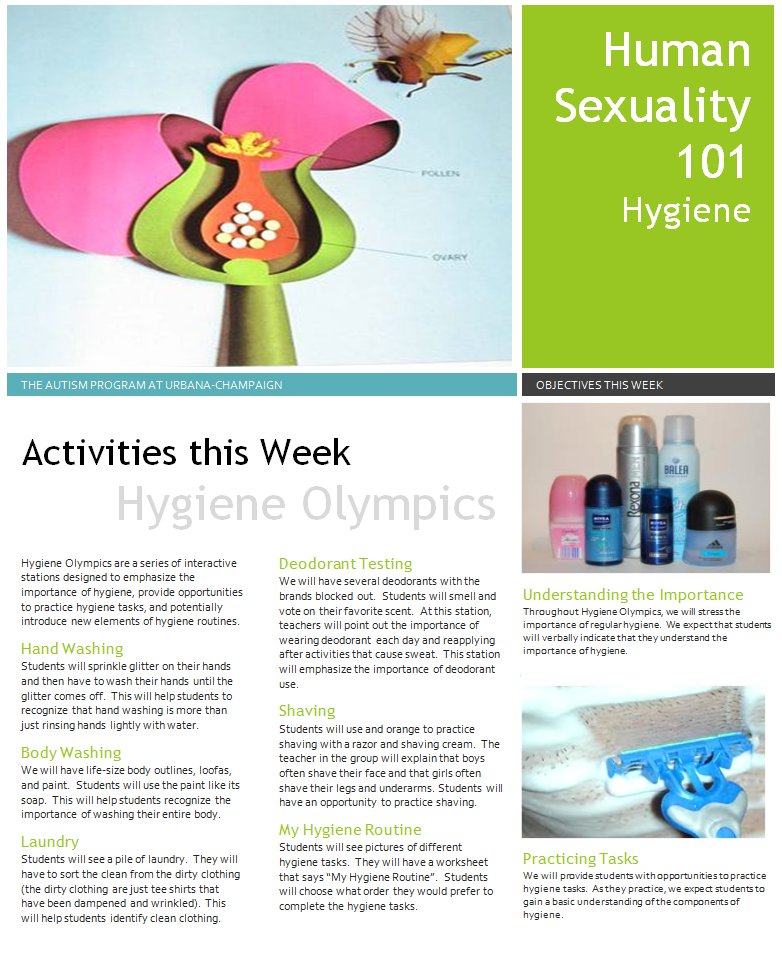
Hygiene is not on the SEICUS guidelines for what to teach in a human sexuality class, but we find that it can be a hard topic for students.  It also is strongly connected to puberty because it is during puberty that hygiene needs change at the same time young people have more autonomy and responsibility for their hygiene.  We tackled hygiene with a series of activities we called hygiene Olympics.  In small groups, students moved throughout the stations to practice and contemplate hygiene tasks.

  • Hand washing: Students rubbed glitter mixed with lotion on their hands and then had to wash their hands until the glitter came off.  This will helped students to recognize that hand washing is more than just rinsing hands lightly with water.
  • Body washing: We will had life-size body outlines, loofas, and paint.  Students used the paint like it was soap.  This helped students recognize the importance of washing their entire body.
  • Laundry: Students saw a pile of laundry.  They then sorted the clean from the dirty clothing (the dirty clothing are just tee shirts that have been dampened and wrinkled).  The helped students identify clean clothing.
  • Shaving: Students used an orange to practice shaving with a razor and shaving cream.  The teacher in the group explained that boys often shave their face and that girls often shave their legs and underarms. Students had an opportunity to practice shaving. 
  • Deodorant testing: We had several deodorants with the brands blocked out.  Students smelled and voted on their favorite scent.  At this station, teachers  pointed out the importance of wearing deodorant each day and reapplying after activities that cause sweat.  This station emphasized the importance of deodorant use. 
  • My Hygiene Routine: Students saw pictures of different hygiene tasks.  They also had a worksheet that said “My Hygiene Routine.” Students chose what order they would prefer to complete the hygiene tasks.  This activity provided students with control and choice while also committing them to completing the necessary tasks.

Materials for this week

Human Sexuality 101 Week 8: Wrap Up and Review

For the final session of Human Sexuality 101 we reviewed what we learned during the class.  Overall, students seemed to enjoy the class and learn something.  The students also seemed to like each other.  Sexuality is a social topic, so I was excited that students were able to share and connect throughout the class.

Activities

Vote with Your Feet:  We printed ‘true’ and ‘false’ on sheets on the opposite sides of the room.  When presented with true/false statements, participants chose the correct response.  We specifically chose items that we knew were difficult for students.  Then we switched to agree/disagree.  This allowed us to touch upon the difference between facts and opinions.  We also had students make their own statements.  They did a great job.

Booklets:  We passed out booklets to the participants that reviewed all the information we covered and had additional activities for them to do at home. We did complete an evaluation, but I don’t think it was very successful.  I’d consider the evaluation to still be “under construction.”

Materials

Social Signals- Curriculum

Social Signals ($159.oo) is a series of  videos and curriculum are designed to teach adolescent students with autism and intellectual disability about safe relationship skills.  There is also a parent curriculum for $23.99.  They have a sample video and lesson available for free so you can preview before you purchase.  I liked the video.  I like to teach about expected and unexpected behaviors and I think these videos could be a good tool.  There are also sample lessons that accompany the videos.

Living Safer Sexual Lives- Training Pack

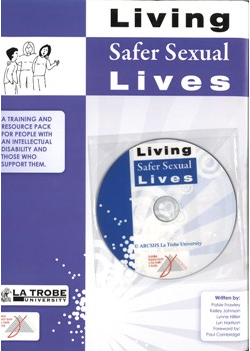
Living Safer Sexual Lives is a training pack available for purchase ($57.23) for those of you who may be doing training on human sexuality and disabilities.  I have not personally used their materials, but it was developed in a very interesting way and it’s not very expensive so I thought I’d pass it along.  A research group in Australia interviewed several people with intellectual disability about their sexual lives and then used their stories to develop this training.  The training is targeted toward parents, professionals, and self advocates.  The training pack has three parts: introduction, training, and resources (including a DVD of people with intellectual disability telling their stories).

You can read the full report which outlines the findings from the interviews and how they used the interviews to shape the training.  The report also includes accounts from people with disabilities about their sexuality.

The key themes that emerged from the stories were:

  • Diversity and similarity. Diversity within the lives of the story-tellers and similarities between needs and desires of this group and other adults.
  • The issues of rights and sexuality.
  • The hidden nature of people’s sexual lives.
  • Celebration of sexuality and relationships.
  • Gender issues.
  • Loneliness and rejection.

The Circles of Sexuality

No, these aren’t the circles we usually talk about related to levels of intimacy and based on the Circles curriculum.  These circles developed by Dr. Dennis Dailey, focus on Sensuality, Sexualization, Intimacy, Sexual Identity, and Sexual Health.  I think these might make a good framework for a 5 module course or could be used to introduce the concept of sexuality.  Click here for a full explanation of The Circles of Sexuality

“Intimate Relationships and Sexual Health” – A Curriculum

Courtesy of Indiana University

Thank you to the folks at TAP in Rockford for bringing this curriculum to my attention!

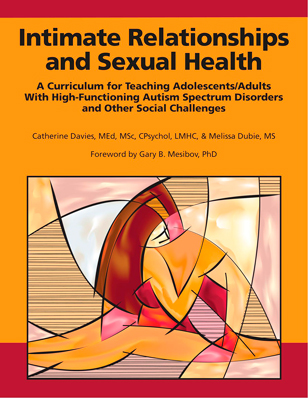
Intimate Relationships and Sexual Health” is a curriculum written by Catherine Davies and Melissa Dubie who are affiliated with the Indian Resource Center for Autism.

“Intimate Relationships and Sexual Health” is geared toward folks who are pretty independent and have few intellectual impairments, so it’s not for everyone.  But they do do a nice job of showing how to think about lesson planning  that would apply to anybody.  You can see a fair amount of the curriculum on Amazon to see if it might work for you.

Free Curriculum and Parent Resources

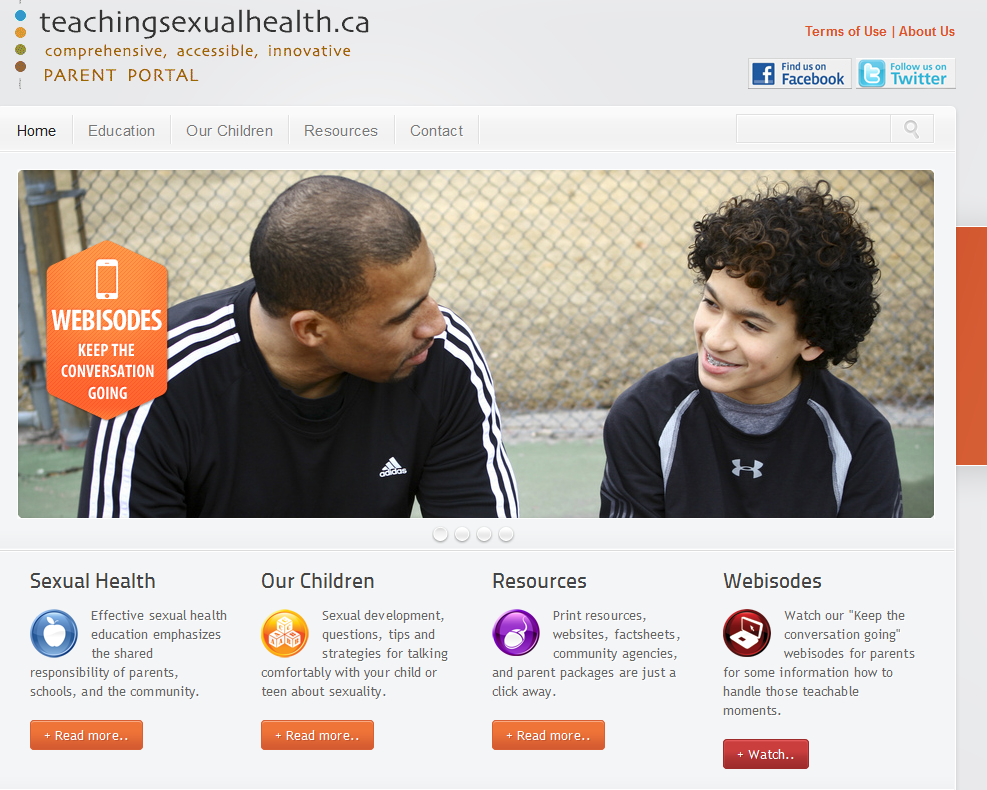
A lot of the curriculum we used for the puberty unit of our Human Sexuality 101 group was adapted from “Teaching Sexual Health“.  They are a group out of Canada that provides support for teachers and parents.  I used their general curriculum but they also have a curriculum for students of differing ability levels.  They have great resources for parents including “webisodes” that give examples of parents talking to kids about sexuality topics.  The website is very well organized and easy to use!

Image

Hierarchy: Masturbation Training by Lisa Mitchell

Below is a “Hierarchy: Masturbation Training” by Lisa Mitchell, LCSW-R at Penn State.  Her plan for what she calls, “private touching”, was specifically developed for individuals with Autism Spectrum Disorders, but I think it is a good general framework.  The hierarchy goes from lowest level of support to highest level of support.  Across the board, masturbation is a topic people want more information about.  I think this is a nice way to think about what kind of education or training is available as well as what you might want to try before moving on to something more intensive.  I have also included a link to her entire powerpoint.  She covers other topics/tips you may find interesting (relationship checklist, key concepts for topic areas, teaching techniques, problem behaviors).

  1. When appropriate, work with families and/or residence to establish a visual “private time schedule.”
  2. When appropriate, supply individual with lubricant, explaining that it is for use during “private time.”
  3. Meet with individual. Present illustrations of same sex persons masturbating, in conjunction with verbal explanation regarding technique.
  4. Meet with individual. Use illustrations and anatomical model in conjunction with verbal explanation of technique.
  5. Meet with individual. Use anatomically correct dolls to demonstrate appropriate masturbatory technique, in conjunction with verbal explanation.
  6. When appropriate, supply masturbatory aids such as body pillows, magazines, collages of stimulating pictures, vibrating pillows, masturbation sleeves, masturbation pumps, or vibrators. Explain safe usage of such aids.
  7. Meet with individual. Arrange for multiple viewings (when necessary) of instructional masturbation movies “Handmade Love” for males, or “Fingertips” for females. Viewings should occur in the individual’s bedroom or the private location where masturbation will be allowed to occur. Trainer may need to supply a verbal explanation while simultaneously viewing the tape to reinforce principles. (I would have the person watch on their own before feeling the need to view with another present. In general I think the videos are very good but very explicit. You could use the video in place of the verbal instructions indicated in the hierarchy).
  8. For individuals with more significant challenges, consider use of ABA type
    approach (preferably done with relatively unfamiliar trainer) to teach more
    successful masturbatory technique. Shape up steps one at a time (e.g. “Pull pants
    and underwear down”, “Lay on belly”, “Put pillow between legs”, “Rock from side to
    side”. Or “Pull pants down”, “Sit on bed”. “Put fingers around penis”, “Rub up and
    down, up and down.”) – I have heard of this method, but I do not know anyone personally who has ever instructed on masturbation at this level.  I would want to have a very comprehensive plan on how this would be implemented, full team support, and special attention paid to protecting the individual being instructed and the person doing the instruction.  

Free Curriculum- Parent Version, Teacher Version, Spanish Version

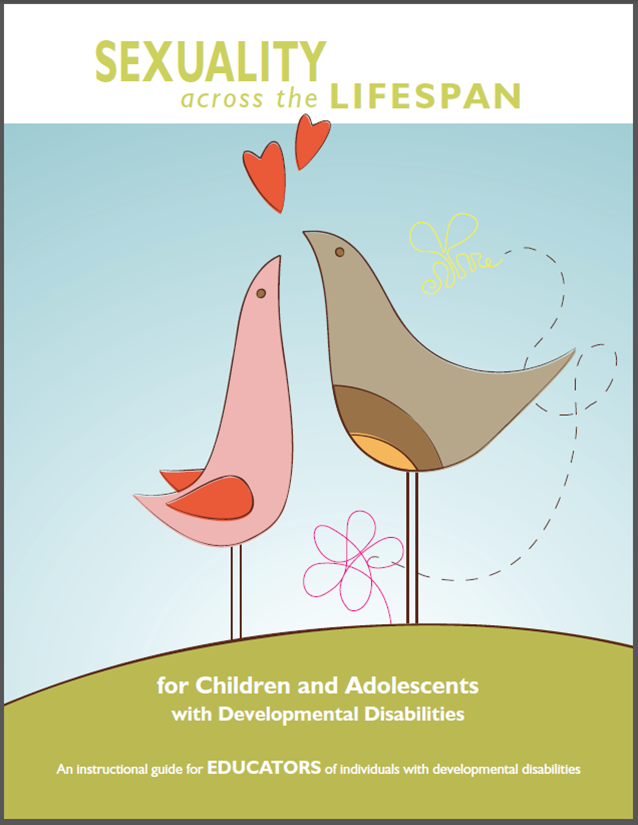
ImageI’m really excited about this free curriculum, “Sexuality Across the Lifespan” by: DiAnn L. Baxley and Anna L. Zendell.  It has versions for educators, teachers, and Spanish speakers.  You can view the curriculum by clicking on the links below.

What makes this special?  They do a nice job at adjusting lessons for different age groups, giving ideas for supplemental activities, and giving ideas for incorporating the topics into routines.  The parent version really focuses on how to reinforce healthy sexual development through interactions and daily routines.

This curriculum in not comprehensive but does have sections on social skills, dating, sexual abuse, puberty, and anatomy.  I hope you find this useful!

Introduction to Sexuality Education for Individuals Who Are Deaf-Blind and Significantly Developmentally Delayed

I found this great (free) book online.  Although it targets parents, caregivers, and professionals who work with individuals who are deaf-blind and significantly developmentally delayed- you may find useful info even if this not your target population.  Kate Moss & Robbie Blaha’s overall approach to education considers four basic tools for instruction: routines, units, teachable moments, and behavior plans.  Chapters include …

Chapter 1 – Introduction
Chapter 2 – Sexuality Education
Chapter 3 – Developing an Instruction Plan
Chapter 4 – Modesty
Chapter 5 – Appropriate Touch and Personal Boundaries
Chapter 6 – Menstruation
Chapter 7 – Masturbation
Chapter 8 – Sexual Health Care
Chapter 9 – Sexual Abuse

I just want to highlight a couple of things I found particularly useful.  They provide instructions for developing a sexual education policy and provide a model policy as well as sample permission forms.  I also thought that their plan for supporting with menstruation was well thought out and useful.

There’s also the Texas School for the Blind and Visually-Impaired’s website, which offers some strategies for supporting and educating visually impaired individuals about many topics such as gender roles, social skills, personal safety, gender identity, sexual language, masturbation, and reproductive anatomy.

Social Narrative for Initiating Social Interactions

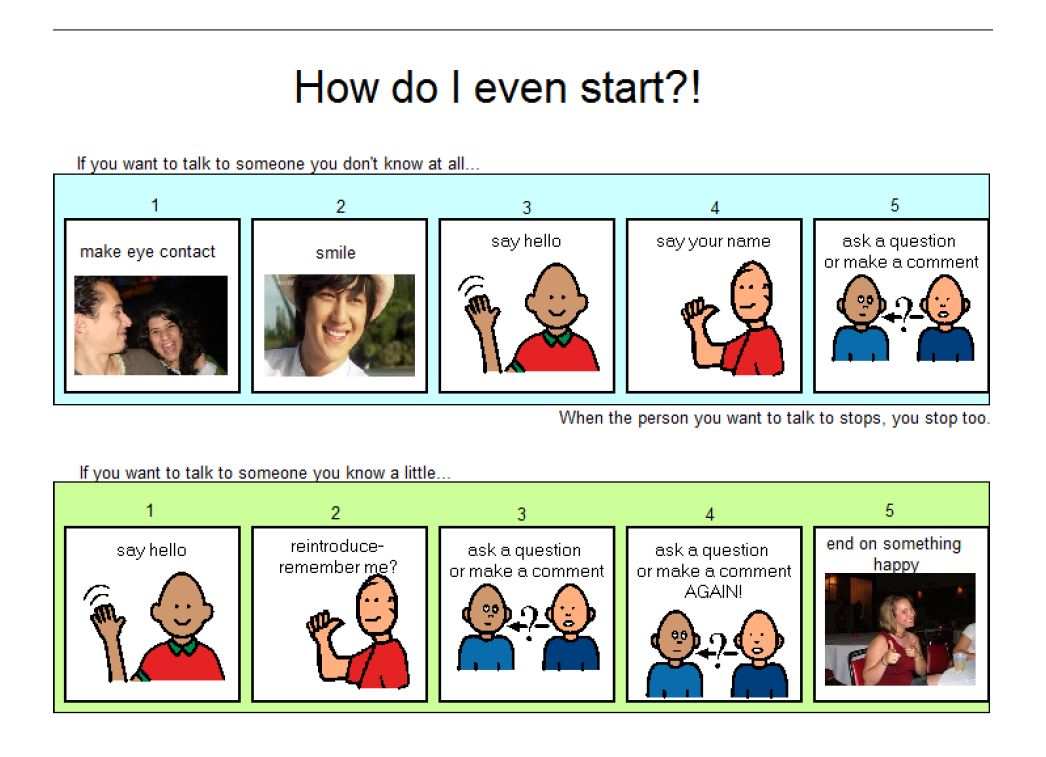
This is a social narrative in comic strip form.  It supports initiating social interactions.  One strip is for people you don’t know at all and the other strip is for people you know a little.  I would use this in combination with role playing (can you tell I like role playing?).  Over initiating and under initiating can both be a problem.  This is geared more towards encouraging initiation, but it could be used to help establish boundaries too. The YAI relationship videos also cover some of this information. Click here to get as a pdf: How do I even start

.