Guide For Gynecology and Testicular Exams

Testicular and gynecological exams are very important to the health of your reproductive organs. These exams help to play a critical role in early detections of cancer which can help to increase chances of successful treatment. Testicular exams are used to check for lumps, swelling or changes in the testicles and identify other issues like infections or injuries. Gynecological exams are used to examine the uterus, ovaries, and cervix for any abnormalities along with screening for cancers, infections or other health issues. Overall, these exams are an important part of sexual health. Make sure you are going to get one around once a year. Here is a step-by-step guide of what to expect during these exams.

Testicular Exams:

Purpose: The reason you should get one done is to help detect changes in the testicles early on such as lumps, swelling, or anything that is out of the normal that could indicate cancer or other conditions.

Who should be getting one: A person who has biological male reproductive parts. Men should start getting these around age 15 every year with a healthcare provider.

What to expect during this exam: First you will talk to the doctor. They will ask you questions such as family history and if you are sexually active. They will also ask if you have any concerns that you would like to address. After they will give you privacy to undress from the waist down. You are able to keep your shirt on during this. After the doctor will do a visual check of the scrotum and groin area. Lastly, they will feel each testicle using their fingers to check size, shape, tenderness, or if there are any lumps.

Always remember that at any time during this if you feel uncomfortable you can ask the doctor to stop. You are able to ask any questions you make like and have the doctors explain these steps to you as well.

Gynecology exam:

Purpose of these exams: These exams are important for maintaining reproductive health and catching early problems such as cervical or ovarian cancer. Gynecologists can also help you show your options for different birth control methods such as the pill, IUD, the patch and many others. 

Who should be getting one: Anyone with female reproductive organs should see a gynecologist. Most should start getting exams starting at 21 or sooner if you are sexually active. You can also start going younger if you have any concerns or irregular periods.

What to expect during these exams: Starting off the doctors will come in and discuss any general health concerns or questions you might have. They will ask if your menstrual cycle is regular or if you have concerns about this.

  1. External exam: the docotor will look at the outside of your vagina area to check for irritation, swelling, or any other visible concerns.
  2. Pelvic exam: The doctor will gently examine the internal organs (uterus and ovaries) They do this by inserting one or two gloved fingers while genetly pressing on the abdomen to feel for anything out of the normal.
  3. Speculum exam: It is a medical tool that is used to open the vaginal walls so the doctor can see the cervix. This should not be painful. It can be a little uncomfortable or have some pressure. During this the doctors may collect a small sample of cells from the cervis to screen for early signs of cervical cancer. This is called a pap smear and only takes a few seconds. 

Always remember that at any time during this if you feel uncomfortable you can ask the doctor to stop. You are able to ask any questions you make like and have the doctors explain these steps to you as well.

How to set up an appointment:
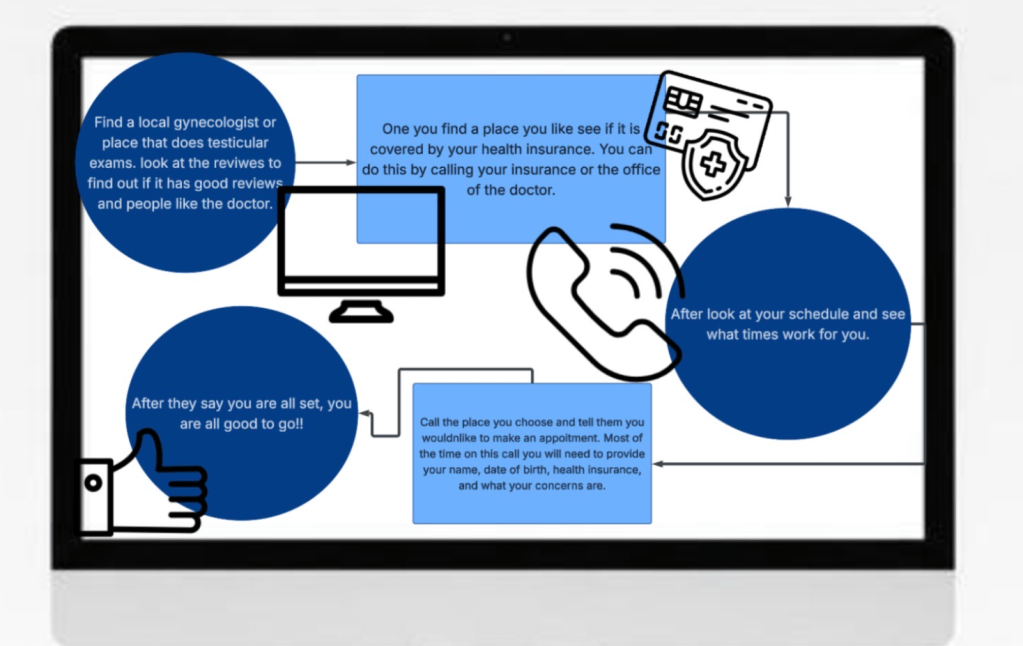
Find a local gynecologist or place that does testicular exams. look at the reviews to find out if it has good reviews and people like the doctor. One you find a place you like see if it is covered by your health insurance. You can do this by calling your insurance or the office of the doctor. Look at you schedule and see what times work for you. Call the place you choose and tell them you would like to make an appoitment. Most of the time on this call you will need to provide your name, date of birth, health insurance, and what your concerns are. After they say you are all set, you are all good to go!

Common concerns 

  1. They are painful: these exams should not be painful at all. If they are painful make sure you let your doctor know so they can help figure out what is going on.
  2. Only get these exams when you are sexually active: you definitely should get these exams while you are sexually active but you should also get them before if you have any concerns. Also get them if testicular or cervix/ovary cancer runs in your family. 

For more information about these exams click on the links below:

Testicular exam – Mayo Clinic

What Happens During a Gyno Exam, From Start to Finish – ScienceInsights

Overall testicular and gynecological exams are an important part of maintaining overall sexual and reproductive health. These exams help you have a peace of mind in early detection of cancers, infections, and any other concerns you may have. Although this can feel nerve-wracking to do, they are very quick, safe, and not painful. Make sure you talk to your doctor if you feel uncomfortable at any time.
Understanding Pregnancy Emotions

It is very normal to experience a range of emotions when you find out you are pregnant, since it is a major life event that brings about a lot of change. It’s important to remember that every experience is valid and part of the parenthood journey.

Common Reasons for Pregnancy Emotions

Hormones: There are significant hormonal shifts, which can have an intense impact on your emotions. Your estrogen and progesterone hormones fluctuate, which then influences the hormones that regulate your mood (serotonin and dopamine), leading to mood swings and heightened emotions.

Body and body image changes: Your body goes through a lot of physical changes (weight gain, changes in posture, changes in skin, etc.) which can sometimes provoke emotions about body image and self-esteem. Some expectant parents may feel proud that their body’s changing to nurture life, but others may experience feelings of discomfort or insecurity.

Stress: This is a very stressful time for parents, and you may feel stressed about finances, relationship adjustments, childbirth itself, and parenting. Your body heightens its stress response system (your cortisol levels) which can lead to feelings of anxiety, mood swings, and irritability.

Fatigue: Changing hormones, difficulty sleeping, and stress can cause fatigue and exhaustion, which is very common during pregnancy. This can further heighten feelings and make you emotional.

Emotional Changes Throughout Pregnancy

First trimester: Can bring on a lot of early pregnancy emotions and first-trimester mood swings. You may experience a whirlwind of feelings as you come to terms with the reality of being pregnancy, and may feel excited, anxious, and/or overwhelmed.

Second trimester: Experience a welcome break from intense emotions of early pregnancy. You may feel more stable and have more balanced emotions, but you may continue to feel anxious or stressed.

Third trimester: As you’re preparing for childbirth, it can evoke even stronger emotions. You may be fearful of the unknown, but also excited about the arrival of a child. Common feelings include anticipation and excitement, occasional impatience, and anxiety.

Managing Emotional Changes During Pregnancy

It’s important to be able to identify and label what you’re feeling, so that it can be addressed in healthy and effective ways. Be mindful of what you’re experiencing in the present moment. You also should practice self-compassion by acknowledging the work that your body is doing by being pregnant, and accepting these changes.

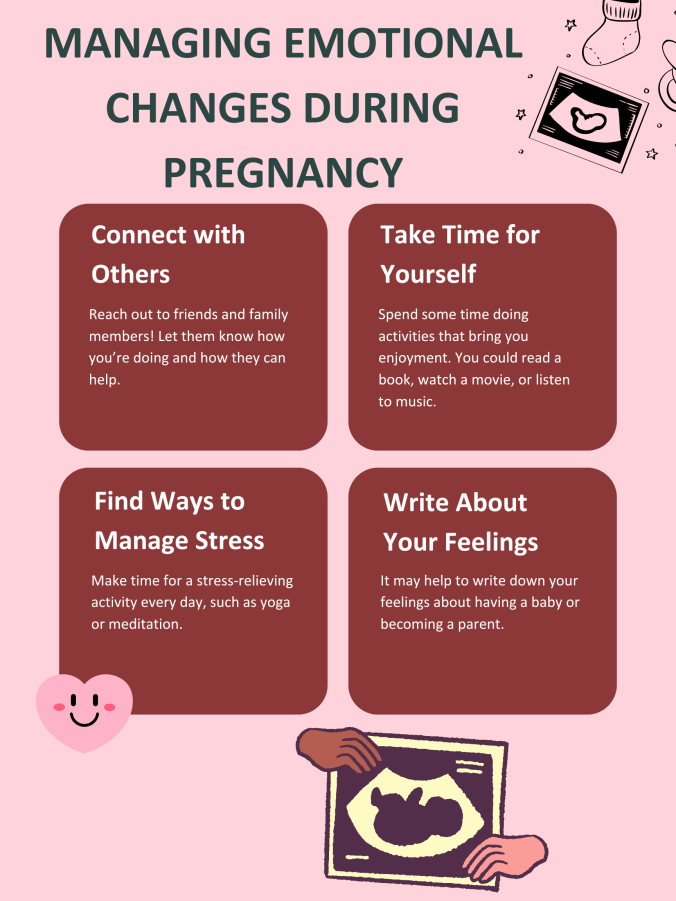
NewYork-Presbyterian provided some strategies to manage your emotional changes during pregnancy:

Title: Managing Emotional Changes During Pregnancy. On the top-right page, black and white clip art of an ultrasound and a sock. Two boxes on top, two below. Upper-left box: Connect with Others: Reach out to friends and family members! Let them know how you're doing and how they can help. Upper-right box: Take Time for Yourself: Spend some time doing activities that bring you enjoyment; You could read a book, watch a movie, or listen to music. Bottom-left box: Find Ways to Manage Stress: Make time for a stress-relieving activity every day, such as yoga or meditation. Bottom-right box: Write About Your Feelings: It may help to write down your feelings about having a baby or becoming a parent. At the bottom of the page, a clip art image of a person holding an ultrasound of a fetus.

When to Seek Help for Pregnancy Mood Swings

There is no shame in reaching out to a mental health professional when you’re struggling. Symptoms of depression can sometimes resemble pregnancy mood swings, but the American College of Obstetricians and Gynecologists (ACOG) recommends to speak to your provider if you have any of these signs for at least two weeks:

  • Depressed mood most of the day, almost every day
  • Loss of interest in work or other activities
  • Persistent feelings of guilt, hopelessness, or worthlessness
  • Difficulty sleeping or sleeping more than usual
  • Loss of appetite or other concerns around weight
  • Trouble paying attention, concentrating, or making decisions
  • Thoughts about death or suicide


Gender Dysphoria in Adolescents

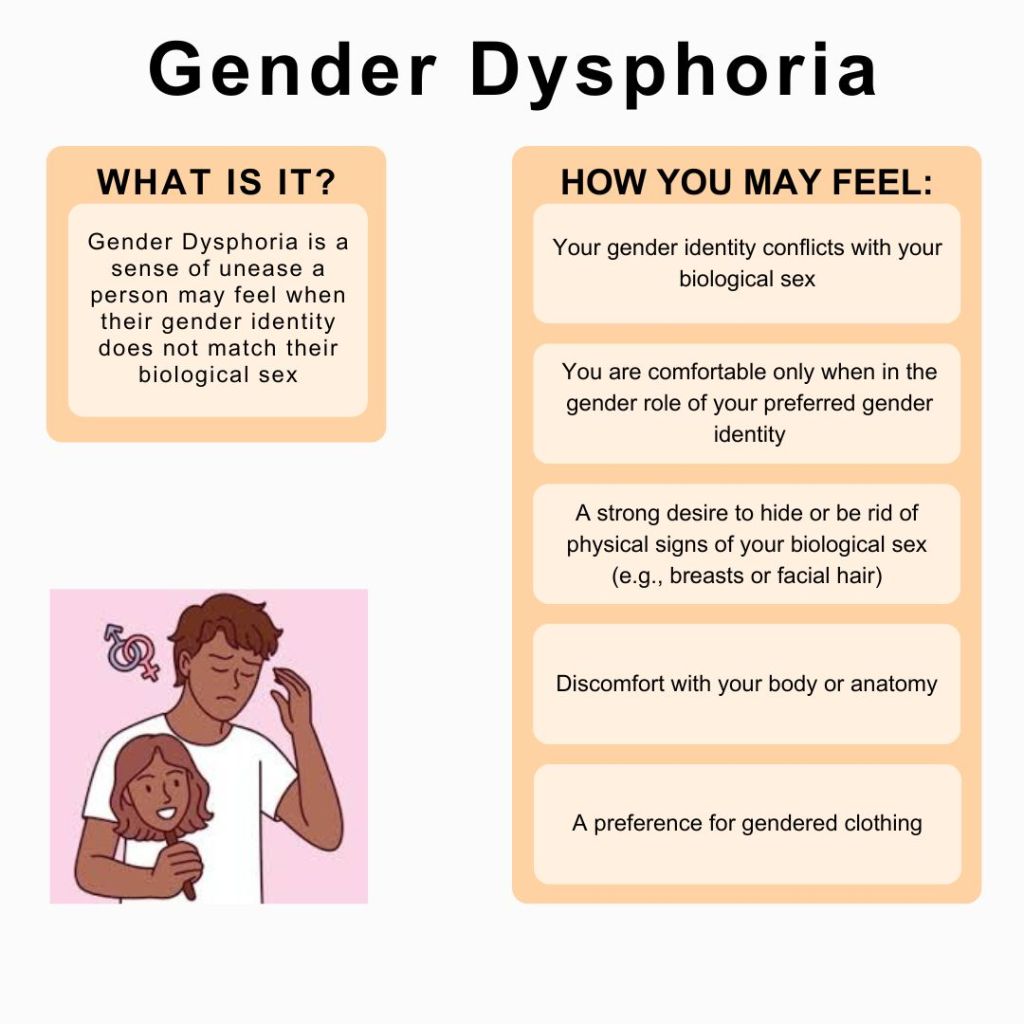
Gender dysphoria is a sense of unease that a person may have because of a mismatch between their sex assigned at birth and gender identity. In adolescence, especially around puberty when young teenagers’ bodies are changing, and they begin exploring their sexual and romantic identities, gender dysphoria typically increases around this time. Included below are some helpful definitions to include in discussions around gender dysphoria, a visual aid tool to discuss how someone may feel if they experience gender dysphoria, and helpful resources from transgender people talking about their gender identity.

Definitions to incorporate while discussing gender dysphoria:

  • Biological sex – label assigned at birth based on physical characteristics (e.g., chromosomes, hormones, and reproductive organs)
  • Primary sex characteristics – changes in the reproductive organs (males: growth of testes, penis, scrotum, and spermarche; females: growth of the uterus and menarche)
  • Secondary sex characteristics – visible physical changes that occur during puberty (males: broader shoulders, a lower voice; females: breast development, hips broaden)
  • Gender Expression – learned roles, behaviors, and actions of women/girls and men/boys (i.e., how society expects certain genders to act and look like)
  • Gender identity – our sense of who we are and how we see and describe ourselves
  • Transgender – people whose gender identity does not match their sex assigned at birth

*For clarification: based on your biological sex (what physical characteristics you are born with), society assigns you a gender (how you should act, what you should be interested, and your role in the world)*

Title: Gender Dysphoria. A single text box titled "What is it?" with the definition below: gender dysphoria is a sense of unease a person may feel when their gender identity does not match their biological sex. A single-column table titled "How you may feel:" In descending order: your gender identity conflicts with your biological sex, you are comfortable only when in the gender role of your preferred gender identity, a strong desire to hide or be rid of physical signs of your biological sex (e.g., breasts or facial hair), discomfort with your body or anatomy, and/or a preference for gendered clothing.

Helpful Resources:

Teen Vogue has an article discussing what it’s like to be transgender and living with gender dysphoria.

The Guardian also has an article where people who identify as transgender discuss their experience with exploring their gender identity. Although gender dysphoria is not the main focus, it is thoroughly discussed in the experiences of the transgender people featured.

This article from BuzzFeed includes people with disabilities exploring their gender identity and how it intersects with their disability. Gender dysphoria is mentioned, but the article mainly focuses on how society has created barriers for transgender people with disabilities. It would still be beneficial to use, as it brings attention to an often overlooked area of the disability and transgender community.

Accessible Mental Health Services

Accessible mental health services can be a challenge for people with disabilities, as there can be a lack of specialized provider training and difficulties with financial costs. We are defining accessibility in terms of disability and financial costs. This post provides a few mental health services for people with disabilities, with some services offering in-person services and others offering both in-person and online services.

Envision Unlimited

Mission Statement: “Envision Unlimited is a certified Community Mental Health Provider offering a full complement of behavioral health services to people with a variety of mental health concerns. We are committed to assisting clients in their best and meaningful lives.”

  • Offers outpatient therapy services to adults and adolescents, both in person and via telehealth
  • Based in Chicago, Illinois

Envision Unlimited emphasizes that no one will be denied access to services due to an inability to pay, and a discount is available.

There is also a program called ENVISION MORE for people with disabilities.

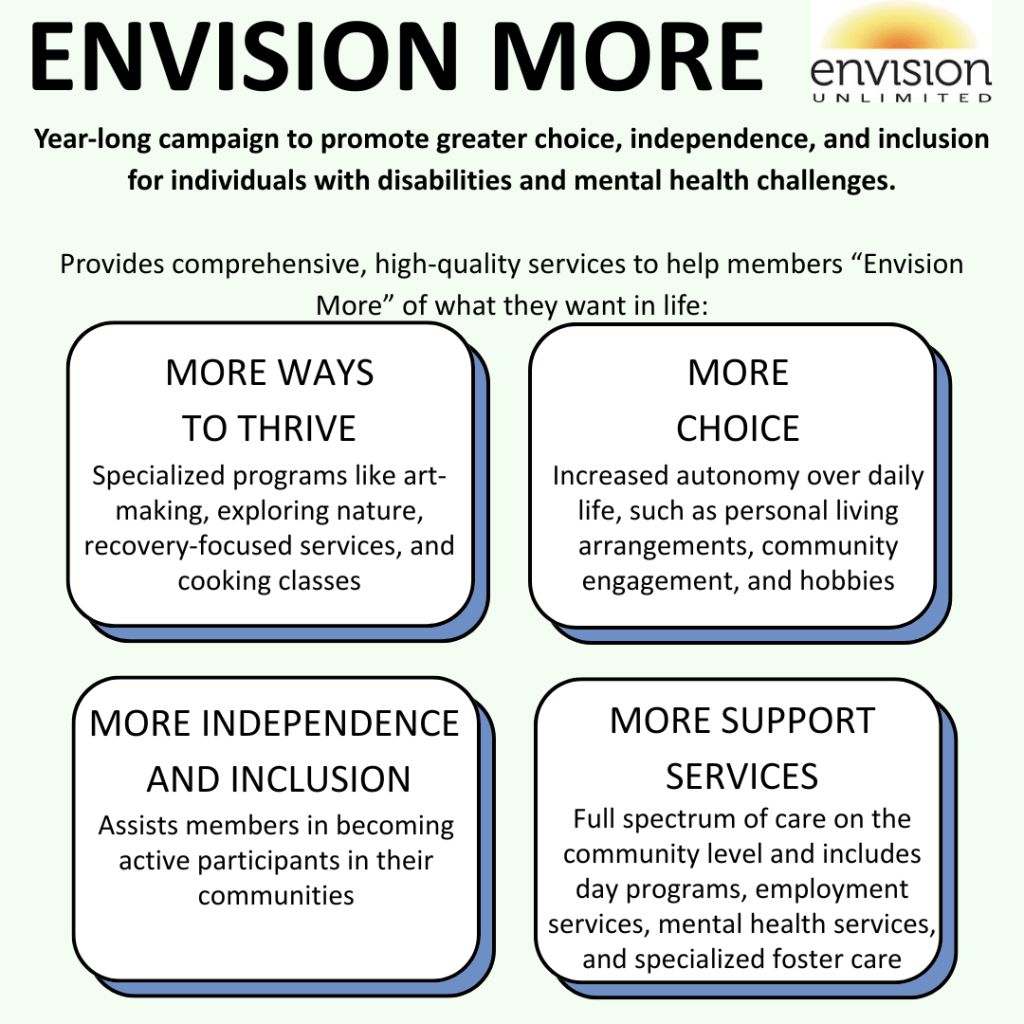
Title: ENVISION MORE. Year-long campaign to promote greater choice, independence, and inclusion for individuals with disabilities and mental health challenges. Provides comprehensive, high-quality services to help members "Envision More" of what they want in life. Box 1: More Ways to Thrive; Specialized programs like art-making, exploring nature, recovery-focused services, and cooking classes. Box 2: More Choice; Increased autonomy over daily life, such as personal living arrangements, community engagement, and hobbies. Box 3: More Independence and Inclusion; Assists members in becoming active participants in their communities. Box 4: More Support Services; Full spectrum of care on the community level, and includes day programs, employment services, mental health services, and specialized foster care. The logo for Envision Unlimited is in the upper right-hand corner.

NYSTART (New York Systemic, Therapeutic, Assessment Resources and Treatment)/CSIDD (Crisis Services for Individuals with Intellectual and/or Developmental Disabilities)

Goal: “…to build relationships and support across service systems to help people remain in their homes and communities and enhance the ability of the community to support them.”

  • Offers crisis prevention and response services to people who have both developmental disabilities and complex behavioral needs, as well as to their families and those who provide supports
  • Services are available 24 hours a day, 7 days a week to OPWDD (The New York State Office for People with Developmental Disabilities) eligible individuals age 6 and over who meet NYSTART/CSIDD eligibility
  • Based in New York, must be a New York resident 

The Arc

The Arc company logo.

Mission Statement: “Promoting and protecting the human rights of people with intellectual and developmental disabilities and actively supporting their full inclusion and participation in the community throughout their lifetimes.”

Delaware Disability Resources and Advocacy Organizations

  • All of the following services are based in Delaware

NAMI (National Alliance on Mental Illness)

Mission Statement: “NAMI Delaware supports, educates, and advocates for an improved quality of life for individuals and families affected by mental health conditions.”

  • Offers a variety of signature programs, an annual education conference, and special events (for individuals, families, and professionals to receive support and information)
  • Shapes public policy, has a toll-free NAMI Delaware Helpline, and works with media, educators, healthcare professionals, and elected and appointed officials (to raise awareness, fight stigma, and encourage understanding)
  • This link is for Delaware’s NAMI program, however, there are more than 650 NAMI State Organizations and Affiliates across the country

Division of Substance Abuse and Mental Health

Mission Statement: “To improve the quality of life for Delaware’s citizens by promoting health and well-being, fostering self-sufficiency, and protecting vulnerable populations.”

  • Offers help for mental health issues (in which all services are free, and any referrals are available regardless of insurance), support groups and one-on-one counseling, suicide prevention resources, and other additional resources. 

Mental Health Association in Delaware

Mission Statement: “The Mental Health Association in Delaware strives to strengthen knowledge, resources and support around mental health and recovery.”

  • Offers education, support, and advocacy
  • Support: Offers wellness groups (one is a disability & chronic illness haven wellness group), mental health screening, and a peer support program with the mental health court (mental health court is available for people who have been charged with crimes because of a behavioral health disorder)

Discover Intimacy Coaching: Reclaiming Connection and Pleasure

Intimacy coaching is a specialized type of relationship coaching that focuses on helping emotional and physical intimacy. Intimacy and connection are essential parts of being human. Everyone deserves the chance to experience it fully. Intimacy coaching offers a supportive, judgement-free space to help individuals or couples explore and deepen their capacity for emotions, physical, and even spiritual intimacy. An intimacy coach helps you reconnect with your desires and communicate your needs. If you’re looking to bring back the spark, try something new, or simply understand your needs/desires better, intimacy coaching is the perfect way to go. 

To learn more about what intimacy coaching does, watch this video.

Here are some intimacy coaches that have great reviews and cater towards people with disabilities. 

Joslyn Nerdahl: Certified Sex Coach and Clinical Sexologist, Physical Disabilities

Joslyn Nerdahl is an intimacy coach who specialize in working with people with physical disabilities. She believes that communication and consent are the foundation of healthy intimacy. She has a passion for helping people learn how to talk about sex openly and provides a safe space for her clients to explore their needs and desires. Her services include intimacy coaching, sex education, and sexual rehabilitation. Learn more about her: Services – Joslyn Nerdahl

Grace Myhill: Intimacy Coach, Neurodiverse Couples Coaching

Grace Myhill is a couples coach and educator who specializes in working with couples where on or both partners are a person with autism. She focuses on each partner experience and validating each other their perspectives. She wants to help both partners work together to build emotional and relation skills. If you want to know more about her work visits her website: https://www.gracemyhill.com/

Dr. Mitchell Tepper: Sex Coach and Educator for People with Physical Disabilities

Dr. Mitchell Tepper is an educator who specializes in working with individuals with disabilities and chronic conditions to help reclaim pleasure and intimacy. His approach focuses on empowerment, inclusion, and accessibility. He emphasizes that everyone, regardless of physical ability deserves access to intimacy, pleasure, and love. To explore his work and resources visit his website: Coaching – Dr. Mitchell Tepper

Amy Gravino: Autism and Sexuality Advocate, Speaker, and Relationship Coach

While Amy Gravino is not an intimacy coach, she still advocates for autism sexuality. She is an educator who empowers autistic adults to embrace healthy relationships, self-advocacy, and sexual expression. If you want to learn more about her advocacy or watch one of her videos visit: A.S.C.O.T Consulting

I think intimacy coaching is a great way to explore yourself, your relationship, and spice things up.

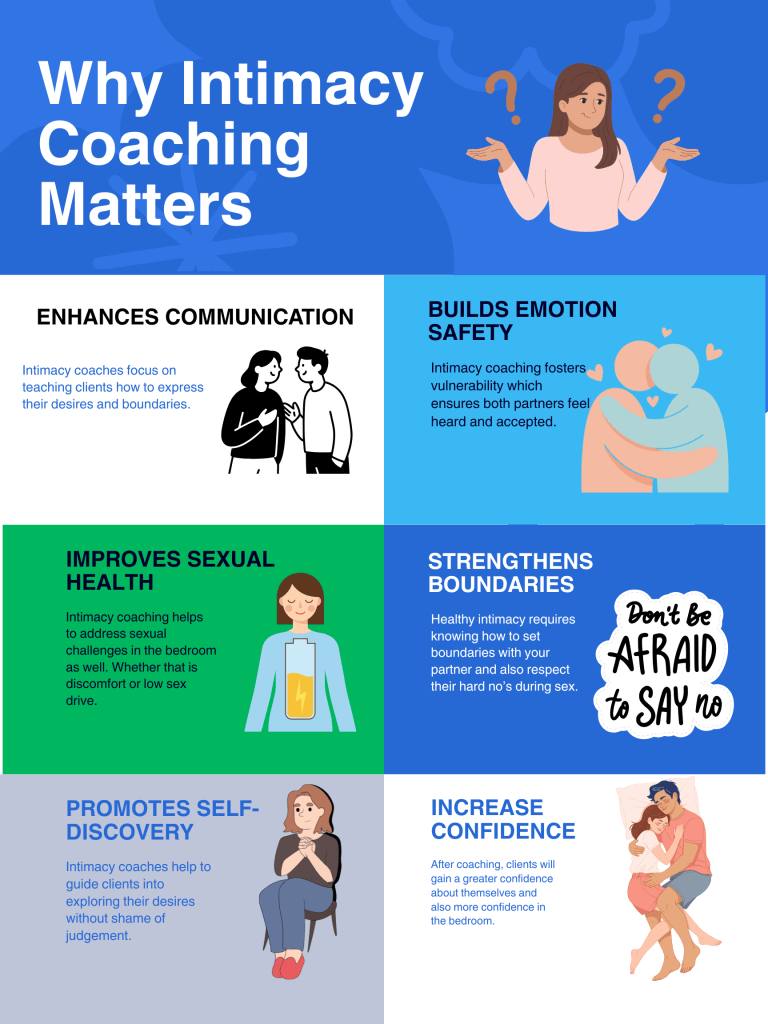
Why intimacy coaching matters. Enhances communication. Intimacy coaches focus on teaching clients how to express their desires and boundaries. Builds emotion safety. Intimacy coaching fosters vulnerability which ensures both partners feel heard and accepted. Improves sexual health. Intimacy coaching helps to address sexual challenges in the bedroom as well. Whether that is discomfort or low sex drive. Strengthen boundaries. Healthy intimacy requires knowing how to set boundaries with your partner and also respect their hard no’s during sex. Promote self discovery. Intimacy coaches help to guide clients into exploring their desires without shame of judgement. Increase confidence. After coaching, clients will gain greater confidence about themselves and also more confidence in the bedroom.

How to Guide on Flirting Online

Social media can be difficult to navigate as there are unknown “rules” and behaviors that are widely followed when first interacting with others, especially those you are interested in romantically. This aid demonstrates several unspoken guidelines, intimidating behaviors, and tips on staying within the guidelines on social media when trying to flirt. It is worth mentioning that this is not a comprehensive list of all guidelines and intimidating behaviors, but rather a guide to help you talk to your crush online in a fun, respectful way that keeps everyone comfortable. As a 21-year-old who has been online from a young age, some of these guidelines are based on my own experiences and knowledge.

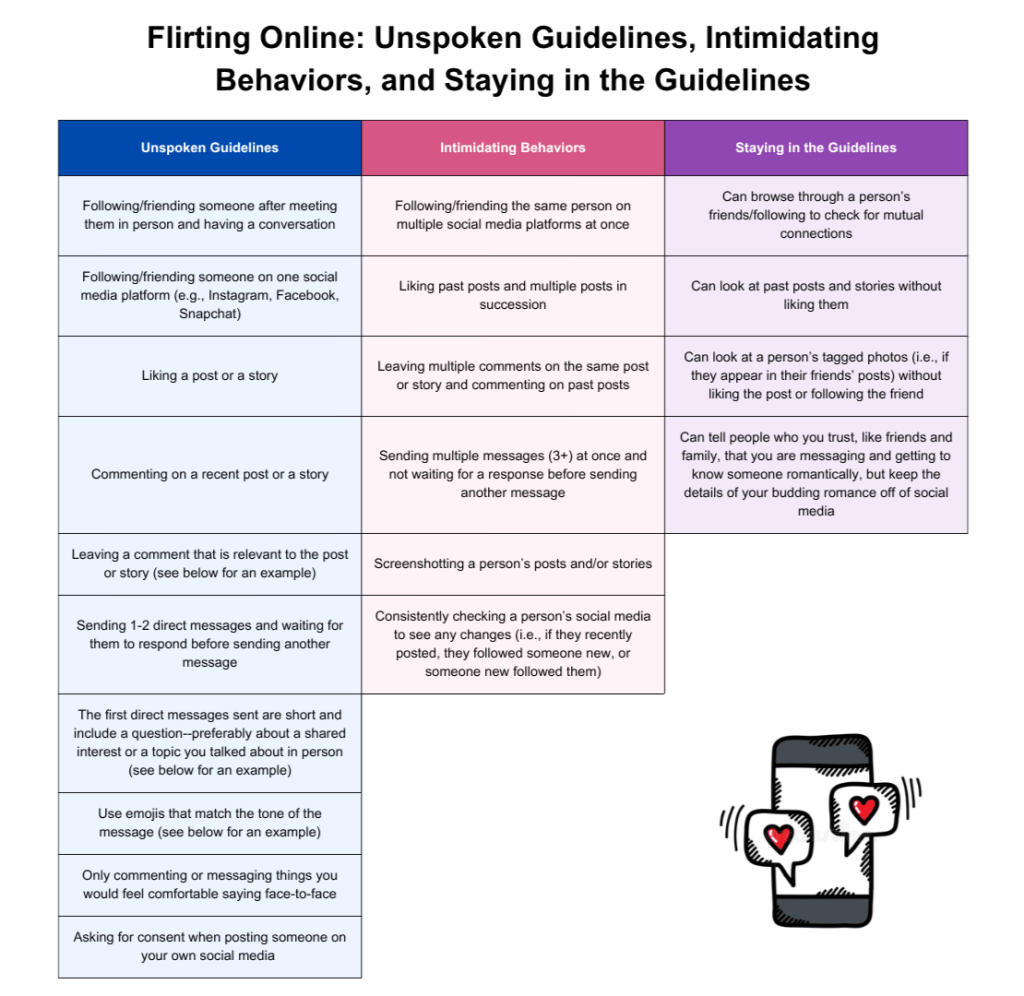
Table of unspoken guidelines, intimidating behaviors, and tips on staying in the guidelines. From top going down, unspoken guidelines: following/friending someone after them meeting in person, following/friending someone on one social media platform, liking a post/story, commenting on recent post/story, leaving relevant comments on posts/stories, sending 1-2 direct messages and waiting for a response before sending another message, the first direct messages are short and include a question, use emojis that match message tone, only commenting/messaging things you can say face-to-face, and ask for consent when posting someone. From top going down, intimidating behaviors: following/friending someone on multiple social media platforms at once, liking past posts and multiple posts in succession, leaving multiple comments and commenting on past posts, sending multiple messages at once and not waiting for a response before sending another message, screenshotting posts and stories, and consistently checking a person's social media for any changes. From top going down, staying in the guidelines: can browse through a person's friends/following, can look at past posts and stories without liking them, can look at a person's tagged photos without liking the post or following the friend, and can tell people who you trust, like friends and family, that you are getting to know someone, but keeping the details of your budding romance off of social media.

Example of a relevant comment: Someone posts a photo of them graduating school and you comment, “Congratulations!”

Example of a direct message: You talked to someone last week about a book series and sent this message: “Hi! It’s [your name], we talked last week about [book series]. I started reading it and really liked it. Do you have any other recommendations?”

Examples of using emojis: (1) You are messaging your crush about a movie that you both recently watched and talking about a scene that left you in disbelief: “I can’t believe that happened 😭 I was not expecting it at all!” (2) You made plans to hang out with your crush in person and sent this message: “I’m excited to hang out on Saturday 😊 See you then!”

Teen Vogue has a list of questions to keep the conversation going with your crush, whether you’re looking for something low-pressure, flirty, deep, random, interesting, or just plain fun.

The Napoleon Cat Blog gives some tips for commenting on someone’s post, showing different examples for different post scenarios. Some of them are intended for friends, but can still be used for your crush’s posts. Their 35 Short Comments for Instagram section is best used when you first start commenting, as they are simple, not intimidating, and friendly.

How to Handle Rejection: Tips, Resources, and Lesson Plans

Listed below are a slideshow, worksheet, and plain-language guide designed to help people understand and cope with rejection. These resources explain what rejection can look like and explore how people react when they feel rejected. You’ll also find ways to cope and work through those feelings in healthy ways.

Resources:

Part 1: Slideshow Rejection 101

Part 2: Rejection worksheet

Part 3: Plain Text Rejection Guide (No formatting)

Supporting Resource: 10 tips for dealing with romantic rejection

Rejection is a normal part of life, and it’s something everyone goes through. You don’t have to run away from it, you can face it and grow stronger from it.

Friendship & Dating Program: Helping Children and Adults to Acquire Relationship Skills

The Friendships & Dating Program (FDP) offers inclusive teaching plans for individuals with intellectual and developmental disabilities. A unique aspect of this program is its emphasis on preventing interpersonal violence. There is a version of this program for youth with serious emotional disturbance. The FDP focuses on skill development through experimental learning and group activities with an interactive 10-week curricular plan. Interested groups can purchase the curriculum on its own ($600) or purchase the curriculum in combination with a train the trainer support provided live online ($1,800). You can find more information about the FDP from the below link. Some module illustrations are available on the website.

https://www.fdprogram.org/

More Info. Less Weird. AMAZE Takes the Awkward Out of Sex Ed

These days, it is hard to find an age appropriate content about sex, dating and abuse. Children have questions about their bodies, gender and reproduction. Teenagers worry if their bodies are developing normally or not while older adolescents struggle with peer pressure, changing relationships and emerging sexual feelings. AMAZE is an amazing website for parents and educators which helps them to expose their child to age appropriate content about sex through short videos. The website provides an insight to young people to successfully understand puberty, healthy body image, distinguish between healthy and unhealthy relationships, concepts of consent and mutual respect. Video topics are designed to meet the learning objectives outlined in the National Sexuality Education Standards.

Parents are the primary sexual educators of their children. By answering children’s questions, a parent let them know that you are “askable” and establishes an open line of communication that will serve you and your children well as they mature into sexually healthy young adults.

AMAZE also has resources for younger children like the parents’ playlist from amaze jr. It is designed to help parents become comfortable and confident talking to their children openly and honestly at any age.

https://amaze.org/

There are some videos for parents reference.

This video will help parents to know when to talk about sexuality with their kids.

Do you think so playing “doctor – doctor” is safe or not? Check this video out which helps you to communicate your thinking and others about this game.

This video will model to the adolescents with disabilities to learn about manage their relationships with person they like or have attractions. This video guide them to deal with peer pressure and make healthy relationship.

This video helps your child to understand their body parts, difference between a male and female, and similarities between boy and girl.

https://youtu.be/wW627gpkWbw

Sexuality Resources for Parents

Raising an individual with a disability presents a different set of obstacles then an abled individual may, but one topic that all parents must address is sexuality. Individuals with disabilities are sexual beings and therefore deserve an education on sexuality. While parents may acknowledge this need, finding resources and strategies to present the information may be more difficult if you are raising an individual who requires a different method of learning.

The Sexuality Resource Center for Parents provides a well rounded variety of information pertaining to sexuality. The website includes a section of information labeled “for all parents” that contains subjects they believe are useful for all children. In addition, they provide sections titles “For parents of children of typical development”, “For parents of children with developmental disabilities”, and “For parents of children with physical disabilities”. In each section, you can find a variety of information such as basics, specifics, activities, and additional resources. They also include tip guides!

The Sexuality Resource Center for Parents works to provide a better, comprehensive information base for parents to use when addressing sexuality to their child. The variety of knowledge is extremely useful when trying to find information to meet your child’s specific needs. In their own words, their mission statement claims “It’s time to acknowledge that children with developmental disabilities will become adults with sexual feelings, and as such, we must provide them with the information and skills they’ll need to become sexually healthy adults.

http://www.srcp.org/index.html

Sexual Safety Resource: Chicago Children’s Advocacy Center

Chicago Children’s Advocacy Center is a program for sexual abuse prevention and response to crisis. They have supports specifically for children with disabilities. They recommend creating a family safety plan, teaching children about sex and sexuality, learning about sexual development, taking to caregivers/program staff about issues of sexuality, and watching others’ behaviors.I like this resource because the focus in on prevention through increasing the viability of sexuality.

ccac-header-logo

The culture that makes it inappropriate to talk about healthy sex and sexuality creates a hidden space where dangerous sexual behavior can take place.  Whenever we’re talking about prevention, I think that it is important to highlight that children and often adults with developmental disabilities cannot prevent their own abuse. Adults and older children with more power and more control manipulate to create situations where they can abuse. Prevention looks like trying to eliminate those spaces and creating opportunities for reporting.  This agency seems to focus on that method and minimize language that blames the victim.

Here is a webinar which aired live on December 9th, 2015 on Safety & Autism: Helping caregivers and providers talk about sexual abuse and prevention.

High School Human Sexuality 101 Week 1: Welcome

This summer, at TAP in Urbana-Champaign, we are doing an eight week human sexuality group for middle school students.  We have three boys and three girls in our group who range in age throughout the middle school years (from starting 6th grade to finishing 8th grade).   Check out the slides that accompany the lesson.

Our first week was a blast.  You can check out the full curriculum here [Sex Ed week 1].  We used a worksheet to help the students come up with their own definition of human sexuality.  I love the definition we came up with as a group, “Sometimes human sexuality topics make us feel uncomfortable, but it’s a part of life, specifically, part of our private life.  Human sexuality is about how we feel about people like loving someone and liking someone, but sometimes two people’s feelings may not match with each other. Human sexuality has to do with emotions, the body, and relationships.”

We sent a letter home with parents that explained the activities with fairly significant detail, touched on next weeks activities, and provided additional resources.  One of the important parts of this letter was suggestions for ways to incorporate these topics at home.  This week, as it was mostly about introductions, the parent component focused on using the rights and responsibilities at home.

Human Sexuality 101 Week 2- Anatomy

Today’s Agenda

Parts and Post-it Notes:  We started the group out by having them label body parts they already knew.  By starting out with safe, comfortable body parts students were more prepared for unknown body parts or parts that may have caused feelings of anxiety.

Terminology: We introduced sexual terminology in written from and asked the students to say the words out loud.  Between each word we’d pause and they had a worksheet with the question “I feel…” Reading a word and saying it are easier then looking at a body part so we were building their comfort level.  Also, feelings of embarrassment can be difficult for students to manage.  This is structuring a way for them to think about and express their feelings.

We had a lot of fun learning about anatomy although the topic was also met with groans, giggles, and our group’s favorite lamentation, “I want to throw up.”  More over there was general confusion about what the parts of the body involved with reproduction even are.  Essentially, they knew butt, penis, vagina, testicles and breasts but that was it.

Fruity Anatomical Model:  The students will made anatomical models of the reproductive organs using fruit.  As they made the model, we talked about the function of each part.  Again the fruit makes the concept a little more abstract and safe.  This is a fun way to engage students in what is essentially a vocabulary task.

We saw some clear developmental differences today. The older kids in the group were able to stick with the more abstract activities and accomplish the tasks, but the younger kids in the group were a little overwhelmed. In the future, I may modify the task for younger students to focus on fewer parts of the body and instead of making the anatomical models,  we could play a game with body flash cards.

Privacy: We introduced the concept that privacy is about personal things you want to keep to yourself and explained that the parts of the body we were just talking about were private body parts.  We will also introduced that certain places are private, that you share with different people private information or ideas, that ideas can be private.  The main distinction is that there is a difference between private and public, but we presented three levels to indicate that there is a continuum of privacy.

We were a little rushed when we got to the privacy section.  It was hard for them to transition from private body parts to other concepts of privacy.  Although they seemed capable of these ideas, they were a little to revved up from the anatomical models and we needed more time.

For more information on anatomy view our  EXPLAINING ANATOMYYOUTUBE EDUCATIONAL RESOURCES: HEALTHCHANNEL, SEXPLANATIONS, AND CSPHADULT HUMAN SEXUALITY WEEK 2- ANTATOMY & REPRODUCTION posts

Materials for Today’s Lesson

Human Sexuality 101 Week 3- Puberty

I have to say, the puberty session went great!  It was just at the right level.  Here are the activities we did…

Defining Puberty: This was the language we used to define puberty: puberty is your body changing from a child’s body to an adult’s body.  It causes changes to your body inside and outside. Everyone goes through puberty but it might happen at different times and people’s bodies change to look different.  Puberty is a time when you start to get sexual feelings.  You don’t have control over going through puberty, but you do have control over how you react to it.  It’s normal to have mixed feelings, some good feelings and some negative feelings.  This definition highlights several key features of puberty (it’s in some ways different and some ways the same for everyone, it’s a natural biological process, it can be an adjustment). 

They Tell Me I’m Going Through Puberty: This is a story told from the point of view of a teenager about the changes that are happening during puberty.  This exercise helps students to understand that many of the changes that are happening in puberty happen to both boys and girls.  The narrative format may help students relate to the changes that are occurring.         

Boys/Girls/Both: In this activity, participants were given a series of cards each with a change that happens during puberty.  They decide if these changes happen to boys, girls, or both.  Again, this exercise helps students to understand that many of the changes that are happening in puberty happen to both boys and girls.  Many of these changes are repeated from the first exercise although more are introduced.  Each card separates out each change as concrete steps.

Puberty Worksheet: This worksheet is a check in on the changes participants have experienced, how they feel about these changes, and changes they anticipate.  The worksheet was designed to help students anticipate some of the changes that will happen during puberty and help them to be aware of the changes that are happening in their own body. We use both open ended and multiple choice questions to stimulate different levels of thinking.

Diversity:We showed power point slides with pictures of several people showing a diversity of bodies and ages.  Students were asked, “Which ones are going through puberty?”.  This activity reinforces the concept that puberty is in some ways different and some ways the same for everyone.  One thing that became evident was that the students had difficulty understanding that children hadn’t gone through puberty but the were quick to grasp onto the idea that adults are finished going through puberty.  We used a few favorite characters to help the kids get a little excited about the topic.

Click on the Links Below to AccessMaterials

Human Sexuality 101- Reproduction

My favorite comment from this session was, “Can we stop working on the worksheet for a minute? I just really want to listen!”  We based the lesson the Nova’sLife’s Greatest Miracle” (you can stream for free or buy the DVD for $20).  We covered the material in one session but didn’t have time for the breakout groups and we went over our allotted time.  We could have easily split it up into two sessions.  The video is very well done and contains a lot of good information.  We had the students fill out a worksheet to help them key into important points and break down euphemisms.  It’s amazing how much they are learning but also what is slipping by.  For example, as we’re watching the sperm and the egg meet I asked, “Is this happening inside the man’s body or inside the woman’s body?” and they didn’t really have any idea.

For the parent component of the session, we manly focused on two questions. 1) What do you think about preemptive birth control? and 2) What are your hopes and fears about your child becoming a parent in the future.  Unfortunately, these are some of those questions without any easy answers.

Download the materials…